Identification
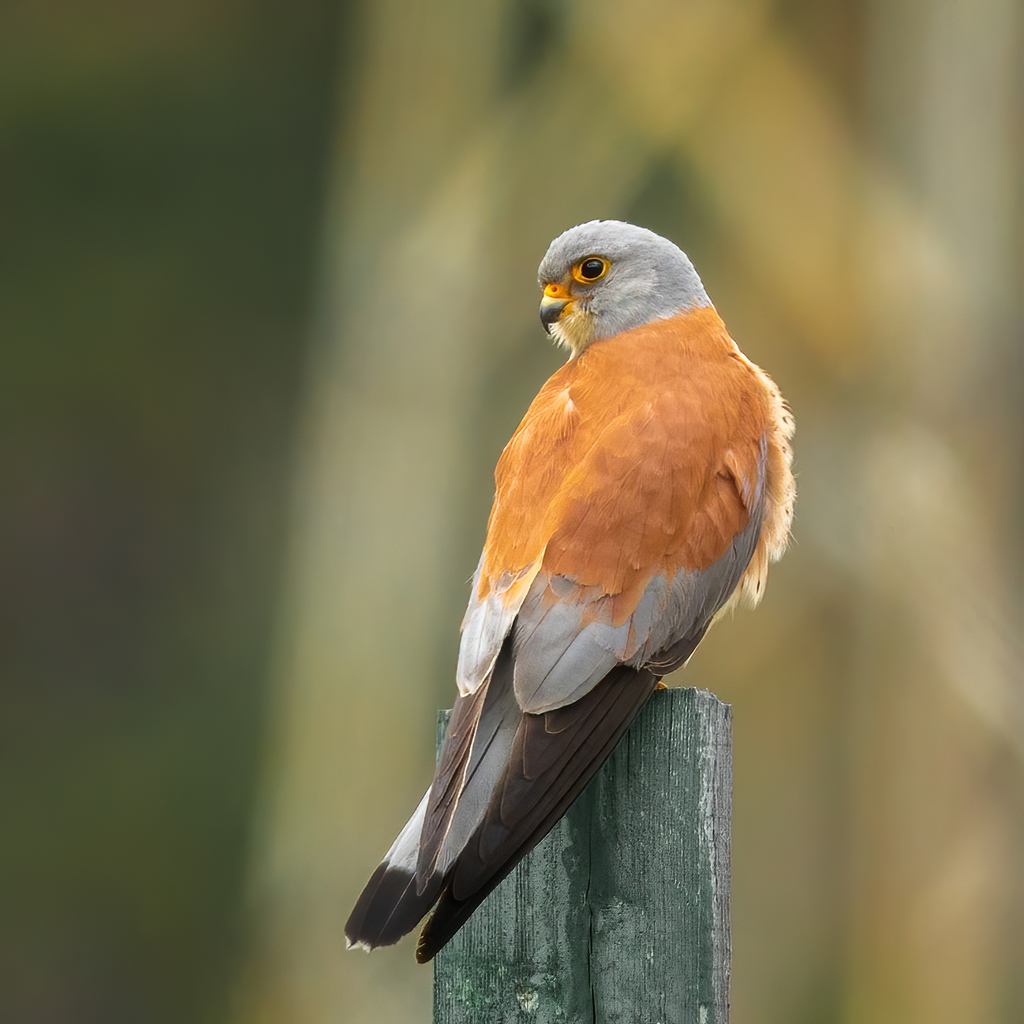
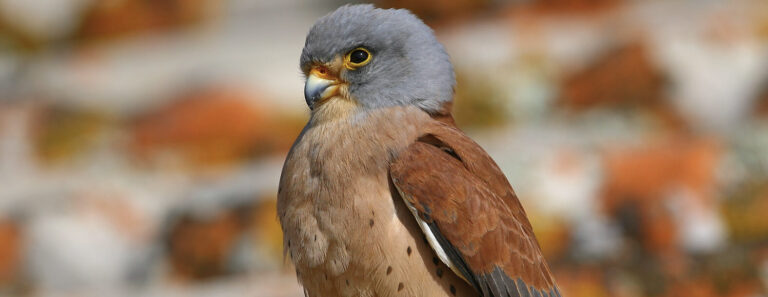
The lesser kestrel is a small falcon, measuring 27–33 cm in length with a wingspan of 63–72 cm. It bears a striking resemblance to the larger common kestrel, though it has proportionally shorter wings and tail. Both sexes share a brown back and barred grey underparts with the common kestrel, but males are distinguished by a grey head and tail without the dark spotting on the back or the characteristic black malar stripe. Males also display grey patches in the wings. Females and young birds are slightly paler than their common kestrel counterparts and require careful observation to distinguish.
Several features help confirm identification at closer range. The lesser kestrel's call is a diagnostic harsh chay-chay-chay, distinctly different from the common kestrel's kee-kee-kee. Uniquely among falcons, both sexes possess whitish-horn coloured talons rather than the typical dark ones—though this is only conspicuous at very close range. The lack of a malar stripe in both sexes and the grey wing colouration are key distinguishing features from its larger relative.
Range & Habitat
The lesser kestrel breeds from the Mediterranean across Afghanistan and Central Asia, extending to China and Mongolia. It is a summer migrant, with populations wintering in Africa, Pakistan, and occasionally in India and Iraq. The species is rare north of its breeding range and has shown declining numbers in its European distribution.
Recent genetic research has revealed two distinct populations divided by the Caucasus Mountains, each with separate wintering grounds. The southwestern population winters in the Sahel region of tropical northern Africa from Senegal east to Sudan, while the northeastern population winters from Ethiopia south to South Africa. On their African wintering grounds, lesser kestrels favour a "latitude belt" through Senegal where locusts and grasshoppers are abundant, often roosting communally in large groups.
Behaviour & Diet
The lesser kestrel is an insectivore that also hunts small birds, reptiles, and rodents, particularly mice, which are often captured on the ground. Being smaller and more delicate than the common kestrel, it nests colonially on buildings, cliffs, or in tree holes, laying 3–6 eggs without constructing a nest structure—typical of falcons. These birds are highly social, particularly on wintering grounds where they roost communally; surveys in Senegal have documented massive communal roosts holding tens of thousands of birds alongside other species.
The species is widespread and plentiful globally, classified by the IUCN as Least Concern. However, it faces threats from habitat destruction and the indiscriminate use of pesticides, the latter having particularly strong effects due to its insectivorous diet.
Best Time & Places to See It
To observe lesser kestrels in their breeding range, visit the Mediterranean region and across to Central Asia during summer months. For those seeking larger concentrations, the species is abundant on its African wintering grounds, particularly in Senegal and the wider Sahel region from December to January, where massive communal roosts offer spectacular viewing opportunities. The northeastern population can be encountered from Ethiopia south to South Africa during winter months.
Photography Tips
Photograph lesser kestrels in good light to capture the subtle plumage differences from the common kestrel—focus on the lack of malar stripe and grey wing patches in males. The bird's small size and swift movements demand fast shutter speeds. Capture close-ups of the distinctive whitish-horn talons if possible, though this requires very close approach. Communal roosts on the wintering grounds offer opportunities for dramatic flock photography. Record vocalizations to document the diagnostic harsh chay-chay-chay call, useful for confirming identification in the field.