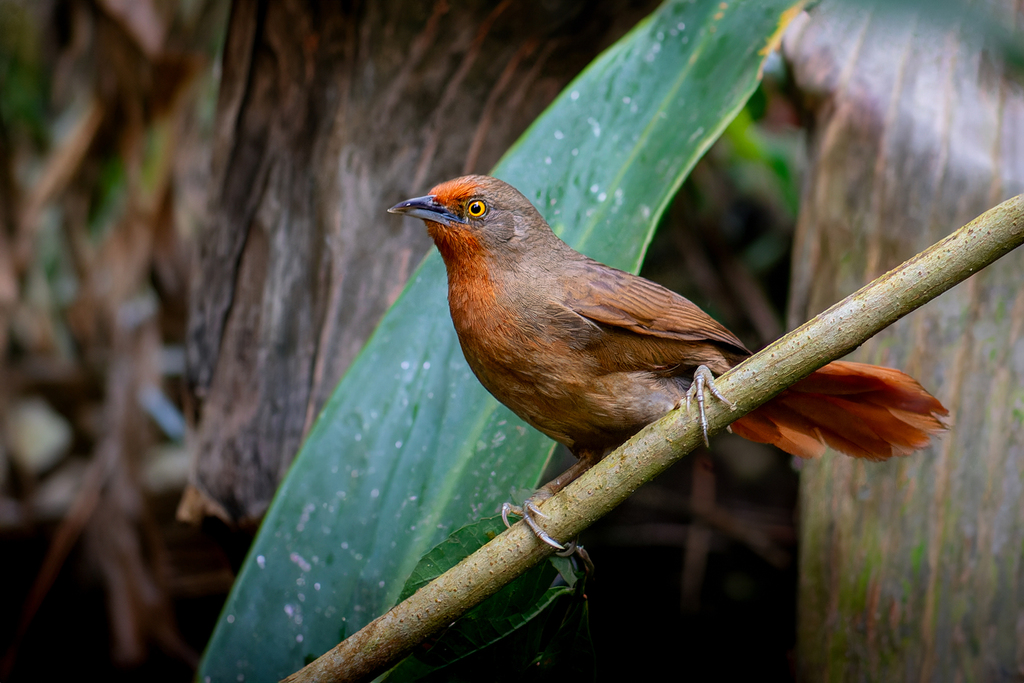
Orange-eyed Thornbird
Photo © Enéas V. Gouvêa Junior
Photo © Enéas V. Gouvêa Junior — CC BY-SA 4.0 — Source: iNaturalist photo #429487429The orange-eyed thornbird (Phacellodomus erythrophthalmus) is a species of bird in the Furnariinae subfamily of the ovenbird family Furnariidae. It is endemic to Brazil. == Taxonomy and systematics == The orange-eyed thornbird is monotypic. However, what is now the orange-breasted thornbird (P. ferrugineigula) was previously treated as a subspecies of it under the common name red-eyed thornbird. In addition to differences in eye and plumage color, the two taxa have different voices and are locally sympatric in São Paulo state without evidence of interbreeding. For a while after the two were split, some taxonomic systems continued to use "red-eyed" for P. erythrophthalmus and others used it for P. ferrugineigula. The current "orange-eyed" and "orange-breasted" English names were adopted to avoid confusion with the former "red-eyed". To further complicate matters, for a time in the early twentieth century some authors placed the former two-subspecies red-eyed thornbird alone in genus Drioctistes. Later some authors, but not all, merged that genus into Phacellodomus. A 2011 publication placed the two current species firmly in Phacellodomus. == Description == The orange-eyed thornbird is 16 to 18 cm (6.3 to 7.1 in) long and weighs about 21 to 27 g (0.74 to 0.95 oz). It is…
Tijuca National Park
Brazil
+317 birds+13 mammals
Where the Atlantic forest rises steeply from Rio de Janeiro's urban edge, Tijuca National Park encompasses a landscape of dramatic granite peaks, cascading waterfalls, and closed-canopy…
VIEW NATIONAL PARKItatiaia National Park
Brazil
+519 birds+12 mammals
Where granite peaks pierce the Atlantic rainforest canopy in southeastern Brazil, Itatiaia National Park rises as one of the country's oldest and most ecologically vital protected…
VIEW NATIONAL PARKSerra da Bocaina National Park
Brazil
+441 birds+5 mammals
Where the escarpment of the Serra da Bocaina rises sharply from the Atlantic coastal plain, tropical rainforest cloaks steep mountainsides that climb toward peaks exceeding 2,000…
VIEW NATIONAL PARKSerra dos Órgãos National Park
Brazil
+446 birds+13 mammals
Granite peaks thrust skyward through the Atlantic Forest canopy in the mountains immediately north of Rio de Janeiro, their bare rock faces rising above a landscape…
VIEW NATIONAL PARKSerra do Gandarela National Park
Brazil
+333 birds+3 mammals
Where granite massifs rise through Atlantic Forest in southeastern Brazil's highlands, Serra do Gandarela National Park protects nearly 1,000 square kilometres of montane terrain that few…
VIEW NATIONAL PARKNo community photos yet. Log in to add the first one.
No community observations of this species yet.