Plumbeous Ibis
Photo © Hugo Hulsberg
Photo © Hugo Hulsberg — CC0 1.0 — Source: iNaturalist photo #435596918Identification
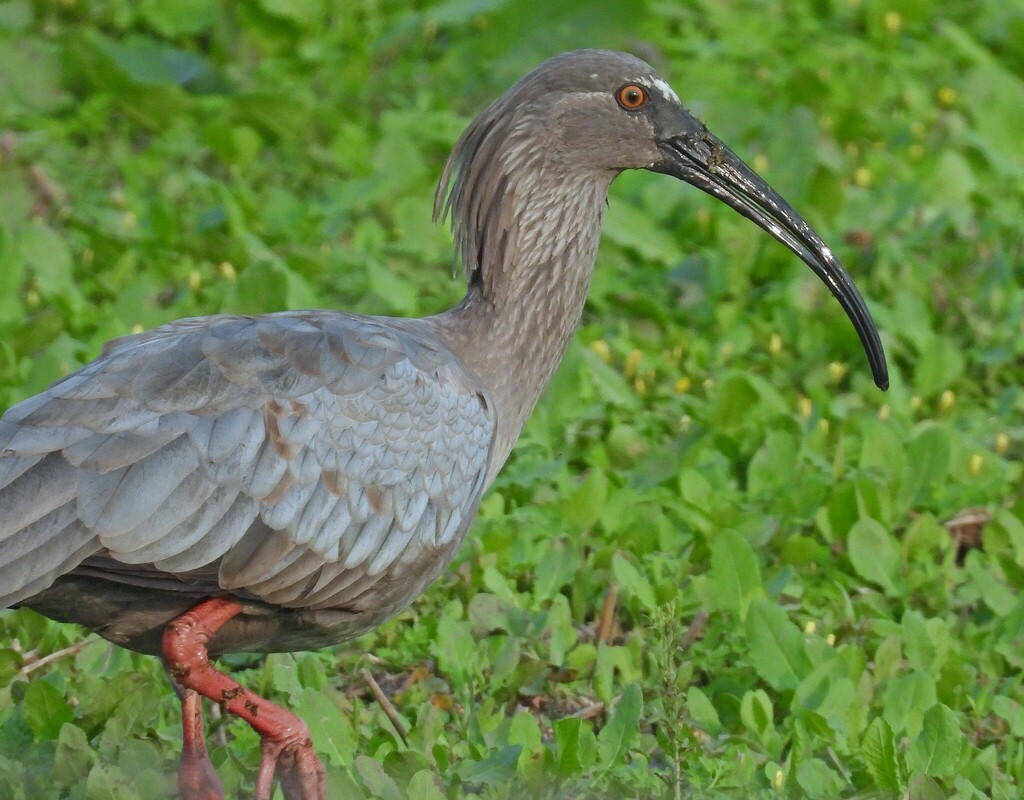
The plumbeous ibis is a large ibis measuring 71–77 cm in length, instantly recognizable by its distinctive shaggy crest of long grey plumes extending from the back of the head down the nape. A prominent narrow white feathered band encircles the forehead, earning it the German name Stirnbandibis (headband ibis). The adult plumage is predominantly grey, though it can appear bluish-grey, greenish-grey, or brownish-grey depending on the light, with dorsal feathers mottled greyish-brown. In the correct light, the plumage can appear silvery grey with dark blue primary feathers and a dark green tail. The bird has a thick neck, a black downward-curved serrated bill, and distinctive bare black or dark grey skin on the lores and throat. The legs are pinkish orange, darkening during breeding season, and the iris is deep orange.
In flight, the plumbeous ibis is sturdy and direct, stretching out its neck and wings with steady, powerful beats interspersed with gliding. Young birds are distinguishable from adults by their light grey downy plumage, dark iris, grey legs, less developed nuchal crest, and more extensive white forehead band. The plumbeous ibis is most morphologically similar to the sympatric buff-necked ibis, but differs notably in colouration and neck structure.
Range & Habitat
The plumbeous ibis is endemic to parts of central South America, with a relatively narrow range extending through south-western Brazil (especially southern Mato Grosso and Rio Grande do Sul), Paraguay (particularly the Chaco and Paraguayan Parana Basin), Uruguay, north-eastern Argentina, and northern and eastern Bolivia. The westernmost portion of its range extends into the Andean foothills of central Bolivia and Tucuman. The northern Bolivian population is geographically isolated from the larger continuous population occupying the remainder of the species's range.
Although the plumbeous ibis appears relatively common overall, it is patchily distributed throughout its global range, being relatively abundant in some regions while less common in others. For example, it is uncommon in Rio Grande do Sul but frequently occurs in the northern Lagoa dos Patos and is relatively common in the Chaco of Paraguay, where large numbers can be found throughout the region.
Behaviour & Diet
The plumbeous ibis is notably vocal, uttering a diverse range of loud calls that emphasize the importance of long-range communication between individuals, especially mates. The basic call is a high-pitched, rapid pi-pi-pi-pi with a metallic timbre, audible from considerable distances. During flight, the bird produces a slow but energetic trumpeting call transcribed as kree kreee kree or a series of k and kuh sounds, often gliding with motionless downward-curved wings. When perched on branches or at the nest site, it utters rapid nasal cackles transcribed as tututututu, sometimes interspersed with ti-ti sounds and often in duet between distant mates.
Between foraging mates, the species makes a cackling contact call. These distinctive vocalizations demonstrate the complex social communication within the species, particularly between paired birds.
Best Time & Places to See It
The plumbeous ibis can be found in the Chaco region of Paraguay, where large numbers occur throughout the landscape, making this an excellent location for sightings. The northern Lagoa dos Patos in Brazil and the Paraguayan section of the Parana Basin are also reliable areas. In Argentina, occasional sightings occur as far south as Cordoba and Buenos Aires provinces, though the species is non-native in these regions.
Due to the species's patchily distributed range, visiting known strongholds such as the Paraguayan Chaco offers the best chances of successful encounters with this distinctive ibis.
Photography Tips
Photograph the plumbeous ibis in varied lighting conditions to capture the full spectrum of its plumage coloration—from silvery grey to bluish and greenish tones. The bird's distinctive shaggy crest and white forehead band are key identifying features and should be prioritized in compositions. The contrasting dark flight feathers with their glossy greenish-bronze sheen photograph particularly well against lighter plumage.
In flight, capture the bird's characteristic posture with neck and wings stretched and its steady wing beats interspersed with gliding. The bare black skin on the lores and throat, combined with the deep orange iris and pinkish-orange legs, provide excellent detail opportunities for close-up shots. The bird's loud, distinctive vocalizations make audio recording a valuable complement to visual documentation, particularly duetting calls between distant mates.
Peixe National Park Lagoon
Brazil
+293 birds+4 mammals
Where the coastal plains of Rio Grande do Sul meet the Atlantic, Peixe National Park Lagoon sprawls across nearly 2,200 square kilometres of shallow waters, reed…
VIEW NATIONAL PARKChapada dos Guimarães National Park
Brazil
+450 birds+1 mammals
Where weathered sandstone plateaus rise above the cerrado grasslands of central Brazil, Chapada dos Guimarães National Park protects 624 square kilometres of ecological transition zone that…
VIEW NATIONAL PARKPantanal Matogrossense National Park
Brazil
+322 birds+17 mammals
Where the flooded forests of central Brazil meet vast seasonally inundated grasslands, Pantanal Matogrossense National Park sprawls across nearly 2,900 square kilometers of one of the…
VIEW NATIONAL PARKEl Palmar National Park
Distrito Sexto, Argentina
+244 birds+14 mammals
Across the Paraná River floodplain in northeastern Argentina, palms rise from wetland and grassland in a landscape shaped by water and time. El Palmar National Park…
VIEW NATIONAL PARKRío Pilcomayo National Park
Argentina
+271 birds+13 mammals
Where the Río Pilcomayo cuts through northeastern Argentina's subtropical lowlands, a sprawling mosaic of wetlands, grasslands, and seasonally flooded forests creates one of South America's most…
VIEW NATIONAL PARKEl Rey National Park
Municipio de Las Lajitas, Argentina
+317 birds+4 mammals
Where the eastern slopes of the Andes descend into northwestern Argentina's subtropical transition zone, El Rey National Park unfolds across 841 square kilometers of dramatically varied…
VIEW NATIONAL PARKCalilegua National Park
Municipio de Calilegua, Argentina
+288 birds+8 mammals
Where the eastern Andean slopes plunge into northwestern Argentina's humid subtropics, nearly 2,645 square kilometers of steep terrain and luxuriant forest compose one of South America's…
VIEW NATIONAL PARKParque Provincial Pampa del Indio
Laguna Limpia, Argentina
+231 birds+4 mammals
Across the flat horizons of Chaco Province, where the Paraná River system spills into vast wetlands and grasslands, Parque Provincial Pampa del Indio protects one of…
VIEW NATURE RESERVEChaco National Park
Municipio de Presidencia de la Plaza, Argentina
+258 birds+7 mammals
Across the humid subtropical lowlands of northeastern Argentina, where the Paraná River basin feeds vast seasonal wetlands and gallery forests, Chaco National Park protects one of…
VIEW NATIONAL PARKNo community photos yet. Log in to add the first one.
No community observations of this species yet.