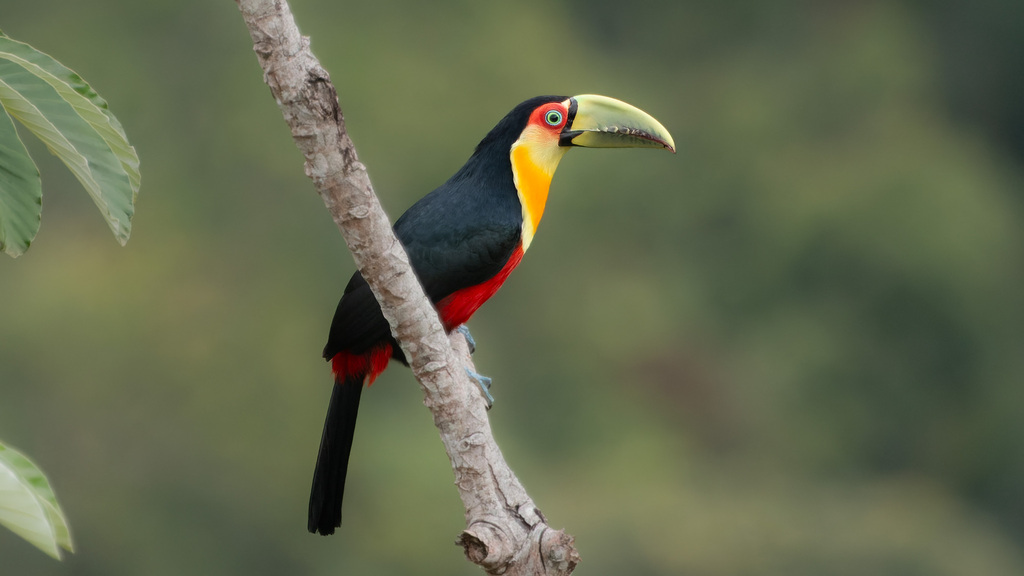
Red-breasted Toucan
Photo © Ricardo Mitidieri
Photo © Ricardo Mitidieri — CC0 1.0 — Source: iNaturalist photo #311264227Identification
The red-breasted toucan (Ramphastos dicolorus) is the smallest member of its genus, measuring 42–48 cm (17–19 in) and weighing 265–400 g (9.3–14 oz). The sexes look alike, though the female's bill is shorter. The bill is mostly green to green-yellow with a vertical black line at the base, red and ivory tomial "teeth," and green striations on the maxilla. The crown, nape, upperparts, and tail are black, except for red uppertail coverts. The face is yellow with bare red, blue, and yellow-green skin around the eye. The throat and breast are yellow with a red patch on the lower breast; the belly and undertail coverts are red, and the flanks are black.
This combination of a green bill and red breast separates it from other large toucans within its range. The contrasting yellow face and red underparts make it unmistakable in good light.
Range & habitat
The species occurs from Tocantins, Minas Gerais, and Espírito Santo in south-central, east-central, and southeastern Brazil, south through eastern Paraguay and Bolivia into northern Argentina's Formosa, Chaco, Corrientes, and Misiones provinces. It primarily inhabits subtropical and tropical sub-montane and montane forest, but also uses scrublands, savanna with trees, and plantations. It mostly ranges between 100 and 1,500 m (300–4,900 ft), and occurs as high as 2,070 m (6,800 ft) only rarely.
In the southern part of its range, it moves to lower elevations during the austral winter, and after breeding some individuals move from natural forest into plantations.
Behaviour & diet
The red-breasted toucan feeds mostly on fruits of both native and introduced plants, including green coffee beans and orchard fruit. To a lesser extent it also takes insects and small birds. It usually forages in pairs and small groups, though 20 or more may gather at times. It typically feeds in the forest canopy but will pick up fallen fruit from the ground.
Breeding occurs between October and February in the southern part of its range and from January to June in the north. Pairs are territorial; males allopreen and courtship-feed females. Nests are in cavities in living or dead trees, either natural or excavated by woodpeckers, and the birds may enlarge both the entrance and the cavity. The clutch is two to four eggs, incubated by both adults for about 16–19 days; fledging occurs 40–50 days after hatch. The song is a loud, raucous "WRèh" or "niuh," along with noisy honking "grrekk" notes and low "ek," "zneep," and growl-like begging. It also claps its bill and rattles its tongue.
Best time & places to see it
Look for this species in protected areas within its broad range, where it is thought to be reasonably common. In the southern part of its range, the breeding season (October–February) is a good time to observe pairs and nesting activity; in the north, breeding occurs January–June. During the austral winter, birds move to lower elevations, so adjust your search accordingly.
Focus on subtropical and tropical forest, including sub-montane and montane zones, as well as scrublands, savanna with trees, and plantations. After breeding, some birds move into plantations, so orchards and coffee plantations can also be productive.
Photography tips
With its green bill, yellow face, and red breast, this toucan is a striking subject. Photograph in soft, diffused light to capture the subtle green striations on the maxilla and the bare facial skin colors. Since the species often forages in the canopy, a telephoto lens is essential; look for fruiting trees where birds may gather in small groups or even 20 or more.
Listen for the loud, raucous song and honking notes to locate birds. Bill-clapping and tongue-rattling are unique behaviors worth capturing. For nesting shots, use a long lens and keep a respectful distance; nests are typically 0.7–6.0 m (2–20 ft) above ground in tree cavities. Patience at fruiting trees or orchards may reward you with close views.
Araucárias National Park
Campos Gerais National Park
Carlos Botelho State Park
Ibitipoca State Park
Iguaçu National Park
Iguazú National Park
Ilha do Cardoso State Park
Intervales State Park
Itatiaia National Park
Nothing matches these filters.
No community photos yet. Log in to add the first one.
No community observations of this species yet.