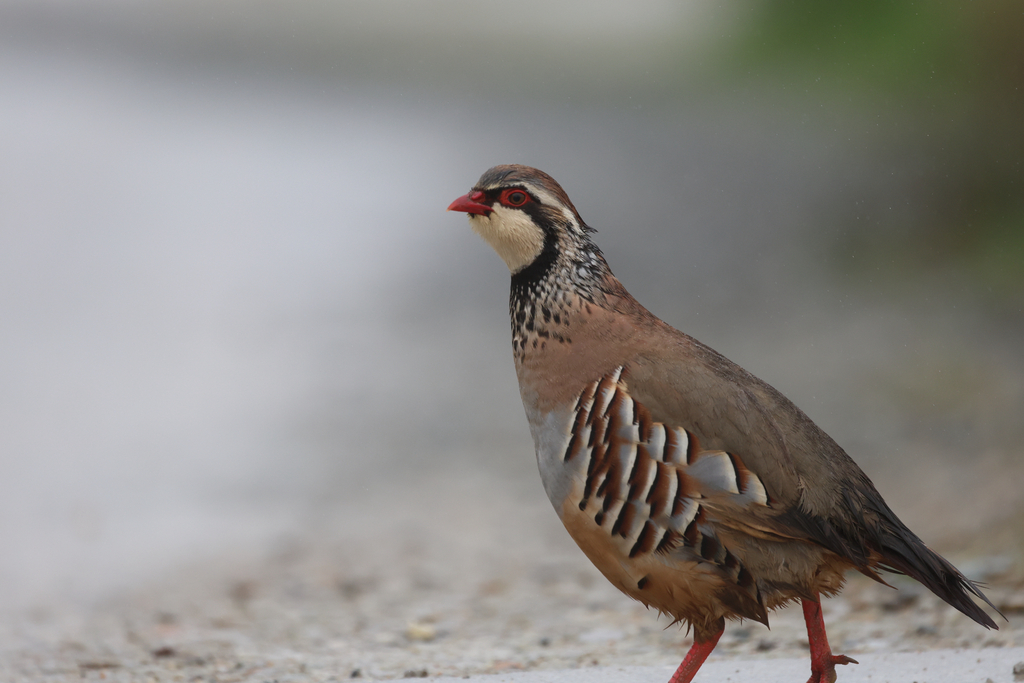
Red-legged Partridge
Photo © James Heal
Photo © James Heal — CC BY 4.0 — Source: iNaturalist photo #688931857Identification
The red-legged partridge is a rotund gamebird with distinctive plumage that makes it readily identifiable in the field. Adults display a sandy-brown upper body contrasting with a pinkish-buff belly and pale grey breast. The most striking features are the bold black gorget (throat patch) bordered by a cream throat, bright red legs, and a red bill with a prominent red eye-ring. The crown is warm pinkish-brown with pale blue-grey edges, and a narrow off-white stripe runs above the eye toward the nape.
The flanks bear eight to ten bold rufous-brown bars, each edged narrowly in black, set against contrasting pale grey or off-white backgrounds. The tail feathers are distinctly pinkish-rufous. When disturbed, this species prefers to run rather than fly, though it will take short flights on rounded wings if necessary. Its three-syllable call, ka-chu-chu, is a useful audio cue for locating birds.
Range & Habitat
The red-legged partridge breeds naturally throughout southwestern Europe, including France, Iberia, and northwestern Italy, with three recognized subspecies occupying different regions. It was introduced to Great Britain in the 18th century from France and has become naturalized, particularly in flat areas of England and Wales, with sightings recorded as far north as Sutherland. The species is non-migratory and forms flocks outside the breeding season.
This partridge inhabits dry lowlands including farmland and open stony areas, showing a preference for hot, dry regions with sandy soil typical of Mediterranean climates. Birds breed in ground nests and have been observed cohabiting with wild rabbits in suitable habitat. It is replaced by the similar rock partridge in southeastern Europe.
Behaviour & Diet
Red-legged partridges are primarily seed-eaters, though the young rely heavily on insects as an essential protein source during their development. The species is gregarious outside the breeding season, forming flocks that move through open terrain. When threatened, these birds demonstrate a characteristic preference for running over flight, making them challenging to flush but rewarding to observe as they scurry across open ground.
Best Time & Places to See It
The species occurs year-round throughout its range, making it accessible to travelers and photographers in any season. In continental Europe, target dry farmland and open stony areas in France, Spain, and Portugal. In Britain, look for red-legged partridges in the flatter, drier agricultural regions of England and Wales where they have become established since their introduction centuries ago.
Photography Tips
The red-legged partridge's preference for running over flying offers a unique photographic challenge and opportunity. Early morning is ideal for locating birds before they disperse across open ground. The species' striking plumage—particularly the red legs, gorget, and flank bars—photographs well in bright, clear light typical of dry Mediterranean and lowland habitats. Patience and slow, careful stalking are essential, as these wary birds will flush readily if approached too quickly.
Private Full-Day Birdwatching Tour from Lisbon to the Tagus Estuary
Nothing matches these filters.
Alpilles Regional Nature Park
Appennino Tosco-Emiliano National Park
Bannau Brycheiniog National Park
Bardenas Reales
Baronnies Provençales Regional Nature Park
Bosques de Plan
Cabañeros National Park
Cabo de Gata-Níjar Natural Park
Cabo Peñas
Nothing matches these filters.
No community photos yet. Log in to add the first one.
No community observations of this species yet.