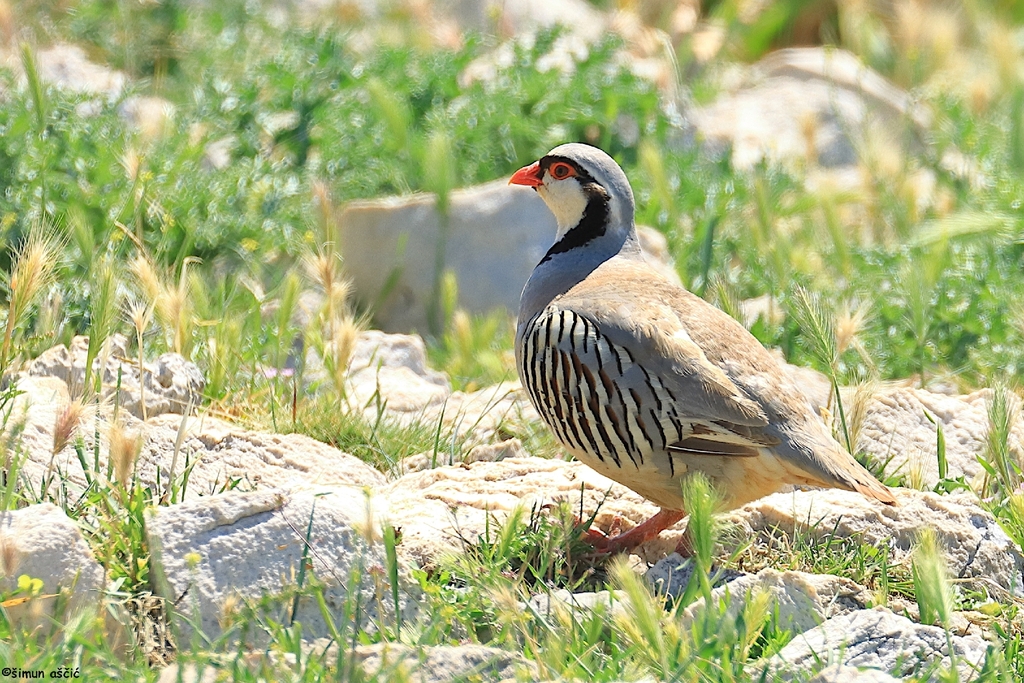
Rock Partridge
Photo © Šimun Aščić
Photo © Šimun Aščić — CC BY 4.0 — Source: iNaturalist photo #664389817Identification
The rock partridge is a rotund gamebird easily recognized by its distinctive plumage and markings. It displays a light brown back, grey breast, and buff belly, with rufous-streaked flanks and striking red legs. The face is white with a sharply defined black gorget (throat patch), which distinguishes it from the similar red-legged partridge. When alarmed, the bird prefers to run rather than fly, but when necessary it will take flight on rounded wings, typically covering only a short distance. Its loud, noisy call—a distinctive ga-ga-ga-ga-chakera-chakera-chakera—is often heard before the bird is seen.
The rock partridge is very similar to its eastern relative, the chukar partridge, but can be distinguished by its greyer back and white (rather than yellowish) foreneck. Understanding these subtle differences is valuable for birders and photographers working across southern Europe and the Mediterranean region.
Range & Habitat
Native to southern Europe, the rock partridge is a resident breeder found across the Mediterranean region, with four recognized subspecies occupying distinct ranges: from Serbia and Albania to Greece and Bulgaria; the Italian Alps from France to western Croatia; Sicily; and Italy. Each subspecies is adapted to its local geography, though some populations show weak differentiation.
This species favours dry, open, and often hilly country, making it well-suited to the rocky, scrubby landscapes of southern European mountains and plateaus. Its preference for such terrain has earned it its common name.
Behaviour & Diet
The rock partridge is a ground-dwelling bird with a diet comprising a wide variety of seeds supplemented by insect food. During breeding season, pairs nest in sparsely lined ground scrapes, where females lay between 5 and 21 eggs, a considerable range reflecting variation in breeding conditions.
When disturbed, the bird's characteristic behaviour is to run rather than fly, making it a challenging subject for photographers despite its preference for open habitats. Its tendency to remain on the ground and cover distance by running makes hearing its distinctive call an important aid to locating the species in the field.
Best Time & Places to See It
The rock partridge is a year-round resident throughout its range, so it can be encountered in all seasons. However, breeding season and spring may offer the best opportunities to locate birds through their vocal activity. The species occurs across southern Europe, including the Balkans, Alps, Apennines, and Mediterranean islands, though specific population strongholds and seasonal movements vary by subspecies and region.
Travellers and birders should focus on dry, open, hilly terrain typical of Mediterranean and Alpine landscapes. Local knowledge of productive sites is invaluable, as this partridge can be elusive despite its loud calls.
Photography Tips
Photographing the rock partridge presents both challenges and rewards. The bird's preference for running over flying means patient stalking in open, hilly terrain is often necessary. Early morning and late afternoon, when birds are more active, offer the best light and activity levels for photography.
The rock partridge's striking field marks—the white face, black gorget, grey breast, and red legs—photograph well in clear daylight. Since the bird prefers to remain on the ground and cover distance by running, photographers should position themselves with advantageous terrain and lighting, or use calls to encourage vocalizing birds to reveal themselves. The bird's conspicuous colouration makes it rewarding when finally encountered.
Mercantour National Park
Isola, France
+146 birds+32 mammals
Where alpine meadows surrender to vertiginous limestone cliffs, the Mercantour's beating heart pulses with Mediterranean and Alpine rhythms. This 4,221-square-kilometre sanctuary straddles France's southeastern border, its…
VIEW NATIONAL PARKÉcrins National Park
La Chapelle-en-Valgaudémar, France
+143 birds+36 mammals
Where granite peaks and Alpine meadows converge across nearly 2,100 square kilometres, Écrins National Park forms one of the wildest mountainous strongholds of the French Alps.…
VIEW NATIONAL PARKVanoise National Park
Val-Cenis, France
+107 birds+29 mammals
Where the French Alps rise in serrated ranks above the Maurienne valley, Vanoise National Park sprawls across more than 1,700 square kilometres of high-altitude wilderness—a realm…
VIEW NATIONAL PARKPirin National Park
Bansko, Bulgaria
+124 birds+10 mammals
Where jagged limestone peaks pierce the Macedonian sky, ancient glacial valleys cradle some of Bulgaria's most pristine wilderness. This southwestern corner of the Balkans rises to…
VIEW NATIONAL PARKRila National Park
Mala tsarkva, Bulgaria
+138 birds+4 mammals
Where granite peaks pierce the Balkan skyline, pristine conifer forests blanket steep mountain slopes in an ecological tapestry that has remained largely undisturbed for centuries. Bulgaria's…
VIEW NATIONAL PARKCentral Balkan National Park
Zhidov dol, Bulgaria
+135 birds+16 mammals
Where granite peaks pierce the Bulgarian highlands, ancient beech and conifer forests blanket mountains that rise dramatically from the Balkan range's heart. This wilderness encompasses three…
VIEW NATIONAL PARKVratsa Balkan
Zgorigrad, Bulgaria
+128 birds+10 mammals
Where limestone cliffs plunge into deep river canyons and beech forests give way to rocky karst plateaus, one of Bulgaria's most dramatic mountain landscapes unfolds across…
VIEW NATURE RESERVEPollino National Park
Viggianello, Italy
+125 birds+9 mammals
Where limestone ridges rise abruptly from the Basilicatan foothills, Pollino National Park enfolds a landscape of profound ecological character—one defined by steep valleys, alpine meadows clinging…
VIEW NATIONAL PARKStelvio National Park
Valfurva, Italy
+116 birds+17 mammals
Where granite peaks rise above three thousand metres and alpine meadows give way to rocky scree, Stelvio National Park guards one of Europe's most dramatically vertical…
VIEW NATIONAL PARKGran Paradiso National Park
Cogne, Italy
+120 birds+16 mammals
Where the western Alps rise steeply above the Aosta Valley, granite ridges and alpine meadows converge in a landscape shaped as much by glacial history as…
VIEW NATIONAL PARKMaiella National Park
Pacentro, Italy
+131 birds+11 mammals
Limestone scarps rise abruptly from the valleys around Pacentro, their pale faces scored by millennia of water and wind into a landscape of canyons, karst features,…
VIEW NATIONAL PARKGran Sasso and Monti della Laga National Park
Pietracamela, Italy
+155 birds+12 mammals
Where the Apennines rise in their most dramatic form, the Gran Sasso e Monti della Laga National Park unfolds across nearly 70,000 hectares of limestone peaks,…
VIEW NATIONAL PARKMonti Sibillini National Park
Castelsantangelo sul Nera, Italy
+113 birds+11 mammals
Where the Apennines rear their limestone spine across central Italy, the Sibillini Mountains National Park reveals a landscape of dramatic vertical relief, high plateaus, and deeply…
VIEW NATIONAL PARKAspromonte National Park
Careri, Italy
+89 birds+5 mammals
Where the Aspromonte massif rises sharply from Calabria's Tyrrhenian coast, ancient beech and mixed temperate forests cloak the upper slopes, giving way at lower elevations to…
VIEW NATIONAL PARKPindos National Park
Ioannina Regional Unit, Greece
+163 birds+12 mammals
Where limestone peaks rise abruptly from the Pindus range in northwestern Greece, a landscape of dramatic gorges, alpine meadows, and dense beech forests creates one of…
VIEW NATIONAL PARKMount Ainos National Park
Sami Municipal Unit, Greece
+118 birds+1 mammals
Where limestone and conglomerate peaks rise dramatically above the Ionian Sea, Mount Ainos commands the landscape of Kefalonia with a rugged majesty that few Mediterranean summits…
VIEW NATIONAL PARKVikos–Aoos National Park
Ioannina Regional Unit, Greece
+136 birds+4 mammals
Where limestone gorges plunge through the Pindus Mountains, the Vikos–Aoos National Park guards one of Greece's most dramatic inland wilderness areas. The park's defining feature is…
VIEW NATIONAL PARKMount Parnitha National Park
Municipal Unit of Acharnes, Greece
+137 birds+4 mammals
Where pine-clad ridges rise abruptly from the Attica plains, Mount Parnitha National Park unfolds across nearly 4,000 hectares of Mediterranean mountain wilderness. The park's defining character…
VIEW NATIONAL PARKOlympos National Park
Pieria Regional Unit, Greece
+137 birds+3 mammals
Where the Thessalian plains give way to soaring limestone massifs, Olympos National Park rises as one of the Aegean's most dramatic mountain wilderness areas. This IUCN…
VIEW NATIONAL PARKKerkini Lake National Park
Serres, Greece
+291 birds+18 mammals
Where the Strymon River widens into a sprawling freshwater lake hemmed by the Rhodope Mountains, Kerkini National Park unfolds across northern Greece as one of southeastern…
VIEW NATIONAL PARKAbruzzo, Lazio and Molise National Park
Pescasseroli, Italy
+139 birds+18 mammals
Where the central Apennines rise in dramatic limestone and clay ridges, the Gran Sasso e Monti della Laga National Park unfolds across one of Italy's most…
VIEW NATIONAL PARKBelluno Dolomites National Park
Sospirolo, Italy
+72 birds+10 mammals
Where the Dolomites' pale limestone ramparts rise above the Veneto plain, the Belluno Dolomites National Park encompasses a landscape of profound ecological diversity. The park's subarctic-style…
VIEW NATIONAL PARKVal Grande National Park
Verbano-Cusio-Ossola, Italy
+81 birds+6 mammals
Granite peaks and plunging ravines define this Alpine wilderness where the Toce River carves through one of Italy's most remote mountain landscapes. Straddling the Verbano-Cusio-Ossola district…
VIEW NATIONAL PARKNo community photos yet. Log in to add the first one.
No community observations of this species yet.