Savi’s Warbler
Photo © Kudaibergen Amirekul
Photo © Kudaibergen Amirekul — CC BY-SA 4.0 — Source: iNaturalist photo #313925888Identification
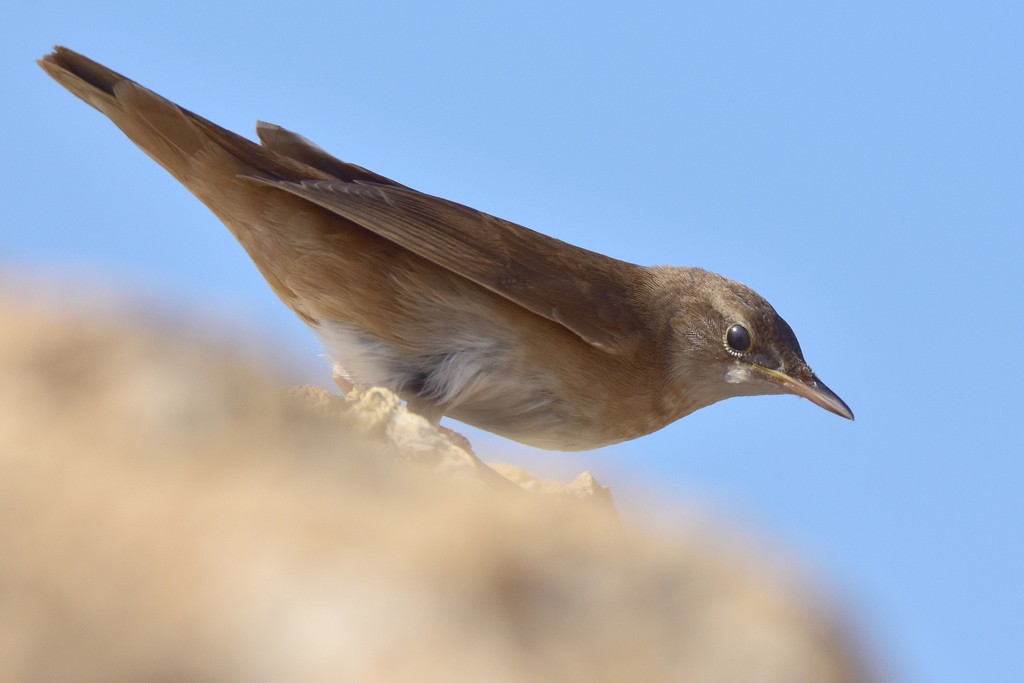
Savi's warbler is a small passerine, around 14 cm long, with subtle plumage that rewards careful observation. The upperparts are uniform dark reddish-brown, sometimes tinged greenish, while the underparts are whitish-buff on the chin and throat, with sandy-brown flanks. Look for indistinct buff eye-stripes, dark lores, and pale brown ear-coverts. The bird has a slender brown beak and brown legs. A key distinction from the similar river warbler is the complete lack of throat streaks. Young birds are noticeably yellower below than adults, and both sexes are identical in plumage—a trait shared with most warblers. In breeding season, both upperparts and underparts become slightly paler than winter plumage.
Range & Habitat
Savi's warbler breeds across Europe and the western Palearctic, from Spain and Portugal through Central and Eastern Europe to Russia's Volga region, with populations also found in North Africa, Turkey, and central Asia. It is strongly migratory, wintering in northern and sub-Saharan Africa from West Africa's Senegal region to Sudan and Ethiopia. The species is an occasional visitor to the United Kingdom, Ireland, and other western European locations.
This warbler is a specialist of reed beds, marshes, and lagoons with dense reeds, sedges, and other marsh vegetation, often with scattered bushes or sallows. It clambers agilely through tangled growth and stem structures, making it difficult to observe except when singing from prominent reed-head positions. Outside the breeding season, birds disperse to less densely vegetated fens and have been recorded in cornfields.
Behaviour & Diet
Savi's warbler is insectivorous, feeding on flies, beetles, moths, grubs, damselflies, and small worms. Although not inherently shy, the species can be frustratingly difficult to see as it flits through reeds with practiced agility. However, upon establishing breeding territories, males become more conspicuous, climbing to reed-head tops to sing from open, prominent positions. Both males and females sing. After breeding, birds moult into winter plumage and depart on migration, with little known of their habits in African wintering grounds beyond their preference for swampy areas and occasional sightings in cornfields and small feeding flocks.
Best Time & Places to See It
The breeding season begins in mid-April in southern regions and extends to late May in Northern Europe, offering the best opportunity to locate these birds through their distinctive song. Arriving males establish territories in reed-dense wetlands, and early arrivals occupy the best habitat patches. Wetlands with extensive reed beds, sedges, and marsh vegetation across the bird's breeding range—particularly in Central and Eastern Europe, the Netherlands, Germany, Poland, Romania, and Bulgaria—offer reliable viewing opportunities. The bird's song, heard especially at dusk, is often your best clue to its presence.
Photography Tips
Patience is essential when photographing Savi's warbler. The bird's habit of singing from elevated reed-head positions with open beak and vibrating throat provides your clearest photographic opportunities. Visit reed beds during early morning or dusk when birds are most vocal and active. Focus on areas with the densest reed coverage, as these represent prime territories. Use the mechanical, insect-like reeling song as an auditory guide to locate singing males. The subtle plumage requires careful exposure to render the reddish-brown tones and buff underparts accurately without losing detail in highlights or shadows.
S’Albufera Natural Park
Platja de Muro, Spain
+253 birds+6 mammals
Where Mediterranean lagoons meet the Balearic coast, S'Albufera stretches across nearly 1,600 hectares of wetland and dune systems that rank among Europe's most ecologically vital shallow-water…
VIEW NATURAL PARKMarjal Pego-Oliva Natural Park
Molinell, Spain
+219 birds+2 mammals
Where the Valencian littoral flattens into wetland and reed-bed, Marjal Pego-Oliva straddles the boundary between the Mediterranean and its inland margins, a mosaic of shallow lagoons,…
VIEW NATURAL PARKL’Albufera Natural Park
València, Spain
+321 birds+18 mammals
Where shallow lagoons meet Mediterranean coastal marshland, L'Albufera Nature Park unfolds as one of Spain's most vital wetland complexes. This protected landscape, designated under IUCN Category…
VIEW NATURAL PARKLower Oder Valley National Park
Schwedt/Oder, Germany
+216 birds+21 mammals
Where the Oder River winds through northeastern Brandenburg, the Lower Oder Valley National Park protects one of Central Europe's most vital wetland systems. This sprawling mosaic…
VIEW NATIONAL PARKVorpommersche Boddenlandschaft National Park
Küstengewässer einschließlich Anteil am Festlandso, Germany
+230 birds+19 mammals
Where the Baltic coast dissolves into a labyrinth of shallow lagoons and coastal wetlands, Vorpommersche Boddenlandschaft National Park protects one of northern Europe's most dynamic and…
VIEW NATIONAL PARKSchleswig-Holsteinisches Wattenmeer National Park
Germany
+378 birds+49 mammals
Where the North Sea ebbs and flows across a vast expanse of exposed mud and sand, the Schleswig-Holsteinisches Wattenmeer National Park reveals one of Europe's most…
VIEW NATIONAL PARKDoñana National Park
Hinojos, Spain
+300 birds+13 mammals
Where the Guadalquivir River delta spreads into the Atlantic, vast marshes, cork woodlands, and coastal dunes converge to create one of southwestern Europe's most biodiverse wetland…
VIEW NATIONAL PARKTablas de Daimiel National Park
Daimiel, Spain
+246 birds+6 mammals
Where the Guadiana River spreads into a labyrinth of shallow lagoons and reed beds across the sun-baked plains of central Spain, Tablas de Daimiel National Park…
VIEW NATIONAL PARKCabo de Gata-Níjar Natural Park
San José, Spain
+274 birds+11 mammals
Where volcanic ridges plunge toward the Mediterranean, Cabo de Gata-Níjar Nature Park unfolds across one of Europe's most arid coastlines, a landscape sculpted by tectonic violence…
VIEW NATURAL PARKDelta de l’Ebre Natural Park
Eucaliptus, Spain
+341 birds+18 mammals
Where the Ebro River spreads into a vast labyrinth of shallow lagoons, reed beds, and brackish marshes before surrendering to the Mediterranean, one of southern Europe's…
VIEW NATURAL PARKCap de Creus Natural Park
Roses, Spain
+245 birds+23 mammals
Where the Pyrenees tumble into the Mediterranean, Cap de Creus Nature Park unfolds across 300 square kilometres of one of northeastern Spain's most dramatic coastal wilderness…
VIEW NATURAL PARKDanube Delta Biosphere Reserve
Tulcea, Romania
+277 birds+27 mammals
Where the Danube surrenders to the Black Sea, a vast labyrinth of channels, reed beds, and freshwater lakes sprawls across nearly 13,400 square kilometers of eastern…
VIEW NATIONAL PARKCollserola Natural Park
Barcelona, Spain
+194 birds+20 mammals
Where Mediterranean scrubland rises steeply from Barcelona's urban edge, Collserola unfolds across 173 square kilometres of low mountains that form a crucial ecological buffer between city…
VIEW NATURAL PARKAggtelek National Park
Szin, Hungary
+119 birds+13 mammals
Where limestone karst terrain rises and plunges across North Hungary's borderlands, Aggtelek National Park unfolds across 543 square kilometres of one of Europe's most geologically dramatic…
VIEW NATIONAL PARKDuna-Ipoly National Park
Dömös, Hungary
+208 birds+19 mammals
Where the Danube curves through central Hungary, the limestone hills and forested valleys of Duna-Ipoly National Park create a landscape that feels caught between seasons and…
VIEW NATIONAL PARKFertő–hanság National Park
Fertőszéplak, Hungary
+246 birds+11 mammals
Where the Austro-Hungarian plains meet the foothills of Western Transdanubia, nearly 900 square kilometres of wetland, reed bed, and mixed woodland form one of Central Europe's…
VIEW NATIONAL PARKBükk National Park
Répáshuta, Hungary
+161 birds+15 mammals
Where forested limestone ridges rise across northern Hungary, Bükk National Park unfolds across nearly 900 square kilometres of temperate woodland, rocky gorges, and karst formations that…
VIEW NATIONAL PARKEspacio Natural Remolar-Filipinas
El Prat del Llobregat, Spain
+297 birds+7 mammals
Where the Llobregat River delta meets the Mediterranean, a patchwork of salt marshes, reed beds, and shallow lagoons creates one of Catalonia's most dynamic wetland ecosystems.…
VIEW NATURE RESERVEUrdaibai Biosphere Reserve
Txatxarramendi, Spain
+268 birds+8 mammals
Where the Pyrenean foothills surrender to the Bay of Biscay, tidal estuaries carve through Basque limestone, creating one of Europe's most ecologically vital wetland complexes. Salt…
VIEW BIOSPHERE RESERVECamargue Regional Nature Park
Saintes-Maries-de-la-Mer, France
+378 birds+48 mammals
Where the Rhône Delta sprawls into the Mediterranean, a landscape of stark and haunting beauty emerges—vast salt marshes punctuated by shallow lagoons, reed beds, and scrubland…
VIEW NATURAL PARKDirigida Laguna de Gallocanta Nature Reserve
Las Cuerlas, Spain
+250 birds+7 mammals
Where continental steppe meets the vast mirror of inland water, Spain's largest natural lagoon reveals a landscape of haunting beauty. The shallow alkaline lake, cradled in…
VIEW NATURE RESERVEStrandzha Nature Park
Kondolovo, Bulgaria
+215 birds+19 mammals
Where the Rhodope Mountains descend toward the Black Sea coast, ancient forests rise above limestone plateaus in a tapestry of ecological richness rarely found elsewhere in…
VIEW NATURAL PARKKarula National Park
Võru County, Estonia
+110 birds+9 mammals
Where glacial lakes pierce a landscape of boreal forest and bogland, Karula National Park sprawls across 222 square kilometers of southeastern Estonia, a sanctuary where the…
VIEW NATIONAL PARKSoomaa National Park
Viljandi County, Estonia
+172 birds+20 mammals
Across the boglands of south-central Estonia, where water dominates more than half the landscape, lies one of northern Europe's most hydrologically dynamic national parks. The terrain…
VIEW NATIONAL PARKLahemaa National Park
Lääne-Viru County, Estonia
+237 birds+25 mammals
Where the Baltic coast meets temperate forest in northwestern Estonia, Lahemaa National Park sprawls across more than 1,300 square kilometers of deeply character-filled terrain. Coastal wetlands…
VIEW NATIONAL PARKSerra de Mariola Natural Park
Bocairent, Spain
+164 birds+19 mammals
Where limestone ridges rise above the Valencian interior, Serra de Mariola unfolds across 225 square kilometers of Mediterranean mountain terrain that shifts between dense evergreen woodland,…
VIEW NATURE RESERVELosiny Ostrov National Park
Balashikhinsky District, Russia
+173 birds+20 mammals
Across the forested plateaus of Moscow Oblast, where the Losinka River winds through mixed woodland and marshy clearings, lies a national park that captures the ecological…
VIEW NATIONAL PARKWielkopolska National Park
Trzebaw, Poland
+141 birds+8 mammals
Across the glacial plains of Greater Poland, where ice-age geology shaped a landscape of shallow lakes and mixed forest, Wielkopolska National Park stretches across nearly 190…
VIEW NATIONAL PARKPolesie National Park
Michałów, Poland
+172 birds+9 mammals
Where the Pripyat River winds through eastern Poland, Polesie National Park sprawls across 418 square kilometres of a landscape shaped by water, peat, and millennia of…
VIEW NATIONAL PARKBieszczady National Park
Bieszczady County, Poland
+131 birds+16 mammals
Where the Carpathian foothills roll across southeastern Poland, a vast upland wilderness of beech and spruce forest unfolds across nearly 1,575 square kilometres, sheltering one of…
VIEW NATIONAL PARKDrawa National Park
Strzelce-Drezdenko County, Poland
+84 birds+11 mammals
Where the Drawa River winds through northwestern Poland's sandy lowlands, a landscape of unexpected ecological richness unfolds across 508 square kilometres of protected forest and wetland.…
VIEW NATIONAL PARKWolin National Park
Kamień County, Poland
+232 birds+21 mammals
Where the Baltic shoreline meets vast wetland complexes and Pleistocene woodlands, Wolin National Park unfolds across nearly 440 square kilometres of northwestern Poland's most biodiverse terrain.…
VIEW NATIONAL PARKSłowiński National Park
Smołdzino, Poland
+217 birds+16 mammals
Where the Baltic shoreline surrenders to vast inland dunes and freshwater lagoons, Słowiński National Park spans nearly 610 square kilometres of one of Europe's most dynamic…
VIEW NATIONAL PARKKampinos National Park
Roztoka, Poland
+183 birds+18 mammals
Sandy pine forests and wetland mosaics spread across the glacial plains northwest of Warsaw, where Kampinos National Park protects one of central Europe's most distinctive lowland…
VIEW NATIONAL PARKUjście Warty National Park
Gorzów County, Poland
+212 birds+9 mammals
Where the Warta River spreads into its delta before joining the Oder, wetland and woodland merge into one of central Europe's most vital ecological crossroads. Ujście…
VIEW NATIONAL PARKWigry National Park
Czerwony Folwark, Poland
+130 birds+8 mammals
Where glacial lakes cut through northeastern Poland's primordial forests, Wigry National Park sprawls across 368 square kilometers of one of Europe's least disturbed wilderness tracts. The…
VIEW NATIONAL PARKBiebrza National Park
Goniądz, Poland
+242 birds+33 mammals
Where the Narew River sprawls across northeastern Poland's flatlands, Biebrza National Park unfolds as one of Europe's largest and most ecologically vital wetland complexes. Encompassing roughly…
VIEW NATIONAL PARKBiałowieża National Park
Bialowieza, Poland
+177 birds+23 mammals
Straddling the border between Poland and Belarus, this primordial forest landscape encompasses one of Europe's last remaining expanses of old-growth woodland, where ancient trees rise through…
VIEW NATIONAL PARKKerkini Lake National Park
Serres, Greece
+291 birds+18 mammals
Where the Strymon River widens into a sprawling freshwater lake hemmed by the Rhodope Mountains, Kerkini National Park unfolds across northern Greece as one of southeastern…
VIEW NATIONAL PARKCalanques National Park
Bouches-du-Rhône, France
+233 birds+42 mammals
Where limestone cliffs plunge dramatically into crystalline Mediterranean waters, Calanques National Park preserves one of Europe's most striking coastal landscapes. These steep-sided inlets, carved by erosion…
VIEW NATIONAL PARKNo community photos yet. Log in to add the first one.
No community observations of this species yet.