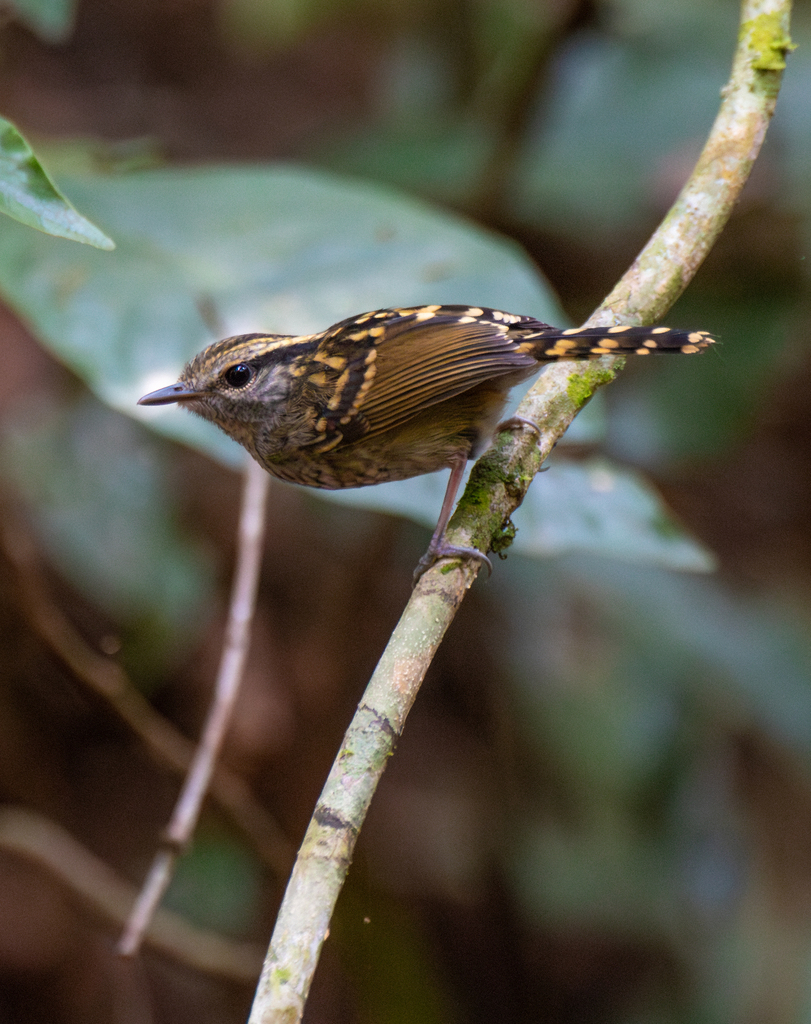
Scaled Antbird
Photo © Henrique Bitencourt
Photo © Henrique Bitencourt — CC BY-SA 4.0 — Source: iNaturalist photo #427179043Identification
The Scaled Antbird is a small passerine, measuring 12–14 cm in length and weighing just 10.5–11 g. Sexual dimorphism is pronounced. Males of the nominate subspecies display a striking black crown with white spotting along the sides, a bold white supercilium, and a black eye-stripe contrasting against a white face with black spots. The upperparts are black with white spots, and the wings are black with white-tipped coverts; the tail is barred black and white. The throat and underparts are white, heavily spotted with black. Females are substantially duller, with dark brown crowns and eye-stripes, buff-spotted dark brown upperparts, and pale cinnamon flanks. The southern subspecies D. s. stictocorypha males show white spotting in the crown center and a darker gray belly, with some overlap between the two forms.
Range & Habitat
Endemic to eastern and southeastern Brazil, the Scaled Antbird occupies two geographically separated populations. The nominate subspecies occurs in Pernambuco, Alagoas, and Bahia, while D. s. stictocorypha ranges from eastern Minas Gerais and Espírito Santo south to extreme northeastern Santa Catarina. The species inhabits dense understorey vegetation in evergreen forests and secondary woodlands, ranging from sea level to 1,100 m elevation, with northern populations tending toward higher elevations. Unlike most congeners, it is not closely dependent on bamboo, though it readily uses bamboo thickets where present.
Behaviour & Diet
The Scaled Antbird is a year-round resident throughout its range. It feeds primarily on arthropods, foraging typically within 4 m of the ground, though occasionally reaching 6 m. Individuals forage singly, in pairs, or in family groups, often joining mixed-species feeding flocks and occasionally following army ant swarms. The bird employs a characteristically active foraging style, hitching up trunks and vines while flicking its wings, and gleaning prey by reaching or lunging from perches, with occasional short flights to the substrate. It exploits both live vegetation and ground-level debris, including downed branches and leaf litter.
Best Time & Places to See It
As a year-round resident, the Scaled Antbird can be encountered throughout the year across its range. It is considered fairly common to common and occurs in several protected areas, making it a reliable species for visitors to southeastern Brazilian forests and woodlands. Early morning hours typically offer the best viewing opportunities, when antbirds are most active. Dense understorey habitat in both evergreen forests and secondary woodlands should be targeted, particularly where dense vegetation and leaf litter provide good foraging substrate.
Photography Tips
The Scaled Antbird's small size and preference for dense understorey vegetation present significant photographic challenges. Position yourself within or near dense vegetation where the bird forages, typically close to the ground. Early morning light will illuminate the male's striking black and white pattern most effectively. The bird's active foraging behavior—hitching and wing-flicking—provides dynamic shooting opportunities, though patience and a fast shutter speed are essential. Focus on capturing the distinctive head pattern and white spotting on black plumage, which define this species photographically.
Carlos Botelho State Park
Ilha do Cardoso State Park
Intervales State Park
Itatiaia National Park
Pau Brasil National Park
Saint-Hilaire/Lange National Park
Serra da Bocaina National Park
Serra do Mar State Park
Serra dos Órgãos National Park
Nothing matches these filters.
No community photos yet. Log in to add the first one.
No community observations of this species yet.