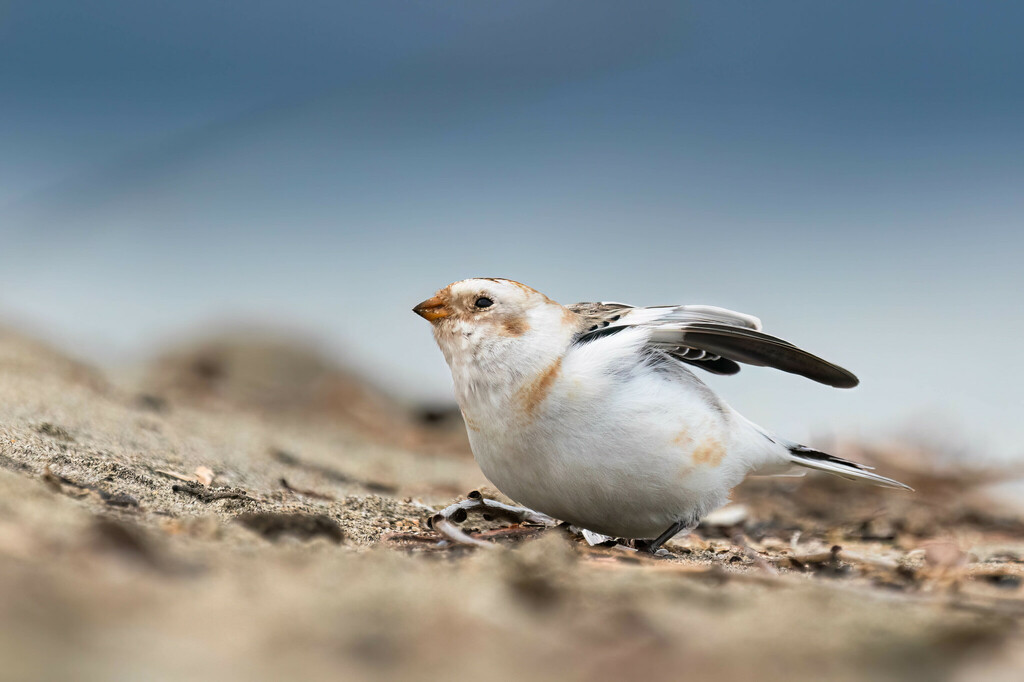
Snow Bunting
Photo © Kalvin Chan
Photo © Kalvin Chan — CC BY 4.0 — Source: iNaturalist photo #260782169Identification
The snow bunting is a medium-sized, ground-dwelling passerine measuring 15 cm with a wingspan of 32–38 cm, weighing 30 to 40 grams. It is fairly large and long-winged for a bunting and displays striking sexual dimorphism. Males in breeding plumage are predominantly white with black wingtips and back, while females show black wingtips with brown-fringed black feathers on the back. In winter, both sexes display broad orangey-brown fringes on their back feathers. The bill is typically yellow with a black tip, though breeding males have entirely black bills. A unique adaptation to extreme cold is its feathered tarsi—a feature shared by no other passerine. The species has a distinctive rippling whistle call and a brief but loud warbling song.
The snow bunting can be confused with McKay's bunting, which has even more white plumage, and with the Lapland longspur, which has minimal white in the wing and a drier, rattling call. The horned lark, another potential lookalike, has a distinctive black-and-yellow head pattern and a longer, partly black tail.
Range & Habitat
This is an Arctic specialist with a circumpolar breeding range throughout the northern hemisphere. The snow bunting holds the remarkable distinction of being the most northerly recorded passerine in the world. Beyond the main Arctic populations, small isolated breeding populations persist on high mountain tops south of the Arctic, including the Cairngorms in central Scotland, the Saint Elias Mountains on the southern Alaska-Yukon border, and the Cape Breton Highlands. Four subspecies are recognized, with slight plumage variations: the nominate subspecies occupies Arctic Europe and North America; the Icelandic and Scottish populations represent subspecies insulae; Arctic Asia hosts vlasowae; and townsendi inhabits the Aleutian Islands, Kamchatka, and coastal far eastern Siberia.
Behaviour & Diet
Snow buntings are ground-dwelling birds that walk, run, and hop as needed. Males are highly vocal during breeding season, with song quality and emission rate directly influencing reproductive success. Interestingly, males do not begin singing until they reach breeding grounds and cease once they find a mate. The song rate serves as an honest signal of foraging ability and parental quality—males capable of singing more frequently demonstrate superior foraging success, which translates to better nestling survival rates. Females select mates based on these song rates. Each male's vocalizations are individually unique, enabling individual recognition among birds, though syllables are sometimes shared between individuals. Songs last approximately 2 seconds with frequencies of 2 to 6 kHz, composed of alternating motifs that repeat to create distinctive patterns.
Best Time & Places to See It
For observers seeking snow buntings, the Arctic regions offer the most reliable viewing during breeding season. Those unable to venture to the High Arctic should consider the isolated southern populations in Scotland's Cairngorms, the Saint Elias Mountains region, or Cape Breton Highlands. Spring migration periods may present opportunities to observe birds in transit. The species' extreme cold tolerance means it remains active in environments where few other passerines venture, making it a prized sighting for dedicated Arctic and alpine birders.
Photography Tips
The snow bunting's striking contrast between white and black plumage makes it visually compelling, particularly during breeding season when sexual dimorphism is most pronounced. Photographers should be prepared for harsh Arctic conditions and use appropriate cold-weather gear. The species' ground-dwelling habits and tendency to run rather than hide offer opportunities for approach, though patience is essential. Males singing from perches or in flight display provide dynamic compositional possibilities. Winter plumage, with its orangey-brown fringes, offers different aesthetic qualities than breeding plumage and may be more accessible to photographers visiting southern populations during migration or winter.
Arctic Ecology and Ecosystem Conservation Tour
Nothing matches these filters.
Tombstone Territorial Park
Acadia National Park
Alaska Maritime National Wildlife Refuge
Algonquin Provincial Park
Alligator River National Wildlife Refuge
Arctic National Wildlife Refuge
Åsnens National Park
Auyuittuq National Park
Badlands National Park
Nothing matches these filters.
No community photos yet. Log in to add the first one.
No community observations of this species yet.