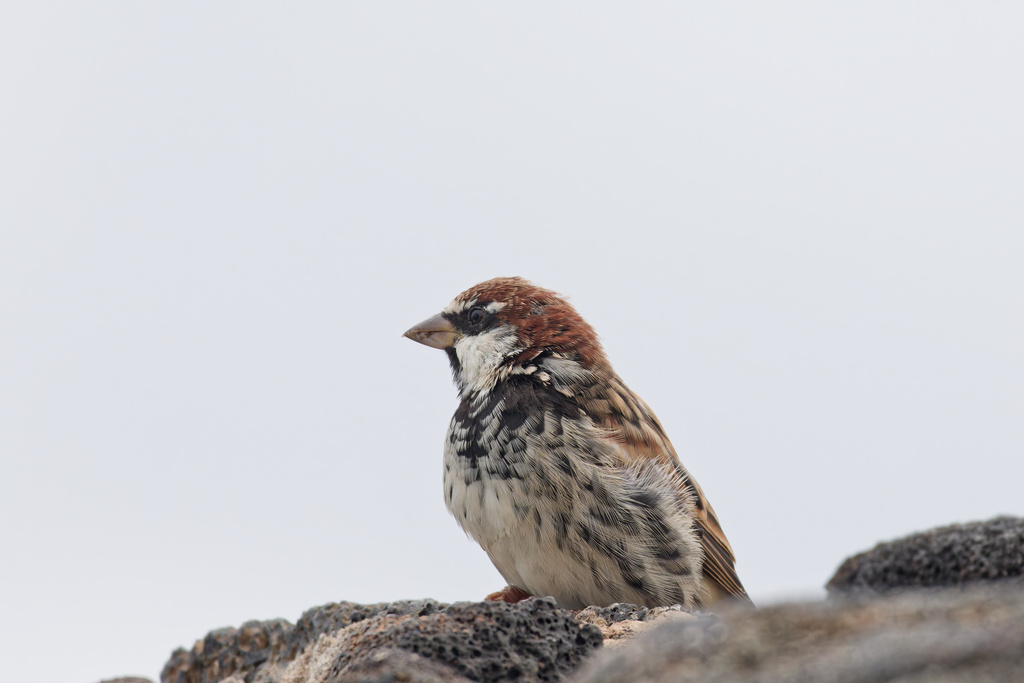
Spanish Sparrow
Photo © Donald Davesne
Photo © Donald Davesne — CC BY 4.0 — Source: iNaturalist photo #453921797Identification
The Spanish sparrow is a rather large sparrow, measuring 15–16 cm in length and weighing 22–36 g, making it slightly larger and heavier than its close relative the house sparrow. It also sports a slightly longer and stouter bill. Males are distinctive, featuring heavily black-streaked underparts, a chestnut crown, and white cheeks—contrasting sharply with the house sparrow's grey crown and cheeks. Females are more challenging to identify, with grey-brown overall plumage that is more boldly marked than house sparrows, featuring light side streaking, a pale cream supercilium, and broad cream streaks on the back.
Two subspecies are recognised: the western Spanish sparrow (P. h. hispaniolensis) and the eastern Spanish sparrow (P. h. transcaspicus), which show little visible difference in worn breeding plumage but are more easily distinguished in fresh winter plumage, with the eastern subspecies being paler and less chestnut.
Range & Habitat
The Spanish sparrow has a highly complex distribution spanning the Mediterranean region, Macaronesia, and southwest to central Asia. It breeds mostly in a band of latitude about 15 degrees wide, from the Danube Valley and the Aral Sea in the north to Libya and central Iran in the south. The western subspecies hispaniolensis breeds in parts of Iberia and North Africa, scattered islands, and the Balkans, occurring in Spain's Tagus valley and sporadically across the northern meseta, eastern coast, and Guadalquivir and Guadiana valleys.
The species' range has expanded significantly over the last two centuries, particularly in the Balkans—reaching Romania, Serbia, and Moldova from 1950 onwards—and in Macaronesia. Vagrants occur widely, reaching as far north as Scotland and Norway, with studies suggesting that vagrancy may be facilitated partly by cargo trains, as vagrant individuals occur notably close to railway lines.
Behaviour & Diet
The Spanish sparrow's vocalisations are similar to those of the house sparrow but distinctly different in display. Males give a pair of strident, disyllabic chirps transcribed as "chweeng-chweeng" or "cheela-cheeli"—louder and higher-pitched than house sparrow calls. A softer, more muted call resembling "tschilp" is used by birds arriving or departing at roosting sites. Other calls include a soft "quer quer quer" given at the nest by mated pairs, a "quer-it" flight call used by flocking birds, and a "chur-chur-it" threat call.
The species is notably associated with moist habitats, reflected in its alternative name "willow sparrow." It shows a complex relationship with the house sparrow across its range, hybridising freely in parts of North Africa and the Mediterranean, creating mixed populations with highly variable characteristics.
Best Time & Places to See It
The Spanish sparrow is best encountered in its core Mediterranean breeding range, particularly in northern Spain's river valleys and coastal regions, North Africa, and the Balkans. The species' recent range expansion means it is increasingly found in eastern Europe, including Romania, Serbia, and Moldova. For reliable sightings, focus on suitable habitat within Iberia, the Maghreb, and the central Mediterranean islands during breeding season.
Travellers venturing beyond the typical range should remain alert to vagrants, particularly near railway infrastructure where Spanish sparrows tend to congregate unexpectedly. Winter plumage observations are particularly valuable for subspecies identification, making the cooler months ideal for detailed study of eastern versus western populations.
Photography Tips
Male Spanish sparrows offer the most photographic interest, with their striking chestnut crowns, bold black underpart streaking, and white cheeks providing excellent contrast and identification features. Capture males displaying at their nests to document their characteristic behaviour and distinctive plumage patterns. Fresh winter plumage shows the subspecific differences most clearly, making this season ideal for detailed comparative photography.
Since the species shows complex hybridisation with house sparrows across much of its range, photographers should document subtle plumage details from multiple angles to aid identification. Focus on the crown colour, cheek pattern, and underpart streaking—key distinguishing features. Early morning and roosting periods offer opportunities to photograph birds in characteristic behaviour, particularly at sites near water or riparian vegetation where the "willow sparrow" name reflects its habitat preference.
Monfragüe National Park
Torrejón el Rubio, Spain
+219 birds+10 mammals
Where the Tagus River cuts through limestone plateaus in central Extremadura, Monfragüe National Park rises as a fortress of Mediterranean and Atlantic woodland, its dramatic rocky…
VIEW NATIONAL PARKMarjal Pego-Oliva Natural Park
Molinell, Spain
+219 birds+2 mammals
Where the Valencian littoral flattens into wetland and reed-bed, Marjal Pego-Oliva straddles the boundary between the Mediterranean and its inland margins, a mosaic of shallow lagoons,…
VIEW NATURAL PARKTeide Natural Monument
La Orotava, Spain
+41 birds+4 mammals
High on the volcanic slopes of Tenerife, where the landscape transforms from lush laurel forests into lunar terrain, the Teide Natural Monument preserves one of Spain's…
VIEW NATURE RESERVEL’Albufera Natural Park
València, Spain
+321 birds+18 mammals
Where shallow lagoons meet Mediterranean coastal marshland, L'Albufera Nature Park unfolds as one of Spain's most vital wetland complexes. This protected landscape, designated under IUCN Category…
VIEW NATURAL PARKPilancones Natural Park
Las Tederas, Spain
+30 birds
Where volcanic ridges and ravines carve through the northwestern interior of Gran Canaria, Pilancones Nature Park preserves one of the archipelago's most dramatic upland ecosystems. The…
VIEW NATURAL PARKTimanfaya National Park
Tinajo, Spain
+37 birds
Across Lanzarote's northwestern plains, where the Atlantic wind sculpts black lava fields into a landscape of geological drama, lies one of Europe's most visually arresting volcanic…
VIEW NATIONAL PARKDoñana National Park
Hinojos, Spain
+300 birds+13 mammals
Where the Guadalquivir River delta spreads into the Atlantic, vast marshes, cork woodlands, and coastal dunes converge to create one of southwestern Europe's most biodiverse wetland…
VIEW NATIONAL PARKTablas de Daimiel National Park
Daimiel, Spain
+246 birds+6 mammals
Where the Guadiana River spreads into a labyrinth of shallow lagoons and reed beds across the sun-baked plains of central Spain, Tablas de Daimiel National Park…
VIEW NATIONAL PARKTeide National Park
La Orotava, Spain
+83 birds+7 mammals
At nearly 3,900 metres, Spain's highest peak rises from the Canary Islands as a singular volcanic monument, its slopes sweeping through five distinct climate zones in…
VIEW NATIONAL PARKGarajonay National Park
Hermigua, Spain
+68 birds+1 mammals
Laurel forests cloak the volcanic ridges of this Canarian national park, their evergreen canopy so dense that mist clings to the moss-draped branches even on cloudless…
VIEW NATIONAL PARKSierra de Tejeda, Almijara y Alhama Natural Park
Frigiliana, Spain
+128 birds+8 mammals
Where limestone ridges rise sharply from the Axarquía lowlands, the Sierra de Tejeda, Almijara y Alhama Nature Park unfolds across a dramatic landscape of white-rock massifs,…
VIEW NATURAL PARKCabo de Gata-Níjar Natural Park
San José, Spain
+274 birds+11 mammals
Where volcanic ridges plunge toward the Mediterranean, Cabo de Gata-Níjar Nature Park unfolds across one of Europe's most arid coastlines, a landscape sculpted by tectonic violence…
VIEW NATURAL PARKParque-Reserva Natural de las Quinientas
Berlanga, Spain
+75 birds
Where Mediterranean scrubland rises and falls across the limestone plateaus of central Extremadura, the Parque-Reserva Natural de las Quinientas protects a landscape of profound ecological richness.…
VIEW NATURE RESERVELagunas de Archidona Nature Reserve
Archidona, Spain
+142 birds+4 mammals
Where shallow freshwater lagoons merge with reed beds and Mediterranean scrub, Lagunas de Archidona in Andalusia creates a wetland mosaic of profound ecological importance. These interconnected…
VIEW NATURE RESERVEDelta de l’Ebre Natural Park
Eucaliptus, Spain
+341 birds+18 mammals
Where the Ebro River spreads into a vast labyrinth of shallow lagoons, reed beds, and brackish marshes before surrendering to the Mediterranean, one of southern Europe's…
VIEW NATURAL PARKDanube Delta Biosphere Reserve
Tulcea, Romania
+277 birds+27 mammals
Where the Danube surrenders to the Black Sea, a vast labyrinth of channels, reed beds, and freshwater lakes sprawls across nearly 13,400 square kilometers of eastern…
VIEW NATIONAL PARKCabañeros National Park
Retuerta del Bullaque, Spain
+183 birds+8 mammals
Cabañeros National Park is one of Spain’s finest wildlife destinations and one of the best-preserved examples of Mediterranean forest and scrubland in Europe. Located in the…
VIEW NATIONAL PARKMercantour National Park
Isola, France
+146 birds+32 mammals
Where alpine meadows surrender to vertiginous limestone cliffs, the Mercantour's beating heart pulses with Mediterranean and Alpine rhythms. This 4,221-square-kilometre sanctuary straddles France's southeastern border, its…
VIEW NATIONAL PARKÉcrins National Park
La Chapelle-en-Valgaudémar, France
+143 birds+36 mammals
Where granite peaks and Alpine meadows converge across nearly 2,100 square kilometres, Écrins National Park forms one of the wildest mountainous strongholds of the French Alps.…
VIEW NATIONAL PARKSierra de las Nieves National Park
Tolox, Spain
+159 birds+7 mammals
Where limestone summits pierce the Mediterranean sky above Andalusia's coastal ranges, Sierra de las Nieves National Park unfolds across nearly 500 square kilometres of dramatically folded…
VIEW NATIONAL PARKSierra de Guadarrama National Park
Rascafría, Spain
+179 birds+13 mammals
Where granite peaks rise abruptly from the central Spanish plateau, the Sierra de Guadarrama National Park unfolds across more than eleven hundred square kilometres of montane…
VIEW NATIONAL PARKSierra de Cazorla, Segura y las Villas Nature Park
Las Canalejas, Spain
+176 birds+21 mammals
Where granite gorges slice through mountainous terrain in eastern Andalusia, the Sierra de Cazorla, Segura y las Villas Nature Park sprawls across more than 5,200 square…
VIEW NATURAL PARKSierra de Andújar Natural Park
Our Lady of Cabeza, Spain
+198 birds+19 mammals
Where granite gorges slice through Mediterranean scrubland and cork forests cascade down Andalusian hillsides, one of Spain's most pristine wilderness areas unfolds across 74,000 hectares of…
VIEW NATURAL PARKSierra de Gredos Regional Park
Candeleda, Spain
+180 birds+18 mammals
Where granite peaks claw at 2,592 metres and alpine meadows give way to cork oak scrubland, Spain's central highlands reveal a landscape of remarkable vertical drama.…
VIEW NATURE RESERVEDirigida Laguna de Gallocanta Nature Reserve
Las Cuerlas, Spain
+250 birds+7 mammals
Where continental steppe meets the vast mirror of inland water, Spain's largest natural lagoon reveals a landscape of haunting beauty. The shallow alkaline lake, cradled in…
VIEW NATURE RESERVEStrandzha Nature Park
Kondolovo, Bulgaria
+215 birds+19 mammals
Where the Rhodope Mountains descend toward the Black Sea coast, ancient forests rise above limestone plateaus in a tapestry of ecological richness rarely found elsewhere in…
VIEW NATURAL PARKVratsa Balkan
Zgorigrad, Bulgaria
+128 birds+10 mammals
Where limestone cliffs plunge into deep river canyons and beech forests give way to rocky karst plateaus, one of Bulgaria's most dramatic mountain landscapes unfolds across…
VIEW NATURE RESERVEMontes de Málaga Natural Park
Málaga, Spain
+159 birds+7 mammals
Where cork oak and pine forest sweep across the rugged hills inland from the Costa del Sol, the Montes de Málaga Nature Park unfolds as a…
VIEW NATURAL PARKEstrecho Natural Park
Pedro Valiente, Spain
+281 birds+20 mammals
Where Mediterranean pine forests meet wind-sculpted coastal cliffs, one of Europe's most dynamic ecological crossroads unfolds across the Strait of Gibraltar. Spanning 686 square kilometers of…
VIEW NATURAL PARKSierras Subbéticas Natural Park
Algar, Spain
+156 birds+10 mammals
Where limestone ridges rise abruptly from the Córdoba countryside, the Sierras Subbéticas Nature Park sprawls across nearly 583 square kilometres of one of Andalusia's most rugged…
VIEW NATURAL PARKLa Maddalena Archipelago National Park
La Maddalena, Italy
+86 birds+1 mammals
Crystalline waters lap against granite islands scattered across the Tyrrhenian Sea, where Dell'Arcipelago di la Maddalena unfolds as a Mediterranean archipelago of raw geological beauty and…
VIEW NATIONAL PARKGargano National Park
Cagnano Varano, Italy
+219 birds+7 mammals
Where the Gargano Peninsula's limestone plateaus descend toward the Adriatic, Cagnano Varano sits at the threshold of one of southern Italy's most ecologically vital landscapes. The…
VIEW NATIONAL PARKAsinara National Park
Porto Torres, Italy
+103 birds+5 mammals
Rocky limestone cliffs plunge toward the Tyrrhenian Sea where Dell'Asinara National Park guards a slender island sanctuary off Sardinia's northwestern coast. The park's terrain is a…
VIEW NATIONAL PARKPindos National Park
Ioannina Regional Unit, Greece
+163 birds+12 mammals
Where limestone peaks rise abruptly from the Pindus range in northwestern Greece, a landscape of dramatic gorges, alpine meadows, and dense beech forests creates one of…
VIEW NATIONAL PARKVikos–Aoos National Park
Ioannina Regional Unit, Greece
+136 birds+4 mammals
Where limestone gorges plunge through the Pindus Mountains, the Vikos–Aoos National Park guards one of Greece's most dramatic inland wilderness areas. The park's defining feature is…
VIEW NATIONAL PARKSounio National Park
Municipal Unit of Ayios Konstantinos, Greece
+103 birds
Where rocky headlands plunge into the Aegean Sea along Attica's southeastern coast, Sounio National Park preserves a landscape shaped by millennia of human presence yet alive…
VIEW NATIONAL PARKButrint National Park
Vagalat, Albania
+140 birds+3 mammals
Where the Ionian coast meets ancient alluvial plains, Butrint National Park spans a landscape of extraordinary ecological complexity that has shaped human settlement for three millennia.…
VIEW NATIONAL PARKOlympos National Park
Pieria Regional Unit, Greece
+137 birds+3 mammals
Where the Thessalian plains give way to soaring limestone massifs, Olympos National Park rises as one of the Aegean's most dramatic mountain wilderness areas. This IUCN…
VIEW NATIONAL PARKSamaria National Park
Chania Regional Unit, Greece
+103 birds+1 mammals
Vertical walls of pale limestone rise nearly a kilometre from the Cretan seabed, their flanks carved by the Samaria Gorge into one of Europe's most dramatic…
VIEW NATIONAL PARKKerkini Lake National Park
Serres, Greece
+291 birds+18 mammals
Where the Strymon River widens into a sprawling freshwater lake hemmed by the Rhodope Mountains, Kerkini National Park unfolds across northern Greece as one of southeastern…
VIEW NATIONAL PARKAlta Murgia National Park
Bari, Italy
+168 birds+6 mammals
Across the limestone plateaux of Apulia's interior, where the Adriatic's influence fades into continental warmth, lies a landscape sculpted by millennia of human pastoralism and Mediterranean…
VIEW NATIONAL PARKNo community photos yet. Log in to add the first one.
No community observations of this species yet.