
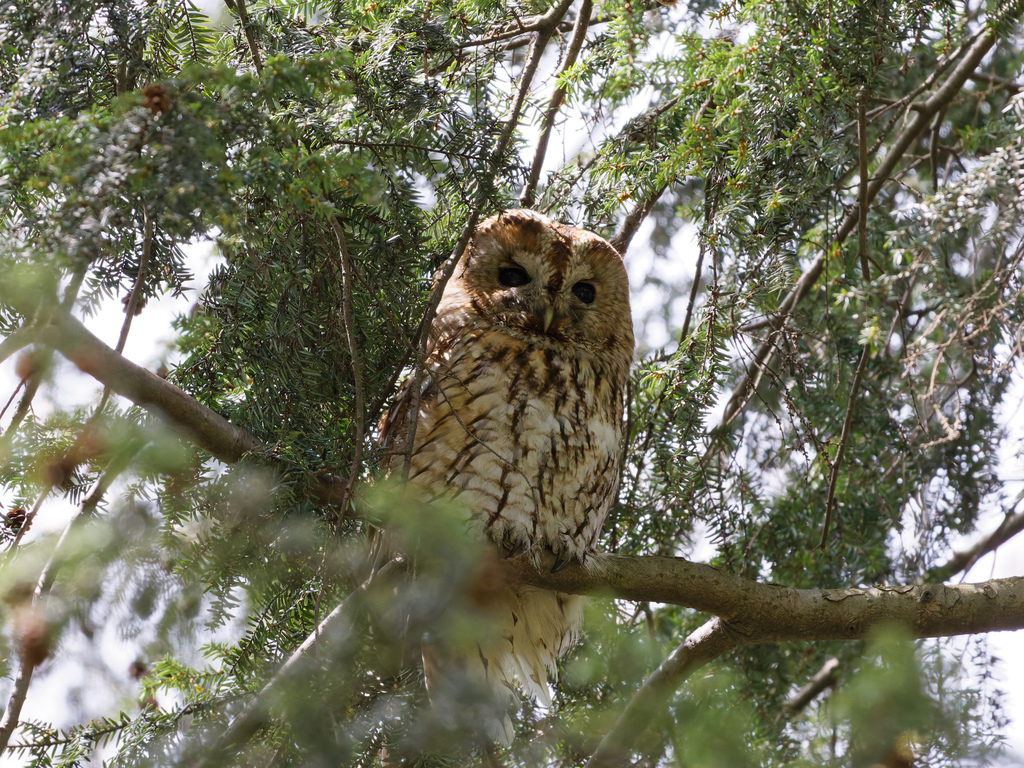
Tawny Owl
Strix aluco
Photo © Donald Davesne
Photo © Donald Davesne — CC BY 4.0 — Source: iNaturalist photo #651585325ABOUT
Subspecies of Tawny Owl
Maghreb OwlCommon Tawny OwlCentral European Tawny OwlStrix aluco willkonskiiStrix aluco sanctinicolaiStrix aluco siberiaeStrix aluco biddulphiStrix aluco harmsi
Identification
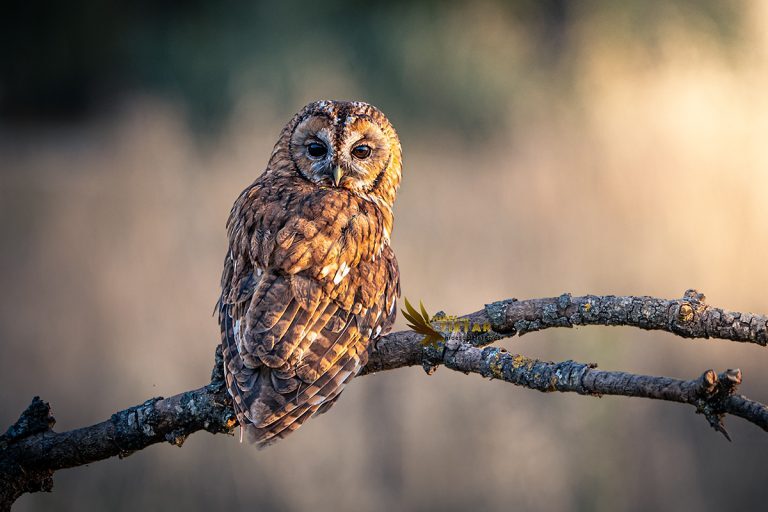
The tawny owl is a stocky, medium-sized owl measuring 37–46 cm in length with a wingspan of 81–105 cm. Its most distinctive feature is a large, rounded head that lacks ear tufts, surrounded by a relatively plain facial disc. The species exhibits two colour morphs: one with rufous-brown upperparts and another with greyish-brown plumage, though intermediates also occur. Both morphs share whitish underparts heavily streaked with brown. Females are noticeably larger than males, being around 5% longer and more than 25% heavier. Within its range, the tawny owl's squat shape and broad wings distinguish it from larger similar species such as the great grey owl, Eurasian eagle-owl, and Ural owl.
Range & Habitat
The tawny owl is commonly found in woodlands across Europe and western Siberia, with seven recognized subspecies across its range. It is non-migratory and highly territorial, remaining in established territories year-round. Young birds face significant challenges when dispersing from the parental nest; without access to a vacant territory of their own, they often starve. The species typically nests in tree holes, where it can protect its eggs and young from potential predators.
Behaviour & Diet
As a nocturnal bird of prey, the tawny owl is superbly adapted for hunting in darkness. It typically hunts by dropping suddenly from a perch and seizing prey, which it swallows whole. Rodents form the typical diet, though in urbanised areas the proportion of birds increases significantly. The species also occasionally catches smaller owls and faces predation from eagle owls and Eurasian goshawks.
The tawny owl's hunting success relies on remarkable sensory adaptations. Its directional hearing is more important than vision: asymmetrically placed ear openings enable precise pinpointing of sound sources, allowing the owl to hunt effectively using hearing alone on dark, overcast nights. The owl can hear ten times better than humans and can detect low-frequency sounds such as prey rustling in vegetation. However, heavy rain impairs this ability significantly, and prolonged wet weather can lead to starvation.
Best Time & Places to See It
Being strictly nocturnal, tawny owls are most active and vocal during darkness. Woodland habitats across Europe and western Siberia offer the best opportunities for encountering this species. Listen for its distinctive calls: the double hoot is a call-and-response exchange between males and females, with females producing a shrill "kew-wick" contact call and males delivering a quavering advertising song. The owl's association with darkness and its haunting vocalisations have long featured in human folklore and cultural references.
Photography Tips
Photographing tawny owls presents considerable challenges due to their nocturnal habits and preference for woodland cover. Night vision equipment and infrared technology are essential for capturing images. The species' silent flight—enabled by soft, furry feather surfaces and a specialised fringe on the outer primary feathers—makes it difficult to locate visually. Focus instead on locating roosting birds during daylight hours by listening for their distinctive calls at night and searching likely tree-hole nest sites. The rounded head and plain facial disc are key identification features to capture. Patience and familiarity with woodland habitats will significantly improve your chances of successful encounters.
HIDES
HOTSPOTS
Country
Type
Sort by
National Park
Abruzzo, Lazio and Molise National Park
Pescasseroli·Italy
+139 birds+18 mammals
National Park
Aggtelek National Park
Szin·Hungary
+119 birds+13 mammals
Natural Park
Alpilles Regional Nature Park
Saint-Rémy-de-Provence·France
+219 birds+37 mammals
National Park
Appennino Lucano Val d’Agri Lagonegrese National Park
Spinoso·Italy
+121 birds+3 mammals
National Park
Appennino Tosco-Emiliano National Park
Ventasso·Italy
+86 birds+8 mammals
National Park
Åsnens National Park
Kronoberg County·Sweden
+141 birds+8 mammals
National Park
Aspromonte National Park
Careri·Italy
+89 birds+5 mammals
Natural Park
Avesnois Regional Nature Park
Saint-Hilaire-sur-Helpe·France
+206 birds+40 mammals
Natural Park
Baronnies Provençales Regional Nature Park
Sahune·France
+135 birds+30 mammals
Nothing matches these filters.
COMMUNITY
Share your photo of this species
Sort by
No community photos yet. Log in to add the first one.
0
Observed by
0
Hotspots reported
0
Countries
No community observations of this species yet.