Identification
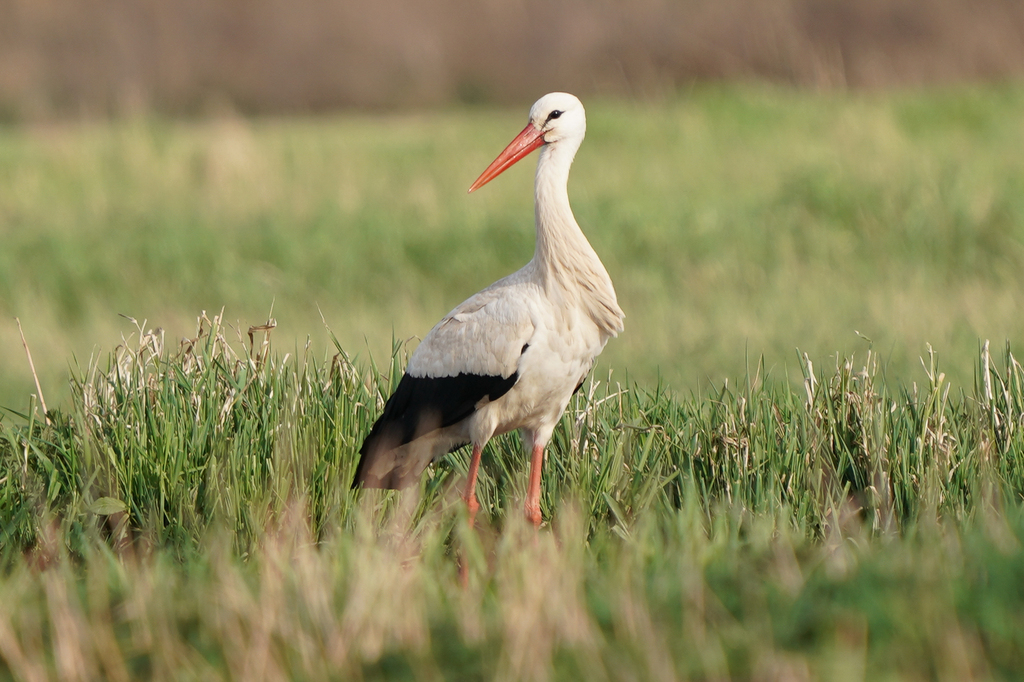
The white stork is an unmistakable large bird, measuring 100–115 cm from beak tip to tail, with an impressive wingspan of 155–215 cm. Its plumage is predominantly white, contrasting sharply with black flight feathers and wing coverts. Adults are immediately recognisable by their long red legs and bright red, pointed beaks—colours derived from carotenoids in their diet. The breast feathers form a long, shaggy ruff used in courtship displays. Males are slightly larger than females, though otherwise the sexes appear identical. With their long necks and legs extended in flight, white storks are elegant and easy to spot against the sky.
Range & habitat
White storks breed across Europe north to Finland, northwestern Africa, and the Palearctic east to southern Kazakhstan, with a separate population in southern Africa. Two subspecies exist, differing slightly in size. These are long-distance migrants that winter in Africa south of the Sahara, with some birds wintering on the Indian subcontinent. When travelling between Europe and Africa, they avoid crossing the Mediterranean Sea, instead detouring via the Levant in the east or the Strait of Gibraltar in the west, as they depend on air thermals for soaring and these do not form over water.
Behaviour & diet
White storks are carnivorous, hunting a wide variety of prey including insects, fish, amphibians, reptiles, small mammals, and small birds. They forage primarily on the ground, among low vegetation, and in shallow water. These birds are monogamous breeders, with both partners building a large stick nest that may be reused for several years. Females lay one clutch of typically four eggs annually, which hatch asynchronously 33–34 days later. Both parents incubate eggs and feed young, which fledge 58–64 days after hatching and receive parental care for another 7–20 days.
Best time & places to see it
White storks are highly conspicuous birds, making them relatively easy to observe during breeding season in their European and African ranges. Conservation and reintroduction programs have successfully restored populations across much of Europe, with breeding now resumed in the Netherlands, Belgium, Switzerland, Sweden, and the United Kingdom. Visiting traditional breeding grounds during spring and summer offers the best opportunities to see these birds, particularly near wetlands, grasslands, and areas with suitable nesting sites such as buildings or specially erected platforms.
Photography tips
The white stork's striking contrast of white plumage against black wings makes it highly photogenic. Photograph birds in flight to capture their elegant soaring posture with neck and legs extended, which showcases their impressive wingspan. Close-ups of adults reveal the brilliant red legs and beaks particularly well in strong daylight. Nesting colonies and feeding birds in shallow wetlands provide excellent opportunities for behaviour and family group shots. The bird's conspicuous nature means patient observation of known nest sites will reward photographers with varied action and interaction sequences throughout the breeding season.