Identification
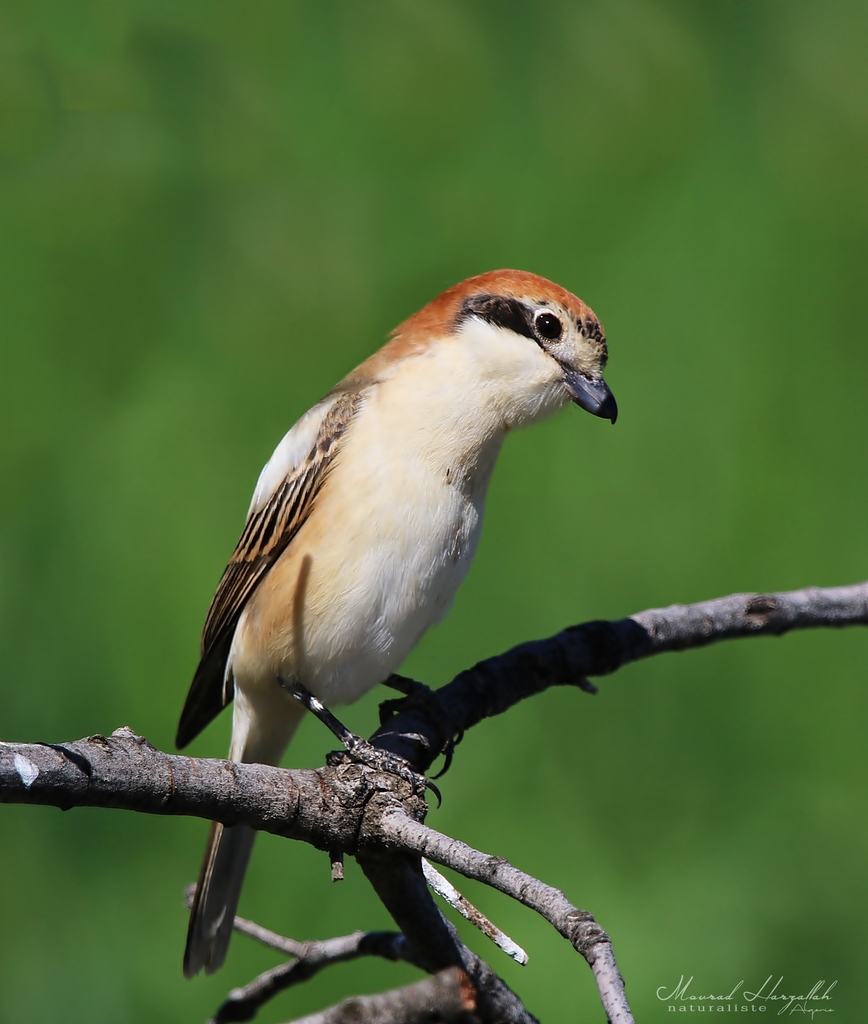
The woodchat shrike is a striking and compact bird, measuring 17–19 cm in length—slightly larger than a red-backed shrike. Males are particularly distinctive, displaying bold black and white upper parts contrasting with a chestnut crown and pure white underparts. Females and young birds are duller, with brown and white vermiculated upperparts and buff underparts, also finely marked. The bird's chestnut cap is its most recognizable feature, so distinctive that it inspired the species' Latin name: senator, after the red stripe on a Roman senator's toga.
Range & Habitat
This Mediterranean species breeds across southern Europe, the Middle East, and northern Africa, with its range extending from Portugal and Greece eastward through Turkey, Iraq, and Iran, and southward from Mauritania and Western Sahara to Libya. It is a long-distance migrant, wintering in tropical central Africa from Senegal and Sudan to Ethiopia and Gabon. Woodchat shrikes occasionally overshoot their breeding range during spring migration and appear as rare but regular visitors to Great Britain; the western Mediterranean subspecies badius has been recorded in Britain about four times as a vagrant.
The species favors open wooded areas with scattered trees—orchards, parkland, and similar semi-open habitats—particularly where bare or sandy ground is present. Nests are built in trees, typically fruit or olive trees, constructed by both sexes as sturdy cups lined with wool, hair, fine roots, cobwebs, and lichen, sometimes incorporating green plant material.
Behaviour & Diet
Woodchat shrikes are mainly insectivorous, with beetles forming the staple of their diet, though they also take other invertebrates and very occasionally small mammals and birds. They hunt from exposed perches 2–6 meters above ground, dropping or gliding down onto prey, and also make sallying flights to catch flying insects. Small insects are crushed in the bill, while larger prey is dismembered. Indigestible material is regurgitated as pellets.
Breeding occurs from early May through mid-July, with clutches of 5–6 glossy eggs laid daily in various shades of olive-green, sandy, greyish-yellow, or brown with darker speckles. The female incubates for 14–15 days, and young fledge after 15–20 days, remaining dependent on parents for a further 3–4 weeks.
Best Time & Places to See It
The breeding season, from May through July, is the best time to observe woodchat shrikes in their southern European range. They are most active in open orchards and scattered woodlands around the Mediterranean basin, particularly in countries such as Spain, southern France, Greece, and Turkey. Spring migrants occasionally reach northern Europe, including Britain, making late April and May promising periods for northern travelers. Winter observers interested in the species should travel to tropical central Africa.
Photography Tips
The woodchat shrike's striking plumage—the white, black, and chestnut combination in males—photographs beautifully in bright Mediterranean light. Photograph birds from a distance using a telephoto lens, as they typically hunt from exposed perches where they are visible but wary. Early morning and late afternoon light will best capture the rich chestnut crown. Look for birds perched prominently on branches or fences scanning for prey; this exposed hunting behavior makes them relatively approachable compared to other shrikes.