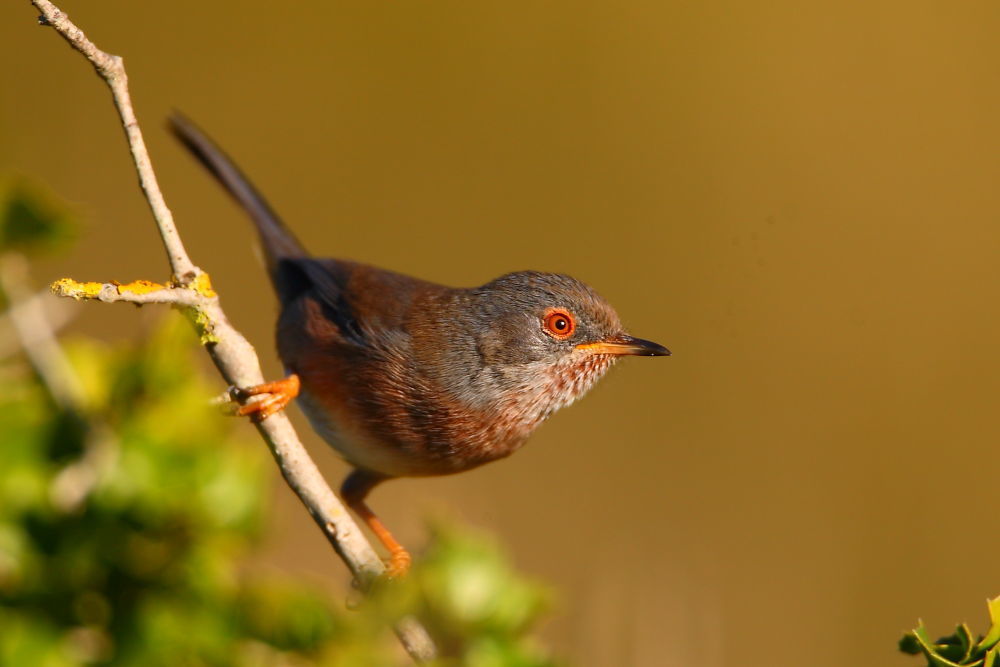
Curruca Rabilarga
Photo © Carles Pastor
Photo © Carles Pastor — CC BY-SA 4.0 — Source: iNaturalist photo #5703674Identification
The Dartford Warbler is a small passerine, measuring just 13 cm in length, and is most readily distinguished by its long tail relative to other warblers. Its plumage is deliberately inconspicuous, blending seamlessly with the dry, dead plants and weathered wood of its preferred habitats. The adult male displays a distinctive appearance: grey-brown upperparts, dull reddish-brown underparts with a dirty white patch on the belly centre, light throat speckles, and a striking red eye-ring. The adult female is noticeably paler, particularly below and on the throat, with browner-grey upperparts. In some populations, males show bluish-grey or brownish-grey backs and heads. Juvenile birds resemble females.
Range & Habitat
The Dartford Warbler inhabits the warmer parts of western Europe and northwestern Africa, with its breeding range extending west of a line from southern England to the heel of Italy. The largest European populations are found in the Iberian Peninsula, with smaller but significant populations across much of France, Italy, and southern England and south Wales. In Africa, it is restricted to small areas in the north, wintering in northern Morocco and northern Algeria. The species is naturally rare.
This warbler favours open fields with degraded scrub brush and is particularly common in heather. During breeding season in southern England, it inhabits heathlands, sometimes near the coast. It nests in dense bushes—typically common gorse or common heather—usually within 60 cm of the ground. In winter, birds may visit urban areas but always remain within shrubs.
Behaviour & Diet
Dartford Warblers are typically resident year-round within their breeding range, though limited migration occurs. They are usually monogamous with pair bonds that can persist across years. Males sometimes construct multiple simple nests before the female selects one, though both birds often participate in building the breeding nest. The compact, cup-shaped nest is formed mainly of grasses and lined with finer materials including thin roots and feathers.
These warblers are predominantly insectivorous, feeding on caterpillars, butterflies, beetles, and spiders. They produce a distinctive rattling warble as their song. Breeding typically involves two broods per year, occasionally three. Eggs are laid from early April in southern France and Spain, and mid-April in southern England. Clutches of 3–5 smooth, glossy eggs are incubated for 12–14 days, primarily by the female. Chicks fledge 10–14 days after hatching and receive parental care for approximately two further weeks.
Best Time & Places to See It
The Iberian Peninsula and southern France support the largest populations and offer the best opportunities for observing this species. Southern England and south Wales host smaller but established populations, particularly on heathlands. The breeding season, from April onwards, is ideal for viewing, though the species remains largely resident year-round in suitable habitat. The bird's preference for dense scrub and heather means patience and careful observation are required, but its distinctive rattling song can aid location during breeding season.
Photography Tips
The Dartford Warbler's muted plumage—comprising unobtrusive, earthy tones—is deliberately camouflaged against dry plants and weathered wood, presenting a significant challenge for photographers. Success depends on visiting quality heathland or scrub habitat during breeding season when birds are more active and vocal. The species' long tail and compact frame are diagnostic features worth capturing. Early morning light will best reveal the male's subtle red eye-ring and throat spotting. Patience is essential; the bird's tendency to remain within dense bushes requires careful positioning and a willingness to wait for it to emerge into more open perches.
Monfragüe National Park
Torrejón el Rubio, España
+118 aves+11 mamíferos
Where granite gorges slice through the heart of Extremadura, ancient Mediterranean scrubland meets a landscape sculpted by the Tagus River. […]
VER PARQUE NACIONALPicos de Europa National Park
Posada de Valdeón, España
+120 aves+17 mamíferos
Where limestone peaks pierce the Asturian sky at nearly 2,700 metres, three colossal massifs create a fortress of vertical rock […]
VER PARQUE NACIONALCañón del Río Lobos Nature Park
Santa María de las Hoyas, España
+126 aves+25 mamíferos
Where limestone cliffs rise abruptly from a serpentine river valley, the Río Lobos carves one of Spain’s most dramatic natural […]
VER PARQUE NATURALSierra Nevada National Park
Válor, España
+71 aves+3 mamíferos
Where granite peaks pierce the Mediterranean sky at nearly 3,500 metres, ancient snow lingers even as spring wildflowers carpet the […]
VER PARQUE NACIONALExmoor National Park
Somerset, Gran Bretaña
+103 aves+21 mamíferos
Windswept moorlands rise abruptly from the Bristol Channel, where heather and gorse blanket rolling uplands carved by Iron Age settlements […]
VER PARQUE NACIONALSouth Downs National Park
Chichester, Gran Bretaña
+122 aves+28 mamíferos
Rolling chalk downlands rise and fall across southern England in a landscape sculpted by millennia of grazing and cultivation. These […]
VER PARQUE NACIONALSierra de Tejeda, Almijara y Alhama Nature Park
Frigiliana, España
+127 aves+24 mamíferos
Where limestone peaks thrust skyward between the Costa del Sol and the Axarquia plain, dramatic gorges and cascading waterfalls carve […]
VER PARQUE NATURALParque-Reserva Natural de las Quinientas
Berlanga, España
+134 aves+23 mamíferos
Where limestone cliffs rise dramatically above emerald valleys, a tapestry of Mediterranean ecosystems unfolds across one of Spain’s most biodiverse […]
VER RESERVA NATURALMontaña Palentina Nature Park
Vidrieros, España
+86 aves+15 mamíferos
Where granite massifs rise above 2,200 metres and beech forests give way to alpine meadows, Spain’s northern interior reveals a […]
VER PARQUE NATURALCap de Creus Nature Park
Roses, España
+148 aves+14 mamíferos
Where granite cliffs plunge into crystalline Mediterranean waters, the easternmost reaches of the Iberian Peninsula reveal a landscape sculpted by […]
VER PARQUE NATURALCabañeros National Park
Retuerta del Bullaque, España
+57 aves+9 mamíferos
Cabañeros National Park is one of Spain’s finest wildlife destinations and one of the best-preserved examples of Mediterranean forest and […]
VER PARQUE NACIONALCévennes (Cœur) National Park
Vebron, Francia
+120 aves+32 mamíferos
Where granite ridges plunge into serpentine river valleys, a wilderness of schist and limestone unfolds across the Massif Central. Ancient […]
VER PARQUE NACIONALMercantour (Cœur) National Park
Isola, Francia
+120 aves+29 mamíferos
Where alpine meadows surrender to vertiginous limestone cliffs, the Mercantour’s beating heart pulses with Mediterranean and Alpine rhythms. This 4,221-square-kilometre […]
VER PARQUE NACIONALSierra de las Nieves National Park
Tolox, España
+79 aves+6 mamíferos
Where Mediterranean pine forests give way to dramatic limestone peaks, a landscape of austere beauty commands attention across Málaga’s hinterland. […]
VER PARQUE NACIONALSierra de Guadarrama National Park
Rascafría, España
+141 aves+19 mamíferos
Where granite peaks rise abruptly from the Castilian plateau, weathered by millennia into a landscape of raw alpine drama, lies […]
VER PARQUE NACIONALParc del Garraf
Rat-Penat, España
+128 aves+11 mamíferos
Where Mediterranean limestone plateaus plunge toward the Catalan coast, sculpted cliffs and hidden ravines create a landscape of stark beauty […]
VER PARQUE NATURALParc del Montnegre i el Corredor
Font-Montnegre, España
+110 aves+24 mamíferos
Where the Mediterranean scrublands rise into pine-clad ridges, a mosaic of ancient forests and rocky outcrops defines one of Catalonia’s […]
VER PARQUE NATURALMontseny Nature Park
Viladrau, España
+105 aves+22 mamíferos
The Montseny Natural Park is one of Catalonia’s most remarkable protected areas, offering an extraordinary blend of biodiversity, scenic landscapes, […]
VER PARQUE NATURALPeneda-Gerês National Park
A Baixa Limia, Portugal
+79 aves+18 mamíferos
Granite peaks pierce the mist-laden highlands of northern Portugal, where ancient schist valleys carve through some of Europe’s last true […]
VER PARQUE NACIONALSierra de Andújar Nature Park
Our Lady of Cabeza, España
+105 aves+20 mamíferos
Where granite gorges slice through Mediterranean scrubland and cork forests cascade down Andalusian hillsides, one of Spain’s most pristine wilderness […]
VER PARQUE NATURALUrdaibai Biosphere Reserve
Txatxarramendi, España
+113 aves+11 mamíferos
Where the Pyrenean foothills surrender to the Bay of Biscay, tidal estuaries carve through Basque limestone, creating one of Europe’s […]
VER RESERVA DE LA BIOSFERASierra de Gredos Regional Park
Candeleda, España
+130 aves+10 mamíferos
Where granite peaks claw at 2,592 metres and alpine meadows give way to cork oak scrubland, Spain’s central highlands reveal […]
VER RESERVA NATURALDirigida Laguna de Gallocanta Nature Reserve
Las Cuerlas, España
+136 aves+21 mamíferos
Where continental steppe meets the vast mirror of inland water, Spain’s largest natural lagoon reveals a landscape of haunting beauty. […]
VER RESERVA NATURALEspai d’interès natural de les Gavarres
Cruïlles, Monells i Sant Sadurní de l'Heura, España
+116 aves+14 mamíferos
Where Mediterranean scrubland meets temperate forest, rolling granite hills define one of Catalonia’s most biodiverse landscapes. Across nearly 600 square […]
VER RESERVA NATURALPorts Natural Park
Alfara de Carles, España
+55 aves+8 mamíferos
Where limestone ridges rise dramatically above Mediterranean scrubland, the Ports massif commands the border between Catalonia and Aragon in northeastern […]
VER PARQUE NATURALSerra de Mariola Nature Park
Bocairent, España
+95 aves+13 mamíferos
Where limestone ridges claw skyward across the inland Valencia region, a landscape of dramatic contrasts unfolds across 225 square kilometers. […]
VER RESERVA NATURALDell’Arcipelago di la Maddalena National Park
Italia
+63 aves+3 mamíferos
Turquoise shallows lap against islands of weathered granite where the Tyrrhenian Sea meets Sardinia’s rugged coast. This archipelago comprises seven […]
VER PARQUE NACIONALDell’Arcipelago Toscano National Park
Italia
+128 aves+22 mamíferos
Azure waters lap against wind-sculpted granite islands where Mediterranean macchia clings to rocky slopes and pine forests crown the hilltops. […]
VER PARQUE NACIONALCilento, Vallo di Diano e Alburni National Park
Campora, Italia
+76 aves+17 mamíferos
Limestone cliffs plunge toward the Tyrrhenian Sea while ancient beech forests crown the interior highlands, creating a mosaic of Mediterranean […]
VER PARQUE NACIONALSomiedo Natural Park
Pola de Somiedo, España
+120 aves+30 mamíferos
Where granite gorges cleave through the Cantabrian Mountains of northern Spain, alpine meadows roll toward beech and oak forests in […]
VER PARQUE NATURALSierra de Boumort
Segan, España
+125 aves+29 mamíferos
Where granite gorges slice through the Catalan Pyrenees, ancient limestone cliffs rise in dramatic ramparts above dense Mediterranean forests. This […]
VER MONTAñA Y ALTA MONTAñAAún no hay fotos de la comunidad. Inicia sesión para añadir la primera.
Aún no hay observaciones de la comunidad de esta especie.