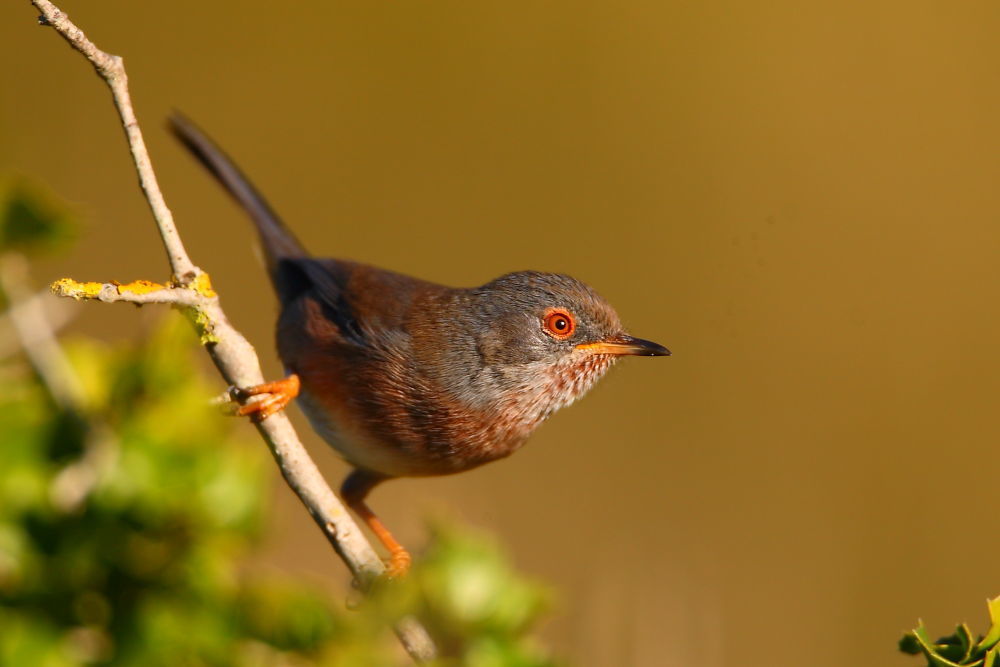
Dartford Warbler
Photo © Carles Pastor
Photo © Carles Pastor — CC BY-SA 4.0 — Source: iNaturalist photo #5703674Identification
The Dartford Warbler is a small passerine, measuring just 13 cm in length, and is most readily distinguished by its long tail relative to other warblers. Its plumage is deliberately inconspicuous, blending seamlessly with the dry, dead plants and weathered wood of its preferred habitats. The adult male displays a distinctive appearance: grey-brown upperparts, dull reddish-brown underparts with a dirty white patch on the belly centre, light throat speckles, and a striking red eye-ring. The adult female is noticeably paler, particularly below and on the throat, with browner-grey upperparts. In some populations, males show bluish-grey or brownish-grey backs and heads. Juvenile birds resemble females.
Range & Habitat
The Dartford Warbler inhabits the warmer parts of western Europe and northwestern Africa, with its breeding range extending west of a line from southern England to the heel of Italy. The largest European populations are found in the Iberian Peninsula, with smaller but significant populations across much of France, Italy, and southern England and south Wales. In Africa, it is restricted to small areas in the north, wintering in northern Morocco and northern Algeria. The species is naturally rare.
This warbler favours open fields with degraded scrub brush and is particularly common in heather. During breeding season in southern England, it inhabits heathlands, sometimes near the coast. It nests in dense bushes—typically common gorse or common heather—usually within 60 cm of the ground. In winter, birds may visit urban areas but always remain within shrubs.
Behaviour & Diet
Dartford Warblers are typically resident year-round within their breeding range, though limited migration occurs. They are usually monogamous with pair bonds that can persist across years. Males sometimes construct multiple simple nests before the female selects one, though both birds often participate in building the breeding nest. The compact, cup-shaped nest is formed mainly of grasses and lined with finer materials including thin roots and feathers.
These warblers are predominantly insectivorous, feeding on caterpillars, butterflies, beetles, and spiders. They produce a distinctive rattling warble as their song. Breeding typically involves two broods per year, occasionally three. Eggs are laid from early April in southern France and Spain, and mid-April in southern England. Clutches of 3–5 smooth, glossy eggs are incubated for 12–14 days, primarily by the female. Chicks fledge 10–14 days after hatching and receive parental care for approximately two further weeks.
Best Time & Places to See It
The Iberian Peninsula and southern France support the largest populations and offer the best opportunities for observing this species. Southern England and south Wales host smaller but established populations, particularly on heathlands. The breeding season, from April onwards, is ideal for viewing, though the species remains largely resident year-round in suitable habitat. The bird's preference for dense scrub and heather means patience and careful observation are required, but its distinctive rattling song can aid location during breeding season.
Photography Tips
The Dartford Warbler's muted plumage—comprising unobtrusive, earthy tones—is deliberately camouflaged against dry plants and weathered wood, presenting a significant challenge for photographers. Success depends on visiting quality heathland or scrub habitat during breeding season when birds are more active and vocal. The species' long tail and compact frame are diagnostic features worth capturing. Early morning light will best reveal the male's subtle red eye-ring and throat spotting. Patience is essential; the bird's tendency to remain within dense bushes requires careful positioning and a willingness to wait for it to emerge into more open perches.
Monfragüe National Park
Torrejón el Rubio, Spain
+219 birds+10 mammals
Where the Tagus River cuts through limestone plateaus in central Extremadura, Monfragüe National Park rises as a fortress of Mediterranean and Atlantic woodland, its dramatic rocky…
VIEW NATIONAL PARKPicos de Europa National Park
Posada de Valdeón, Spain
+166 birds+26 mammals
Where limestone massifs rise abruptly from the Castilian plateau, the Picos de Europa create one of Spain's most dramatic mountain wilderness areas. The park's jagged peaks,…
VIEW NATIONAL PARKSerra D’Irta Natural Park
Alcossebre, Spain
+122 birds+13 mammals
Where Mediterranean limestone cliffs meet the Balearic Sea, Serra d'Irta unfolds as a tapestry of dramatic coastal terrain and diverse terrestrial habitats. This Category 5 protected…
VIEW NATURAL PARKS’Albufera Natural Park
Platja de Muro, Spain
+253 birds+6 mammals
Where Mediterranean lagoons meet the Balearic coast, S'Albufera stretches across nearly 1,600 hectares of wetland and dune systems that rank among Europe's most ecologically vital shallow-water…
VIEW NATURAL PARKCañón del Río Lobos Natural Park
Santa María de las Hoyas, Spain
+136 birds+2 mammals
Where the Río Lobos carves its relentless path through the Iberian plateau, limestone cliffs rise in dramatic ramparts above a ribbon of water that has spent…
VIEW NATURAL PARKPuigventós Nature Reserve
Olesa de Montserrat, Spain
+66 birds+1 mammals
Where the Mediterranean scrubland rises into weathered limestone hills south of Barcelona, Puigventós Nature Reserve protects a landscape of remarkable ecological complexity. The terrain here alternates…
VIEW NATURE RESERVEL’Albufera Natural Park
València, Spain
+321 birds+18 mammals
Where shallow lagoons meet Mediterranean coastal marshland, L'Albufera Nature Park unfolds as one of Spain's most vital wetland complexes. This protected landscape, designated under IUCN Category…
VIEW NATURAL PARKSierra Mágina Natural Park
Bélmez de la Moraleda, Spain
+114 birds+2 mammals
Where limestone ridges rise abruptly from the Jaén countryside, Sierra Mágina unfolds as one of Andalusia's most underrated natural treasures. This protected landscape, anchored by the…
VIEW NATURAL PARKDoñana National Park
Hinojos, Spain
+300 birds+13 mammals
Where the Guadalquivir River delta spreads into the Atlantic, vast marshes, cork woodlands, and coastal dunes converge to create one of southwestern Europe's most biodiverse wetland…
VIEW NATIONAL PARKTablas de Daimiel National Park
Daimiel, Spain
+246 birds+6 mammals
Where the Guadiana River spreads into a labyrinth of shallow lagoons and reed beds across the sun-baked plains of central Spain, Tablas de Daimiel National Park…
VIEW NATIONAL PARKOrdesa y Monte Perdido National Park
Sobrarbe, Spain
+162 birds+13 mammals
Where limestone cliffs soar a thousand metres above cascading rivers, the Pyrenean massif reveals itself in its most dramatic form. Ordesa y Monte Perdido National Park…
VIEW NATIONAL PARKExmoor National Park
Somerset, United Kingdom
+159 birds+32 mammals
Where the Bristol Channel wind scours windswept moorland into rolling open heath, Exmoor rises from the Somerset coast as one of England's most rugged upland landscapes.…
VIEW NATIONAL PARKSouth Downs National Park
Chichester, United Kingdom
+298 birds+45 mammals
Chalk downland ridges rise and fall across the South Downs, their open grasslands and beech hangers creating a mosaic of habitats that has shaped human settlement…
VIEW NATIONAL PARKSierra de Tejeda, Almijara y Alhama Natural Park
Frigiliana, Spain
+128 birds+8 mammals
Where limestone ridges rise sharply from the Axarquía lowlands, the Sierra de Tejeda, Almijara y Alhama Nature Park unfolds across a dramatic landscape of white-rock massifs,…
VIEW NATURAL PARKCabo de Gata-Níjar Natural Park
San José, Spain
+274 birds+11 mammals
Where volcanic ridges plunge toward the Mediterranean, Cabo de Gata-Níjar Nature Park unfolds across one of Europe's most arid coastlines, a landscape sculpted by tectonic violence…
VIEW NATURAL PARKSerra de Montsant Natural Park
La Morera de Montsant, Spain
+134 birds+15 mammals
Rugged limestone ridges and deeply incised gorges define the Serra de Montsant, a 10,000-hectare protected landscape that rises abruptly from the wine-growing plains of Tarragona in…
VIEW NATURAL PARKLagunas de Archidona Nature Reserve
Archidona, Spain
+142 birds+4 mammals
Where shallow freshwater lagoons merge with reed beds and Mediterranean scrub, Lagunas de Archidona in Andalusia creates a wetland mosaic of profound ecological importance. These interconnected…
VIEW NATURE RESERVEMontaña Palentina Natural Park
Vidrieros, Spain
+180 birds+29 mammals
Where the Cantabrian mountains rise above the Palencia plateau, Montaña Palentina Nature Park sprawls across nearly 1,500 square kilometres of some of northern Spain's most dramatic…
VIEW NATURAL PARKRedes Natural Park
Arrobio, Spain
+163 birds+16 mammals
Where the Picos de Europa cast their shadow westward, the Redes Nature Park sprawls across nearly 600 square kilometres of Asturian limestone and schist, a wild…
VIEW NATURAL PARKDelta de l’Ebre Natural Park
Eucaliptus, Spain
+341 birds+18 mammals
Where the Ebro River spreads into a vast labyrinth of shallow lagoons, reed beds, and brackish marshes before surrendering to the Mediterranean, one of southern Europe's…
VIEW NATURAL PARKCap de Creus Natural Park
Roses, Spain
+245 birds+23 mammals
Where the Pyrenees tumble into the Mediterranean, Cap de Creus Nature Park unfolds across 300 square kilometres of one of northeastern Spain's most dramatic coastal wilderness…
VIEW NATURAL PARKCabañeros National Park
Retuerta del Bullaque, Spain
+183 birds+8 mammals
Cabañeros National Park is one of Spain’s finest wildlife destinations and one of the best-preserved examples of Mediterranean forest and scrubland in Europe. Located in the…
VIEW NATIONAL PARKCévennes National Park
Vebron, France
+187 birds+63 mammals
Where granite gorges slice through the limestone plateaux of southern France, the Cévennes Cœur National Park unfolds across nearly 3,500 square kilometres of one of Europe's…
VIEW NATIONAL PARKSierra de las Nieves National Park
Tolox, Spain
+159 birds+7 mammals
Where limestone summits pierce the Mediterranean sky above Andalusia's coastal ranges, Sierra de las Nieves National Park unfolds across nearly 500 square kilometres of dramatically folded…
VIEW NATIONAL PARKSierra de Guadarrama National Park
Rascafría, Spain
+179 birds+13 mammals
Where granite peaks rise abruptly from the central Spanish plateau, the Sierra de Guadarrama National Park unfolds across more than eleven hundred square kilometres of montane…
VIEW NATIONAL PARKTúria Natural Park
València, Spain
+150 birds+21 mammals
Where the Túria riverbed winds through the lowlands south of Valencia, a sprawling natural park of nearly 440 square kilometres unfolds across one of Spain's most…
VIEW NATURAL PARKSierra de Cazorla, Segura y las Villas Nature Park
Las Canalejas, Spain
+176 birds+21 mammals
Where granite gorges slice through mountainous terrain in eastern Andalusia, the Sierra de Cazorla, Segura y las Villas Nature Park sprawls across more than 5,200 square…
VIEW NATURAL PARKParc del Foix
Castellet i la Gornal, Spain
+180 birds+4 mammals
Where the Foix River carves through limestone ridges southwest of Barcelona, a natural park of modest area but outsized ecological richness unfolds across roughly 37 square…
VIEW NATURAL PARKParc del Garraf
Rat-Penat, Spain
+190 birds+15 mammals
Where limestone ridges rise abruptly from the Mediterranean coastal plain, Parc Natural del Garraf unfolds across 319 square kilometers of one of Catalonia's most dramatic protected…
VIEW NATURAL PARKCollserola Natural Park
Barcelona, Spain
+194 birds+20 mammals
Where Mediterranean scrubland rises steeply from Barcelona's urban edge, Collserola unfolds across 173 square kilometres of low mountains that form a crucial ecological buffer between city…
VIEW NATURAL PARKParc del Montnegre i el Corredor
Font-Montnegre, Spain
+148 birds+16 mammals
Where Mediterranean scrubland gives way to deciduous and coniferous woodland, the Parc Natural del Montnegre i el Corredor unfolds across nearly 478 square kilometres of northeastern…
VIEW NATURAL PARKCadí Moixeró Natural Park
Bor, Spain
+172 birds+21 mammals
Cadí-Moixeró Natural Park is one of the largest and most spectacular protected areas in Catalonia, located in the heart of the eastern Pyrenees. Covering more than…
VIEW NATURAL PARKMontseny Natural Park
Viladrau, Spain
+156 birds+30 mammals
The Montseny Natural Park is one of Catalonia’s most remarkable protected areas, offering an extraordinary blend of biodiversity, scenic landscapes, and cultural heritage within easy reach…
VIEW NATURAL PARKPeneda-Gerês National Park
A Baixa Limia, Portugal
+156 birds+15 mammals
Where granite gorges cut through ancient montane forests, the Peneda-Gerês National Park rises across the rugged borderlands between northern Portugal and Galicia, a landscape shaped by…
VIEW NATIONAL PARKSierra de Andújar Natural Park
Our Lady of Cabeza, Spain
+198 birds+19 mammals
Where granite gorges slice through Mediterranean scrubland and cork forests cascade down Andalusian hillsides, one of Spain's most pristine wilderness areas unfolds across 74,000 hectares of…
VIEW NATURAL PARKEspacio Natural Remolar-Filipinas
El Prat del Llobregat, Spain
+297 birds+7 mammals
Where the Llobregat River delta meets the Mediterranean, a patchwork of salt marshes, reed beds, and shallow lagoons creates one of Catalonia's most dynamic wetland ecosystems.…
VIEW NATURE RESERVEMontaña de Montserrat Natural Park
Marganell, Spain
+149 birds+10 mammals
Where granite monoliths erupt from the Mediterranean scrubland like cathedral spires, an otherworldly landscape unfolds across Catalonia's most dramatic mountain reserve. These iconic sandstone and conglomerate…
VIEW NATURAL PARKUrdaibai Biosphere Reserve
Txatxarramendi, Spain
+268 birds+8 mammals
Where the Pyrenean foothills surrender to the Bay of Biscay, tidal estuaries carve through Basque limestone, creating one of Europe's most ecologically vital wetland complexes. Salt…
VIEW BIOSPHERE RESERVESierra de Gredos Regional Park
Candeleda, Spain
+180 birds+18 mammals
Where granite peaks claw at 2,592 metres and alpine meadows give way to cork oak scrubland, Spain's central highlands reveal a landscape of remarkable vertical drama.…
VIEW NATURE RESERVECamargue Regional Nature Park
Saintes-Maries-de-la-Mer, France
+378 birds+48 mammals
Where the Rhône Delta sprawls into the Mediterranean, a landscape of stark and haunting beauty emerges—vast salt marshes punctuated by shallow lagoons, reed beds, and scrubland…
VIEW NATURAL PARKRegional Park of the Catalan Pyrenees
Olette, France
+244 birds+63 mammals
Where granite peaks thrust skyward above cloud-laden valleys, a wild tapestry of Mediterranean and alpine ecosystems interweaves across the Franco-Spanish frontier. These Pyrenean slopes harbour extraordinary…
VIEW NATURE RESERVEDirigida Laguna de Gallocanta Nature Reserve
Las Cuerlas, Spain
+250 birds+7 mammals
Where continental steppe meets the vast mirror of inland water, Spain's largest natural lagoon reveals a landscape of haunting beauty. The shallow alkaline lake, cradled in…
VIEW NATURE RESERVEMontes de Málaga Natural Park
Málaga, Spain
+159 birds+7 mammals
Where cork oak and pine forest sweep across the rugged hills inland from the Costa del Sol, the Montes de Málaga Nature Park unfolds as a…
VIEW NATURAL PARKEspai d’interès natural de les Gavarres
Cruïlles, Monells i Sant Sadurní de l'Heura, Spain
+143 birds+16 mammals
Where Mediterranean scrubland rises and falls across the gentle hills of inland Catalonia, the Espai d'interès natural de les Gavarres protects one of the region's most…
VIEW NATURE RESERVEPorts Natural Park
Alfara de Carles, Spain
+157 birds+13 mammals
Where the eastern Catalan ranges descend toward the Mediterranean, a sprawling mosaic of Mediterranean scrubland, pine woodland, and rocky limestone terrain defines Ports Natural Park, a…
VIEW NATURAL PARKSierra y Cañones de Guara Natural Park
Casbas de Huesca/Casbas de Uesca, Spain
+175 birds+10 mammals
Where limestone gorges slice through the pre-Pyrenean foothills of Aragon, the Sierra y Cañones de Guara sprawls across nearly 940 square kilometers of one of Spain's…
VIEW NATURE RESERVESerra de Mariola Natural Park
Bocairent, Spain
+164 birds+19 mammals
Where limestone ridges rise above the Valencian interior, Serra de Mariola unfolds across 225 square kilometers of Mediterranean mountain terrain that shifts between dense evergreen woodland,…
VIEW NATURE RESERVEEstrecho Natural Park
Pedro Valiente, Spain
+281 birds+20 mammals
Where Mediterranean pine forests meet wind-sculpted coastal cliffs, one of Europe's most dynamic ecological crossroads unfolds across the Strait of Gibraltar. Spanning 686 square kilometers of…
VIEW NATURAL PARKSierras Subbéticas Natural Park
Algar, Spain
+156 birds+10 mammals
Where limestone ridges rise abruptly from the Córdoba countryside, the Sierras Subbéticas Nature Park sprawls across nearly 583 square kilometres of one of Andalusia's most rugged…
VIEW NATURAL PARKSierra de Castril Natural Park
Castril, Spain
+110 birds+13 mammals
Where limestone walls rise abruptly from the Guadalentín valley, carving passages of breathtaking drama through Andalusia's interior, one encounters the raw geological theatre of this protected…
VIEW NATURE RESERVESierra de Huétor Natural Park
Huétor Santillán, Spain
+126 birds+3 mammals
Where limestone ridges pierce the Mediterranean sky above Granada, a 273-square-kilometre sanctuary of pine forest and alpine meadow rises to nearly 2,400 metres. This protected landscape,…
VIEW NATURAL PARKCirceo National Park
Italy
+232 birds+6 mammals
Where limestone headlands plunge toward the Tyrrhenian Sea, Circeo National Park preserves a rare mosaic of Mediterranean coastal habitats that few Italian reserves can match. The…
VIEW NATIONAL PARKLa Maddalena Archipelago National Park
La Maddalena, Italy
+86 birds+1 mammals
Crystalline waters lap against granite islands scattered across the Tyrrhenian Sea, where Dell'Arcipelago di la Maddalena unfolds as a Mediterranean archipelago of raw geological beauty and…
VIEW NATIONAL PARKTuscan Archipelago National Park
Rio, Italy
+174 birds+8 mammals
Where the Tyrrhenian Sea fragments into granite and schist islands, the Arcipelago Toscano National Park protects one of the Mediterranean's most biodiverse maritime realms. Scattered across…
VIEW NATIONAL PARKCilento, Vallo di Diano and Alburni National Park
Campora, Italy
+145 birds+12 mammals
Where the southern Apennines descend toward the Tyrrhenian coast, the landscape transforms into a mosaic of limestone plateaus, deep ravines, and Mediterranean scrubland that defines Cilento,…
VIEW NATIONAL PARKAspromonte National Park
Careri, Italy
+89 birds+5 mammals
Where the Aspromonte massif rises sharply from Calabria's Tyrrhenian coast, ancient beech and mixed temperate forests cloak the upper slopes, giving way at lower elevations to…
VIEW NATIONAL PARKAsinara National Park
Porto Torres, Italy
+103 birds+5 mammals
Rocky limestone cliffs plunge toward the Tyrrhenian Sea where Dell'Asinara National Park guards a slender island sanctuary off Sardinia's northwestern coast. The park's terrain is a…
VIEW NATIONAL PARKSomiedo Natural Park
Pola de Somiedo, Spain
+165 birds+25 mammals
Where granite gorges cleave through the Cantabrian Mountains of northern Spain, alpine meadows roll toward beech and oak forests in a landscape virtually untouched by industrial…
VIEW NATURAL PARKSierra de Boumort
Segan, Spain
+145 birds+13 mammals
Where granite gorges slice through the Catalan Pyrenees, ancient limestone cliffs rise in dramatic ramparts above dense Mediterranean forests. This wild corner of northeastern Spain harbors…
VIEW MOUNTAIN & ALPINEMontañas de Prades
Capafonts, Spain
+151 birds+13 mammals
Where granite peaks rise abruptly from the Tarragona hinterland, a wild mosaic of pine forests, scrubland, and limestone cliffs creates one of northeastern Spain's most biodiverse…
VIEW MOUNTAIN & ALPINEColl de Pal
La Molina, Spain
+142 birds+12 mammals
Where the eastern Pyrenees descend into Catalonia, alpine meadows and rocky slopes define the character of this mountain pass, a threshold between the high Iberian interior…
VIEW MOUNTAIN & ALPINECabo Peñas
Susacasa, Spain
+303 birds+21 mammals
Where sea cliffs rise sheer from the Bay of Biscay, Susacasa's observation point commands one of Asturias's most dramatic coastal vistas. The landscape here is defined…
VIEW OBSERVATION POINTPort-Cros National Park
Hyères, France
+271 birds+29 mammals
Where Mediterranean granite islands rise from crystalline waters off the Provençal coast, Port-Cros National Park protects one of Europe's most intact marine and terrestrial ecosystems. The…
VIEW NATIONAL PARKCalanques National Park
Bouches-du-Rhône, France
+233 birds+42 mammals
Where limestone cliffs plunge dramatically into crystalline Mediterranean waters, Calanques National Park preserves one of Europe's most striking coastal landscapes. These steep-sided inlets, carved by erosion…
VIEW NATIONAL PARKNewport Wetlands National Nature Reserve
Goldcliff, United Kingdom
+153 birds+7 mammals
Across the Severn Estuary's southern reaches, where the Gwent Levels meet tidal mud and reedbed in a mosaic of wet grassland and shallow pools, lies one…
VIEW NATURE RESERVEPurbeck Heaths National Nature Reserve
Norden, United Kingdom
+143 birds+8 mammals
Across the gently undulating plateau of Dorset's heathlands, Purbeck's ancient landscape unfolds as a mosaic of heather, gorse, and scattered pines—a habitat shaped by millennia of…
VIEW NATURE RESERVENo community photos yet. Log in to add the first one.
No community observations of this species yet.