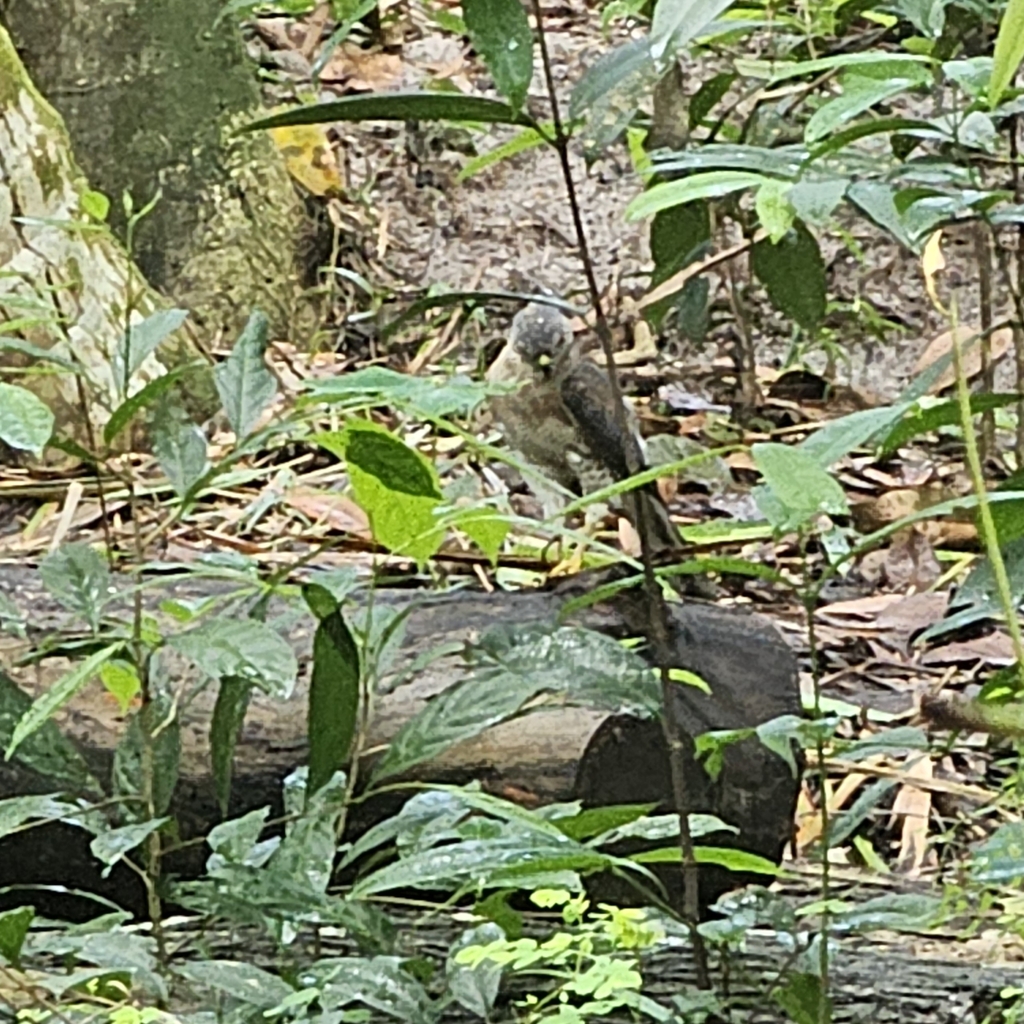
Gavilán chikra
Photo © Gannu03
Photo © Gannu03 — CC BY-SA 4.0 — Source: iNaturalist #231248127Identification
The shikra is a small raptor measuring 26–30 cm in length, characterized by short rounded wings and a narrow, somewhat long tail. Adults display whitish underparts with fine rufous barring, while upperparts are grey. Males have a distinctive red iris, whereas females possess a less vibrant yellowish-orange iris and brownish upperparts with heavier barring below. Females are slightly larger than males. The throat bears a dark but narrow mesial stripe. In flight, males reveal light wing linings with blackish wing tips when viewed from below; from above, tail bands are faintly marked on lateral feathers and lack the strong marking seen in the Eurasian sparrowhawk. The central tail feathers remain unbanded except for a dark terminal band. Juveniles display dark streaks and spots on the upper breast with narrowly barred wings and dark, narrow tail bands. The shikra's distinctive two-note call—"pee-wee," with the first note higher and the second longer—is characteristic, though calls in flight become shorter and sharper as "kik-ki...kik-ki."
Range & Habitat
The shikra is widely distributed across Asia and Africa, with six recognized subspecies occupying distinct regions. The African forms may represent separate species but are typically considered subspecies. In Asia, populations range from southwest India and Sri Lanka through central India and Bangladesh to south China, Indochina, and northern Sumatra, with populations also found in the Caucasus, central Asia, and northwest India. African subspecies are distributed from Senegal and Gambia through southwest Arabia to southern Africa. The species occupies diverse habitats including forests, farmland, and urban areas, demonstrating considerable adaptability. The Indian population inhabits plains and lower hills, reaching elevations up to 1,400 meters in the Himalayas.
Behaviour & Diet
Shikras are typically observed singly or in pairs, employing a characteristic flap-and-glide flight style. During breeding season, pairs soar on thermals and stoop at each other, their flight patterns frequently alarming smaller birds and squirrels. The species feeds on rodents, squirrels, small birds, small reptiles (primarily lizards, occasionally small snakes), and insects. Small birds often escape by diving through foliage, while babblers have been observed rallying together to drive away hunting shikras. Additional prey includes emerging winged termites, small bats hunted at dusk, and rarely, carrion. The shikra's calls are notably imitated by drongos, a behavior thought to aid food theft by alarming birds that associate the calls with predator presence.
Best Time & Places to See It
The shikra's wide distribution across multiple subspecies means that optimal viewing times and locations vary by region. In India, the breeding season from March to June offers good viewing opportunities as pairs engage in conspicuous soaring and stooping displays. The species' presence in both urban and rural environments makes it accessible to observers in various habitat types across its range. Northern populations of subspecies cenchroides are migratory, while African and Asian populations show varying degrees of migratory or nomadic behavior, influencing seasonal availability in specific locations.
Photography Tips
Photographers should focus on capturing the shikra's distinctive aerial displays, particularly during breeding season when pairs soar and interact conspicuously on thermals. The sexual dimorphism—males with bright red iris and lighter coloring versus females with yellowish-orange iris and darker upperparts—offers compositional opportunities. Underwing patterns are distinctive when the bird is photographed from below in flight, showing the characteristic light wing linings and blackish tips. The shikra's tail pattern, with faintly marked lateral feathers and unbanded central feathers, provides identifying features best captured with side or slightly above-angle positioning. Patient observation in varied habitats from urban to forest settings increases encounter opportunities with this adaptable raptor.
Nxai Pan National Park
Botsuana
+83 aves+19 mamíferos
Where acacia woodland gives way to sweeping grasslands and stark salt pans, a landscape of raw African beauty unfolds across […]
VER PARQUE NACIONALMinneriya National Park
Sri Lanka
+123 aves+30 mamíferos
Dawn breaks over a sprawling tapestry of dry deciduous woodland and freshwater marshland where ancient granite outcrops punctuate the landscape […]
VER PARQUE NACIONALWasgamuwa National Park
Sri Lanka
+122 aves+30 mamíferos
Dawn breaks over a landscape where ancient riverine forests meet sprawling grasslands, carved through by the Mahaweli River’s serpentine passage […]
VER PARQUE NACIONALAngamedilla National Park
Polonnaruwa, Sri Lanka
+122 aves+30 mamíferos
Where granite outcrops rise dramatically from dry deciduous forest, Sri Lanka’s central highlands reveal one of the island’s most rugged […]
VER PARQUE NACIONALMaduru Oya National Park
Sri Lanka
+123 aves+30 mamíferos
Granite monoliths rise abruptly from dense dry lowland forest in Sri Lanka’s eastern interior, creating a mosaic of rocky outcrops, […]
VER PARQUE NACIONALKidepo Valley National Park
Uganda
+133 aves+29 mamíferos
Where granite peaks rise above sweeping savanna and acacia woodlands meet riverine forests, one of Africa’s most remote wilderness sanctuaries […]
VER PARQUE NACIONALOrang National Park
Rangagarapathar, India
+147 aves+15 mamíferos
Dawn breaks across the floodplains of Assam, where the Brahmaputra River sprawls into a mosaic of grasslands, riverine forests, and […]
VER PARQUE NACIONALValmiki National Park
Ramnagar, India
+128 aves+30 mamíferos
Where the Himalayan foothills soften into the Ganges plains, dense sal forests rise above meandering rivers and grassland mosaics that […]
VER PARQUE NACIONALRanthambhore National Park
Sawai Madhopur, India
+126 aves+25 mamíferos
Where granite fortresses rise from the Aravalli Hills, a sprawling mosaic of dry deciduous forest, grassland, and ten interconnected lakes […]
VER PARQUE NACIONALEravikulam National Park
Devikulam, India
+127 aves+30 mamíferos
Where the Western Ghats rise into perpetual mist, rolling grasslands stretch across the high plateaus of Kerala’s southern reaches. This […]
VER PARQUE NACIONALPhou Xieng Thong National Protected Area
Khong Chiam District, Tailandia
+81 aves+3 mamíferos
Where limestone karsts pierce a tapestry of dry deciduous forest, Thailand’s Phou Xieng Thong National Protected Area unfolds across rugged […]
VER PARQUE NACIONALMu Ko Ang Thong National Park
Tailandia
+105 aves+18 mamíferos
Limestone karsts pierce an emerald sea, their weathered peaks rising abruptly from turquoise waters where mangrove forests cling to tidal […]
VER PARQUE NACIONALHat Noppharat Thara-Mu Ko Phi Phi National Park
Ao Nang, Tailandia
+127 aves+21 mamíferos
Limestone cliffs plunge into emerald waters where mangrove forests crown the shoreline and coral gardens flourish beneath transparent shallows. This […]
VER PARQUE NACIONALKhao Yai National Park
Prachantakham District, Tailandia
+132 aves+30 mamíferos
Dawn breaks over a mosaic of evergreen forest, bamboo thickets, and grassland valleys where the Thai landscape rises and falls […]
VER PARQUE NACIONALKhao Laem Ya-Mu Ko Samet National Park
Mueang Rayong District, Tailandia
+132 aves+30 mamíferos
Where limestone cliffs plunge into crystalline waters and coastal forests merge with rocky outcrops, a mosaic of Thailand’s most pristine […]
VER PARQUE NACIONALKhao Laem National Park
Sangkhla Buri District, Tailandia
+137 aves+25 mamíferos
Where limestone peaks rise dramatically above a shimmering reservoir, Thailand’s most compelling freshwater ecosystem unfolds across the Thai-Cambodian borderlands. Khao […]
VER PARQUE NACIONALZiwa Rhino and Wildlife Ranch
Nakasongola, Uganda
+131 aves+17 mamíferos
Where papyrus wetlands merge into sprawling savanna, Uganda’s central landscape opens into one of East Africa’s most vital rhino recovery […]
VER SANTUARIO DE VIDA SILVESTREKanha Tiger Reserve
Kanha Kisli F.V., India
+126 aves+29 mamíferos
Where sal forests give way to emerald meadows and crystalline streams carve through ancient valleys, one of India’s finest wilderness […]
VER PARQUE NACIONALTadoba National Park
Palasgaon Singru, India
+133 aves+25 mamíferos
Where sal forests meet open grasslands and rocky outcrops rise from red laterite soil, central India’s landscape unfolds in raw, […]
VER PARQUE NACIONALBandhavgarh National Park
Garhpuri, India
+127 aves+26 mamíferos
Where granite ridges rise dramatically above sal and bamboo forests, one of India’s most pristine tiger reserves unfolds across the […]
VER PARQUE NACIONALPanna National Park
Badgadi Kalan, India
+136 aves+27 mamíferos
Where granite gorges slice through central India’s Vindhyan plateau, a landscape of stark beauty unfolds across nearly six hundred square […]
VER PARQUE NACIONALKeoladeo National Park
Shreenagar Rural, India
+135 aves+19 mamíferos
Where shallow wetlands shimmer beneath vast Rajasthani skies, one of Asia’s finest bird sanctuaries pulses with extraordinary life. This former […]
VER PARQUE NACIONALPeriyar National Park
Mlappara, India
+131 aves+30 mamíferos
Dawn breaks over mist-shrouded ridges where the Western Ghats tumble toward Kerala’s spice-scented lowlands. Here, ancient tropical forests envelope a […]
VER PARQUE NACIONALPampadum Shola National Park
Vattavada, India
+125 aves+30 mamíferos
Where misty shola forests cling to the high plateaus of the Nilgiri Mountains, ancient evergreen remnants create a world apart. […]
VER PARQUE NACIONALBandipur National Park
Hirehalli, India
+135 aves+30 mamíferos
Where the Western Ghats descend into the Deccan plateau, ancient deciduous forests blanket a landscape carved by the Nugu River. […]
VER PARQUE NACIONALNagarahole Tiger Reserve
Nalkeri Forest, India
+120 aves+30 mamíferos
Where granite escarpments rise above dense deciduous forests and the Kabini River carves through pristine wilderness, one of India’s most […]
VER PARQUE NACIONALWaterberg Plateau National Park
Okambukonde, Namibia
+124 aves+31 mamíferos
Where ancient sandstone cliffs rise 200 metres above the surrounding bushveld, a fortress of geology creates one of southern Africa’s […]
VER PARQUE NACIONALAún no hay fotos de la comunidad. Inicia sesión para añadir la primera.
Aún no hay observaciones de la comunidad de esta especie.