Lechuza común
Photo © Claude Kolwelter
Photo © Claude Kolwelter — CC BY 4.0 — Source: iNaturalist photo #585748553Identification
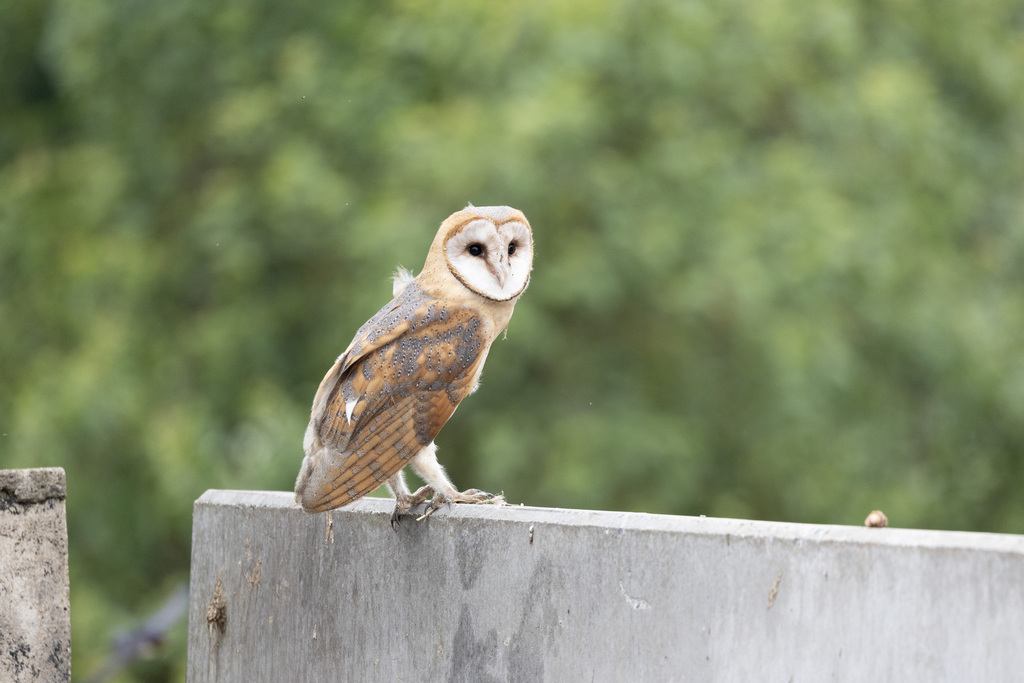
The western barn owl is a medium-sized, pale-coloured owl with striking features that make it unmistakable in the field. Measuring 33 to 35 cm in length with a wingspan of 80 to 95 cm, it is characterized by its distinctly large, heart-shaped facial disc, which is usually bright white in most subspecies. The head and back display mottled grey or brown plumage, while the underparts vary from white to reddish-buff, sometimes speckled with dark markings. In flight, look for the short, squarish tail, long wings, undulating flight pattern, and dangling feathered legs—features that distinguish it from typical owls. The pale face resembles a flat mask with large, oblique black eye-slits, giving the bird an otherworldly appearance often described as ghost-like.
Range & Habitat
The western barn owl is native to Europe, southwestern Asia, and Africa. This species was long thought to be a worldwide species, but recent genetic studies have revealed that what was previously classified as a single species actually comprises four distinct species, with the western barn owl now recognized as the European, southwestern Asian, and African population. The species utilizes a variety of nesting sites, including hollow trees, old buildings, and cliff fissures, making it adaptable to both rural and semi-urban environments.
Behaviour & Diet
The western barn owl is primarily nocturnal throughout most of its range, though in Great Britain it has adapted to hunting during daylight hours as well. These specialized hunters locate prey almost entirely by sound, possessing extraordinarily acute hearing that allows them to pinpoint small mammals in darkness or beneath vegetation. Nearly all of their diet consists of small ground-dwelling mammals. Barn owls typically mate for life, and breeding occurs at varying times depending on locality. Females lay an average clutch of about four eggs and undertake all incubation duties while males provide food. When small prey is abundant, barn owl populations can expand rapidly.
Best Time & Places to See It
Since the western barn owl is nocturnal over most of its range, evening and night hours offer the best viewing opportunities, particularly during the breeding season when hunting activity intensifies. In Great Britain, daytime observations are possible. Look for them hunting over open grasslands, agricultural areas, and rough ground where small mammal populations are healthy. The species' presence is often betrayed by its eerie, drawn-out screech rather than the hooting calls of other owls, making audio detection useful for locating birds.
Photography Tips
Photographing the western barn owl presents unique challenges due to its nocturnal habits. Night-vision equipment or thermal imaging may be necessary for most of the species' range. Focus on capturing the bird's distinctive heart-shaped face and pale plumage, which stand out dramatically against dark backgrounds. In Great Britain, daytime hunting opportunities offer better lighting conditions. The bird's characteristic undulating flight and dangling legs are diagnostic features worth documenting. The pale facial disc and black eyes create a striking portrait; position yourself to capture these defining characteristics that make this species instantly recognizable.
Cañón del Río Lobos Nature Park
Santa María de las Hoyas, España
+126 aves+25 mamíferos
Where limestone cliffs rise abruptly from a serpentine river valley, the Río Lobos carves one of Spain’s most dramatic natural […]
VER PARQUE NATURALNxai Pan National Park
Botsuana
+83 aves+19 mamíferos
Where acacia woodland gives way to sweeping grasslands and stark salt pans, a landscape of raw African beauty unfolds across […]
VER PARQUE NACIONALKhaudum National Park
Botsuana
+57 aves+18 mamíferos
Where the Kalahari’s red dunes roll into dense mopane woodland and riverine thickets, a raw and unforgiving landscape rewards those […]
VER PARQUE NACIONALHarz National Park
Harz (LK Goslar), Alemania
+122 aves+30 mamíferos
Where dense beech and spruce forests rise across rolling highlands, ancient granite peaks emerge from blankets of mist, creating one […]
VER PARQUE NACIONALTimanfaya National Park
Tinajo, España
+132 aves+5 mamíferos
Where volcanic stone dominates the horizon in shades of rust and charcoal, Lanzarote’s most dramatic wilderness unfolds across 13,600 hectares […]
VER PARQUE NACIONALDoñana National Park
Hinojos, España
+146 aves+12 mamíferos
Where the Guadalquivir River spills into the Atlantic, Spain’s southwestern corner erupts into one of Europe’s most biodiverse wetlands. Vast […]
VER PARQUE NACIONALExmoor National Park
Somerset, Gran Bretaña
+103 aves+21 mamíferos
Windswept moorlands rise abruptly from the Bristol Channel, where heather and gorse blanket rolling uplands carved by Iron Age settlements […]
VER PARQUE NACIONALPembrokeshire Coast National Park
Pembrokeshire, Gran Bretaña
+123 aves+28 mamíferos
Where jagged sea cliffs rise dramatically from churning Atlantic waters, one of Britain’s finest coastal wildernesses unfolds across southwest Wales. […]
VER PARQUE NACIONALLake District National Park
Westmorland and Furness, Gran Bretaña
+124 aves+25 mamíferos
Glacial valleys plunge between fell-sided mountains where slate-grey waters mirror some of England’s most dramatic upland terrain. This landscape of […]
VER PARQUE NACIONALYorkshire Dales National Park
North Yorkshire, Gran Bretaña
+104 aves+22 mamíferos
Where limestone escarpments rise above verdant valleys, a patchwork of moorland, grassland, and woodland creates one of England’s most ecologically […]
VER PARQUE NACIONALNorth York Moors National Park
North Yorkshire, Gran Bretaña
+128 aves+21 mamíferos
Heather moorlands roll across 554 square miles of the Yorkshire uplands, where rolling hills give way to deep valleys carved […]
VER PARQUE NACIONALNorthumberland National Park
Northumberland, Gran Bretaña
+71 aves+12 mamíferos
Where the Cheviot Hills rise like ancient sentinels above the Scottish borderlands, a landscape of moorland, forestry, and river valleys […]
VER PARQUE NACIONALSouth Downs National Park
Chichester, Gran Bretaña
+122 aves+28 mamíferos
Rolling chalk downlands rise and fall across southern England in a landscape sculpted by millennia of grazing and cultivation. These […]
VER PARQUE NACIONALCap de Creus Nature Park
Roses, España
+148 aves+14 mamíferos
Where granite cliffs plunge into crystalline Mediterranean waters, the easternmost reaches of the Iberian Peninsula reveal a landscape sculpted by […]
VER PARQUE NATURALParc del Montnegre i el Corredor
Font-Montnegre, España
+110 aves+24 mamíferos
Where the Mediterranean scrublands rise into pine-clad ridges, a mosaic of ancient forests and rocky outcrops defines one of Catalonia’s […]
VER PARQUE NATURALHortobágy National Park
Hortobágy, Hungría
+132 aves+19 mamíferos
Where the Great Hungarian Plain stretches endlessly toward the horizon, vast wetlands and grasslands create one of Europe’s most dynamic […]
VER PARQUE NACIONALTankwa-Karoo National Park
Hantam Local Municipality, Sudáfrica
+101 aves
Where ancient mountains crumble into rust-red plains, the Tankwa Karoo unfolds as one of South Africa’s most austere and compelling […]
VER PARQUE NACIONALMontseny Nature Park
Viladrau, España
+105 aves+22 mamíferos
The Montseny Natural Park is one of Catalonia’s most remarkable protected areas, offering an extraordinary blend of biodiversity, scenic landscapes, […]
VER PARQUE NATURALCairngorms National Park
Muir, Gran Bretaña
+124 aves+27 mamíferos
Where ancient granite massifs rise above the Scottish Highlands, a subarctic wilderness unfolds across 1,748 square kilometres of raw, elemental […]
VER PARQUE NACIONALDell’Arcipelago Toscano National Park
Italia
+128 aves+22 mamíferos
Azure waters lap against wind-sculpted granite islands where Mediterranean macchia clings to rocky slopes and pine forests crown the hilltops. […]
VER PARQUE NACIONALCasentinesi Forests, Monte Falterona, Campigna National Park
Santa Sofia, Italia
+120 aves+30 mamíferos
Where granite ridges rise above 1,600 meters through the heart of Tuscany and Romagna, beech forests transition into alpine meadows […]
VER PARQUE NACIONALKhaudum National Park
Namibia
+46 aves+16 mamíferos
Where mopane woodland gives way to sudden waterhole clearings and ancient elephant paths cross calcrete plains, one of southern Africa’s […]
VER PARQUE NACIONALNamib-Naukluft National Park
Namibia
+119 aves+30 mamíferos
Where rust-coloured dunes rise like frozen waves against an impossibly blue sky, Africa’s oldest desert unfolds across nearly 95,000 square […]
VER PARQUE NACIONALSomiedo Natural Park
Pola de Somiedo, España
+120 aves+30 mamíferos
Where granite gorges cleave through the Cantabrian Mountains of northern Spain, alpine meadows roll toward beech and oak forests in […]
VER PARQUE NATURALSarakinikou National Park
Chania Regional Unit, Grecia
+134 aves+4 mamíferos
Where limestone cliffs plunge toward turquoise waters and endemic Mediterranean scrub clings to rocky slopes, Greece’s most dramatic coastal wilderness […]
VER PARQUE NACIONALSamaria National Park
Chania Regional Unit, Grecia
+138 aves+12 mamíferos
Where granite gorges plunge nearly a kilometer into the Cretan landscape, a dramatic wilderness unfolds across 4,850 hectares of Crete’s […]
VER PARQUE NACIONALAún no hay fotos de la comunidad. Inicia sesión para añadir la primera.
Aún no hay observaciones de la comunidad de esta especie.