Identification
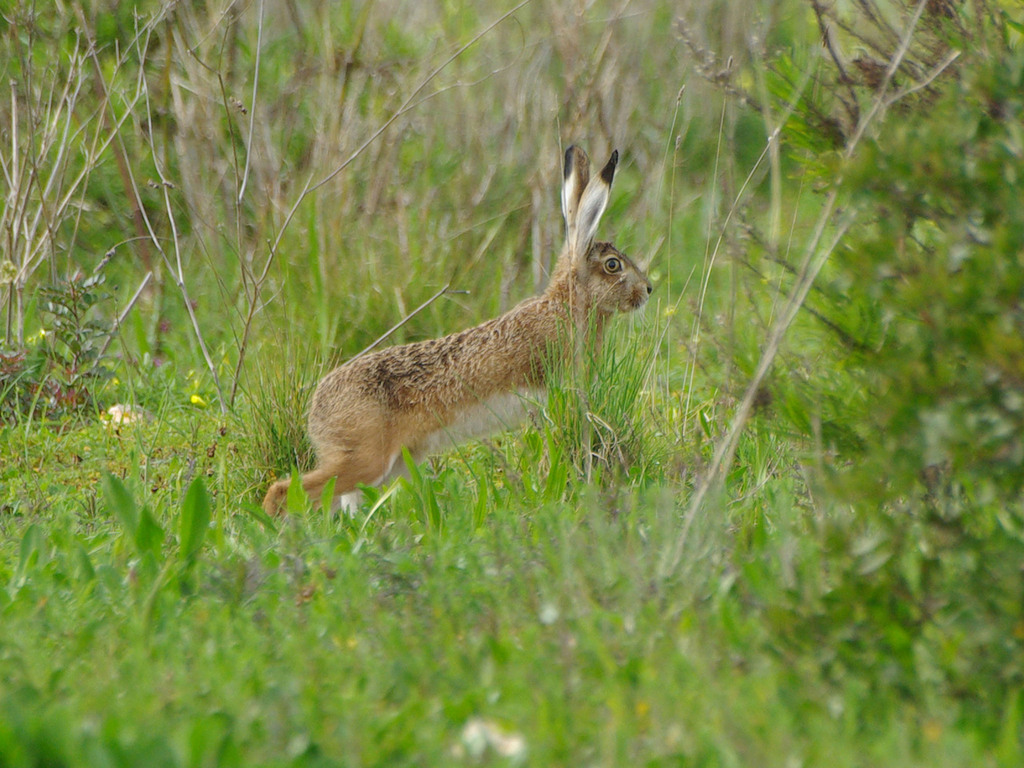
The Iberian hare is a compact hare, noticeably smaller than its European relatives. Adults typically weigh 2–2.6 kilograms and measure 44.5 to 47.3 centimetres in head and body length. The most distinctive field mark is the striking contrast between its gray-brown back and crisp white underside and inner legs, with reddish colouration on the outer legs. The white fur even extends to the tips of the toes. The ears are moderately sized at 9.25 to 10.27 centimetres. Females are slightly heavier than males on average, though this sexual dimorphism is subtle in the field.
Range & Habitat
Endemic to the Iberian Peninsula and the Balearic Islands, this species is found across Spain and Portugal. Three subspecies are recognised: the widespread nominate subspecies L. g. granatensis inhabits much of central and southern Iberia including Andalusia, Extremadura, the Meseta Central, and Valencia, extending into Aragon, Catalonia, and throughout Portugal. The darker northwestern subspecies L. g. gallaecius occurs in Galicia. The third subspecies, L. g. solisi, is found in Mallorca and Ibiza but is considered either critically endangered or extinct by conservation authorities.
Behaviour & Diet
The Iberian hare produces an average of 2 young per litter, though litters can reach as many as 7 leverets. Like other hares, it is primarily nocturnal and crepuscular, relying on speed and vigilance to avoid predators. The species is susceptible to various parasites and diseases, including tapeworms, coccidiosis, and rabbit hemorrhagic disease virus, which can significantly impair its escape ability and fitness. Remarkably, this hare has never been documented with European brown hare syndrome, a disease that affects many of its continental relatives.
Best Time & Places to See It
The Iberian hare is most active during dawn and dusk, and at night. Observers should focus on suitable habitat in central and southern Spain and Portugal, where the nominate subspecies is most abundant. Open scrubland, grassland, and semi-arid terrain are typical habitats. Early morning and evening walks in appropriate regions, particularly in Andalusia, Extremadura, and the Meseta Central, offer the best chances of encounters.
Photography Tips
Photographing Iberian hares requires patience and early starts. The white underparts and distinctive leg colouration are key identifying features to capture. Use a telephoto lens to maintain distance and avoid disturbing this hunted species. Low-angle shots at dawn or dusk will exploit natural lighting to emphasise the colour contrasts on the fur. Remember that this is a small, swift hare—anticipatory positioning and fast shutter speeds are essential for sharp images.
Monfragüe National Park
Torrejón el Rubio, España
+118 aves+11 mamíferos
Where granite gorges slice through the heart of Extremadura, ancient Mediterranean scrubland meets a landscape sculpted by the Tagus River. […]
VER PARQUE NACIONALSerra D’Irta Nature Park
Alcossebre, España
+129 aves+22 mamíferos
Where limestone cliffs plunge into the crystalline Mediterranean, a ribbon of protected coastline unfolds along Spain’s eastern seaboard. The Serra […]
VER PARQUE NATURALS’Albufera Nature Park
Platja de Muro, España
+133 aves+15 mamíferos
Dawn breaks across a mosaic of shallow lagoons and reed beds where the Mediterranean meets one of Europe’s most vital […]
VER PARQUE NATURALCañón del Río Lobos Nature Park
Santa María de las Hoyas, España
+126 aves+25 mamíferos
Where limestone cliffs rise abruptly from a serpentine river valley, the Río Lobos carves one of Spain’s most dramatic natural […]
VER PARQUE NATURALPuigventós Nature Reserve
Olesa de Montserrat, España
+123 aves+28 mamíferos
Where the limestone ridges of Catalonia fold into Mediterranean scrubland, a patchwork of cork oak forests and rocky outcrops creates […]
VER RESERVA NATURALCap de Ferrutx Nature Reserve
Artà, España
+137 aves+12 mamíferos
Where limestone cliffs plunge into crystalline Mediterranean waters, a mosaic of Mediterranean scrubland, pine forest, and rocky terrain defines one […]
VER RESERVA NATURALL’Albufera Nature Park
València, España
+130 aves+22 mamíferos
Dawn breaks over a vast lagoon where freshwater meets saltmarsh, creating one of Spain’s most biodiverse wetland mosaics. This protected […]
VER PARQUE NATURALDoñana National Park
Hinojos, España
+146 aves+12 mamíferos
Where the Guadalquivir River spills into the Atlantic, Spain’s southwestern corner erupts into one of Europe’s most biodiverse wetlands. Vast […]
VER PARQUE NACIONALTablas de Daimiel National Park
Daimiel, España
+137 aves+14 mamíferos
Where two rivers converge across a vast, flat plain in central Spain, shallow wetlands stretch toward an endless horizon—a landscape […]
VER PARQUE NACIONALSierra de Tejeda, Almijara y Alhama Nature Park
Frigiliana, España
+127 aves+24 mamíferos
Where limestone peaks thrust skyward between the Costa del Sol and the Axarquia plain, dramatic gorges and cascading waterfalls carve […]
VER PARQUE NATURALCabo de Gata-Níjar Nature Park
San José, España
+131 aves+21 mamíferos
Where arid mountains plunge toward an impossibly blue Mediterranean, Spain’s southeastern corner harbors one of Europe’s most dramatically understated wilderness […]
VER PARQUE NATURALParque-Reserva Natural de las Quinientas
Berlanga, España
+134 aves+23 mamíferos
Where limestone cliffs rise dramatically above emerald valleys, a tapestry of Mediterranean ecosystems unfolds across one of Spain’s most biodiverse […]
VER RESERVA NATURALPenínsula de Llevant Nature Park
Betlem, España
+138 aves+12 mamíferos
Where Mediterranean limestone cliffs plunge toward turquoise shallows, the eastern peninsula of Mallorca reveals one of Spain’s most ecologically pristine […]
VER PARQUE NATURALLagunas de Archidona Nature Reserve
Archidona, España
+133 aves+25 mamíferos
Where shallow lagoons mirror the vast Spanish sky, a patchwork of reed beds and freshwater marshes creates one of Iberia’s […]
VER RESERVA NATURALSierra de Guadarrama National Park
Rascafría, España
+141 aves+19 mamíferos
Where granite peaks rise abruptly from the Castilian plateau, weathered by millennia into a landscape of raw alpine drama, lies […]
VER PARQUE NACIONALTúria Nature Park
València, España
+103 aves+11 mamíferos
Where limestone cliffs rise dramatically above the sinuous Túria River, one of Spain’s most compelling natural laboratories unfolds across nearly […]
VER PARQUE NATURALSierra de Andújar Nature Park
Our Lady of Cabeza, España
+105 aves+20 mamíferos
Where granite gorges slice through Mediterranean scrubland and cork forests cascade down Andalusian hillsides, one of Spain’s most pristine wilderness […]
VER PARQUE NATURALMontaña de Montserrat Nature Park
Marganell, España
+126 aves+30 mamíferos
Where granite monoliths erupt from the Mediterranean scrubland like cathedral spires, an otherworldly landscape unfolds across Catalonia’s most dramatic mountain […]
VER PARQUE NATURALCamargue Regional Nature Park
Saintes-Maries-de-la-Mer, Francia
+122 aves+30 mamíferos
Where the Rhône Delta sprawls into the Mediterranean, a landscape of stark and haunting beauty emerges—vast salt marshes punctuated by […]
VER PARQUE NATURALMontes de Málaga Nature Park
Málaga, España
+146 aves+12 mamíferos
Where pine forests descend into Mediterranean scrubland and limestone ridges puncture the Andalusian sky, a landscape of remarkable ecological complexity […]
VER PARQUE NATURALEstrecho Nature Park
Pedro Valiente, España
+135 aves+23 mamíferos
Where Mediterranean pine forests meet wind-sculpted coastal cliffs, one of Europe’s most dynamic ecological crossroads unfolds across the Strait of […]
VER PARQUE NATURALSomiedo Natural Park
Pola de Somiedo, España
+120 aves+30 mamíferos
Where granite gorges cleave through the Cantabrian Mountains of northern Spain, alpine meadows roll toward beech and oak forests in […]
VER PARQUE NATURALSierra de Boumort
Segan, España
+125 aves+29 mamíferos
Where granite gorges slice through the Catalan Pyrenees, ancient limestone cliffs rise in dramatic ramparts above dense Mediterranean forests. This […]
VER MONTAñA Y ALTA MONTAñAAún no hay fotos de la comunidad. Inicia sesión para añadir la primera.
Aún no hay observaciones de la comunidad de esta especie.