Identification
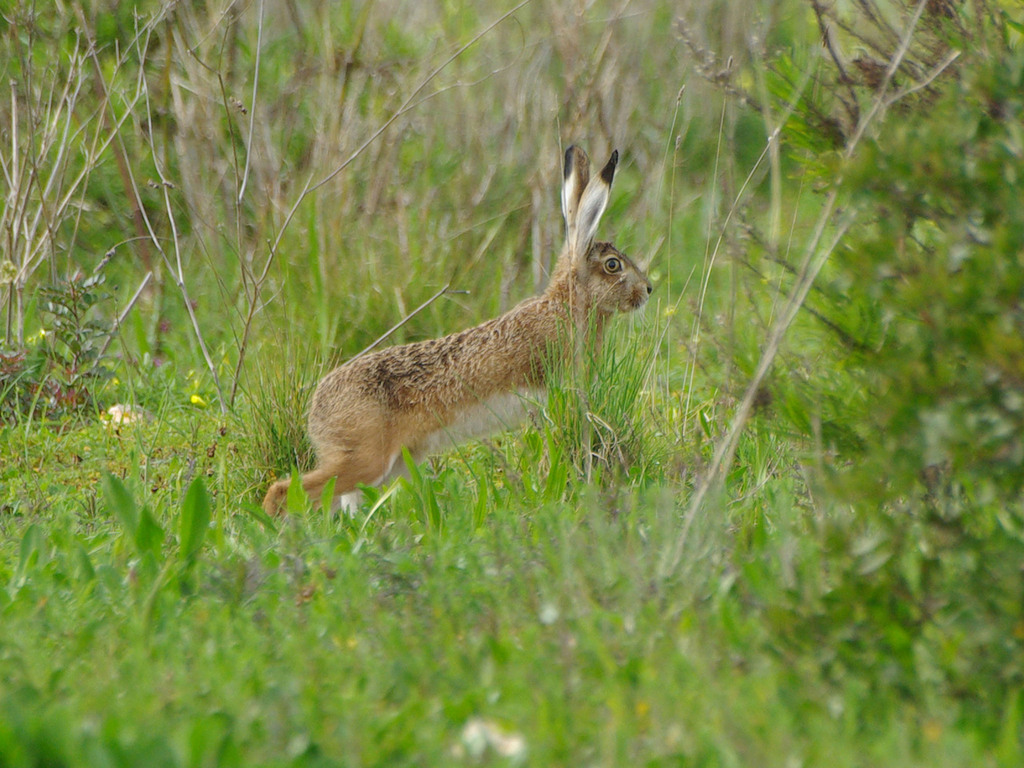
The Iberian hare is a compact hare, noticeably smaller than its European relatives. Adults typically weigh 2–2.6 kilograms and measure 44.5 to 47.3 centimetres in head and body length. The most distinctive field mark is the striking contrast between its gray-brown back and crisp white underside and inner legs, with reddish colouration on the outer legs. The white fur even extends to the tips of the toes. The ears are moderately sized at 9.25 to 10.27 centimetres. Females are slightly heavier than males on average, though this sexual dimorphism is subtle in the field.
Range & Habitat
Endemic to the Iberian Peninsula and the Balearic Islands, this species is found across Spain and Portugal. Three subspecies are recognised: the widespread nominate subspecies L. g. granatensis inhabits much of central and southern Iberia including Andalusia, Extremadura, the Meseta Central, and Valencia, extending into Aragon, Catalonia, and throughout Portugal. The darker northwestern subspecies L. g. gallaecius occurs in Galicia. The third subspecies, L. g. solisi, is found in Mallorca and Ibiza but is considered either critically endangered or extinct by conservation authorities.
Behaviour & Diet
The Iberian hare produces an average of 2 young per litter, though litters can reach as many as 7 leverets. Like other hares, it is primarily nocturnal and crepuscular, relying on speed and vigilance to avoid predators. The species is susceptible to various parasites and diseases, including tapeworms, coccidiosis, and rabbit hemorrhagic disease virus, which can significantly impair its escape ability and fitness. Remarkably, this hare has never been documented with European brown hare syndrome, a disease that affects many of its continental relatives.
Best Time & Places to See It
The Iberian hare is most active during dawn and dusk, and at night. Observers should focus on suitable habitat in central and southern Spain and Portugal, where the nominate subspecies is most abundant. Open scrubland, grassland, and semi-arid terrain are typical habitats. Early morning and evening walks in appropriate regions, particularly in Andalusia, Extremadura, and the Meseta Central, offer the best chances of encounters.
Photography Tips
Photographing Iberian hares requires patience and early starts. The white underparts and distinctive leg colouration are key identifying features to capture. Use a telephoto lens to maintain distance and avoid disturbing this hunted species. Low-angle shots at dawn or dusk will exploit natural lighting to emphasise the colour contrasts on the fur. Remember that this is a small, swift hare—anticipatory positioning and fast shutter speeds are essential for sharp images.
Monfragüe National Park
Torrejón el Rubio, Spain
+219 birds+10 mammals
Where the Tagus River cuts through limestone plateaus in central Extremadura, Monfragüe National Park rises as a fortress of Mediterranean and Atlantic woodland, its dramatic rocky…
VIEW NATIONAL PARKSierra Nevada National Park
Válor, Spain
+137 birds+7 mammals
Where granite ridges rise above 3,000 metres across the Alpujarra foothills, Sierra Nevada National Park crowns southern Spain's most dramatic mountain landscape. The park encompasses a…
VIEW NATIONAL PARKDoñana National Park
Hinojos, Spain
+300 birds+13 mammals
Where the Guadalquivir River delta spreads into the Atlantic, vast marshes, cork woodlands, and coastal dunes converge to create one of southwestern Europe's most biodiverse wetland…
VIEW NATIONAL PARKTablas de Daimiel National Park
Daimiel, Spain
+246 birds+6 mammals
Where the Guadiana River spreads into a labyrinth of shallow lagoons and reed beds across the sun-baked plains of central Spain, Tablas de Daimiel National Park…
VIEW NATIONAL PARKCabo de Gata-Níjar Natural Park
San José, Spain
+274 birds+11 mammals
Where volcanic ridges plunge toward the Mediterranean, Cabo de Gata-Níjar Nature Park unfolds across one of Europe's most arid coastlines, a landscape sculpted by tectonic violence…
VIEW NATURAL PARKMontaña Palentina Natural Park
Vidrieros, Spain
+180 birds+29 mammals
Where the Cantabrian mountains rise above the Palencia plateau, Montaña Palentina Nature Park sprawls across nearly 1,500 square kilometres of some of northern Spain's most dramatic…
VIEW NATURAL PARKDelta de l’Ebre Natural Park
Eucaliptus, Spain
+341 birds+18 mammals
Where the Ebro River spreads into a vast labyrinth of shallow lagoons, reed beds, and brackish marshes before surrendering to the Mediterranean, one of southern Europe's…
VIEW NATURAL PARKCabañeros National Park
Retuerta del Bullaque, Spain
+183 birds+8 mammals
Cabañeros National Park is one of Spain’s finest wildlife destinations and one of the best-preserved examples of Mediterranean forest and scrubland in Europe. Located in the…
VIEW NATIONAL PARKTúria Natural Park
València, Spain
+150 birds+21 mammals
Where the Túria riverbed winds through the lowlands south of Valencia, a sprawling natural park of nearly 440 square kilometres unfolds across one of Spain's most…
VIEW NATURAL PARKSierra de Cazorla, Segura y las Villas Nature Park
Las Canalejas, Spain
+176 birds+21 mammals
Where granite gorges slice through mountainous terrain in eastern Andalusia, the Sierra de Cazorla, Segura y las Villas Nature Park sprawls across more than 5,200 square…
VIEW NATURAL PARKCadí Moixeró Natural Park
Bor, Spain
+172 birds+21 mammals
Cadí-Moixeró Natural Park is one of the largest and most spectacular protected areas in Catalonia, located in the heart of the eastern Pyrenees. Covering more than…
VIEW NATURAL PARKSierra de Andújar Natural Park
Our Lady of Cabeza, Spain
+198 birds+19 mammals
Where granite gorges slice through Mediterranean scrubland and cork forests cascade down Andalusian hillsides, one of Spain's most pristine wilderness areas unfolds across 74,000 hectares of…
VIEW NATURAL PARKSerra de Mariola Natural Park
Bocairent, Spain
+164 birds+19 mammals
Where limestone ridges rise above the Valencian interior, Serra de Mariola unfolds across 225 square kilometers of Mediterranean mountain terrain that shifts between dense evergreen woodland,…
VIEW NATURE RESERVESierra de Castril Natural Park
Castril, Spain
+110 birds+13 mammals
Where limestone walls rise abruptly from the Guadalentín valley, carving passages of breathtaking drama through Andalusia's interior, one encounters the raw geological theatre of this protected…
VIEW NATURE RESERVEColl de Pal
La Molina, Spain
+142 birds+12 mammals
Where the eastern Pyrenees descend into Catalonia, alpine meadows and rocky slopes define the character of this mountain pass, a threshold between the high Iberian interior…
VIEW MOUNTAIN & ALPINENo community photos yet. Log in to add the first one.
No community observations of this species yet.