Identification
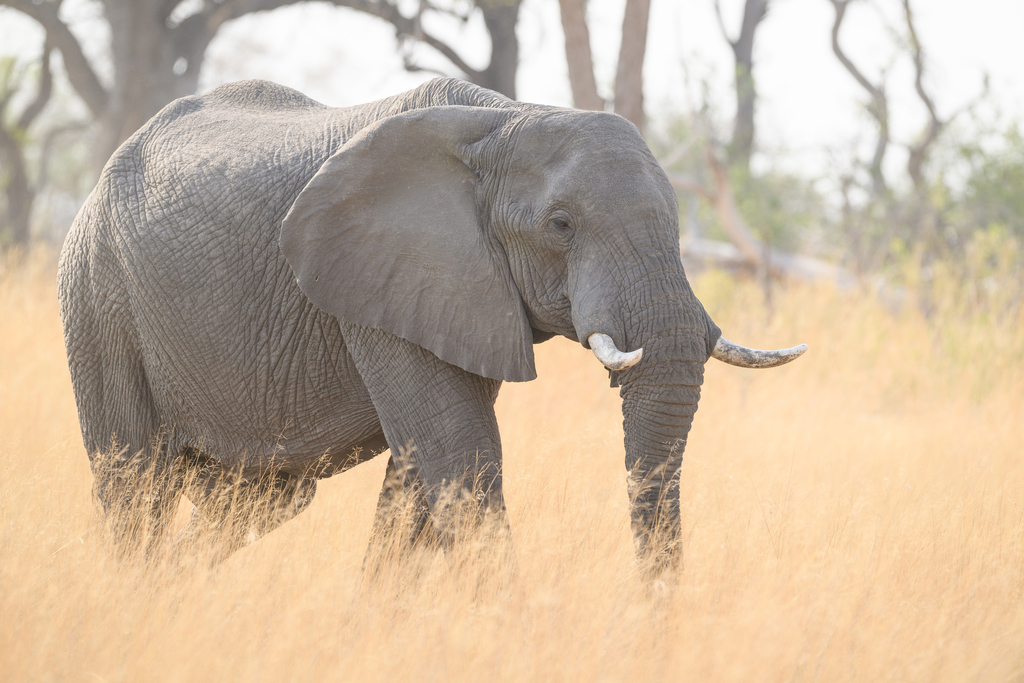
The African savanna elephant is the largest living terrestrial animal, unmistakable in its sheer scale and distinctive features. Fully grown bulls average 3.04–3.36 m (10.0–11.0 ft) at the shoulder, with the largest recorded specimen reaching 3.96 m (13.0 ft). The species is characterised by its long, prehensile trunk with two finger-like processes at the tip, and sturdy, noticeably curved tusks that point forward. Its massive ears are pointed and triangular, covering the whole shoulder and capable of growing as large as 2 m × 1.5 m (6 ft 7 in × 4 ft 11 in).
Physically, African savanna elephants have a concave back, grey skin with scanty hair, and bending cracks in their skin that support thermoregulation by retaining water. The large ears are not merely ornamental—they actively help reduce body heat by flapping to create air currents and expose blood vessels on the inner sides, a critical adaptation for survival in hot climates. Mature females are noticeably smaller than males, averaging 2.60 m (8 ft 6 in) at the shoulder.
Range & Habitat
The African savanna elephant is native to sub-Saharan Africa and inhabits a remarkable variety of landscapes including forests, grasslands, woodlands, wetlands, and agricultural land. This adaptability to diverse environments reflects the species' ecological importance across the continent.
Behaviour & Diet
African savanna elephants are highly social herbivores with complex family structures. Females and their offspring live together in herds, while adult bulls typically live alone or form small bachelor groups. The average adult consumes approximately 150 kg (330 lb) of vegetation and 230 litres (61 US gallons) of water daily, feeding mostly on grasses, creepers, herbs, leaves, and bark. During the breeding season, males undergo musth, a period of elevated testosterone and heightened aggression. Females have a menstrual cycle lasting three to four months, with a gestation period of around 22 months—the longest of any mammal—indicating the significant investment required to produce these giants.
Best Time & Places to See It
African savanna elephants are distributed across multiple range countries throughout sub-Saharan Africa, where they inhabit varied terrain from grasslands to woodlands. The species' presence in wetlands and agricultural lands means sightings are possible in diverse ecosystems, though national parks and protected reserves across the continent offer the most reliable opportunities for observation.
Photography Tips
The sheer scale and distinctive features of African savanna elephants make them compelling photographic subjects. Their large ears, curved tusks, and the texture of their grey, cracked skin offer rich detail for close-up work. The herding behaviour of females and their offspring provides opportunities to capture family group dynamics, while the solitary bulls offer dramatic portraits. Wide-angle lenses can emphasise their immense size within their landscape, particularly in grasslands and woodlands where they are more exposed.