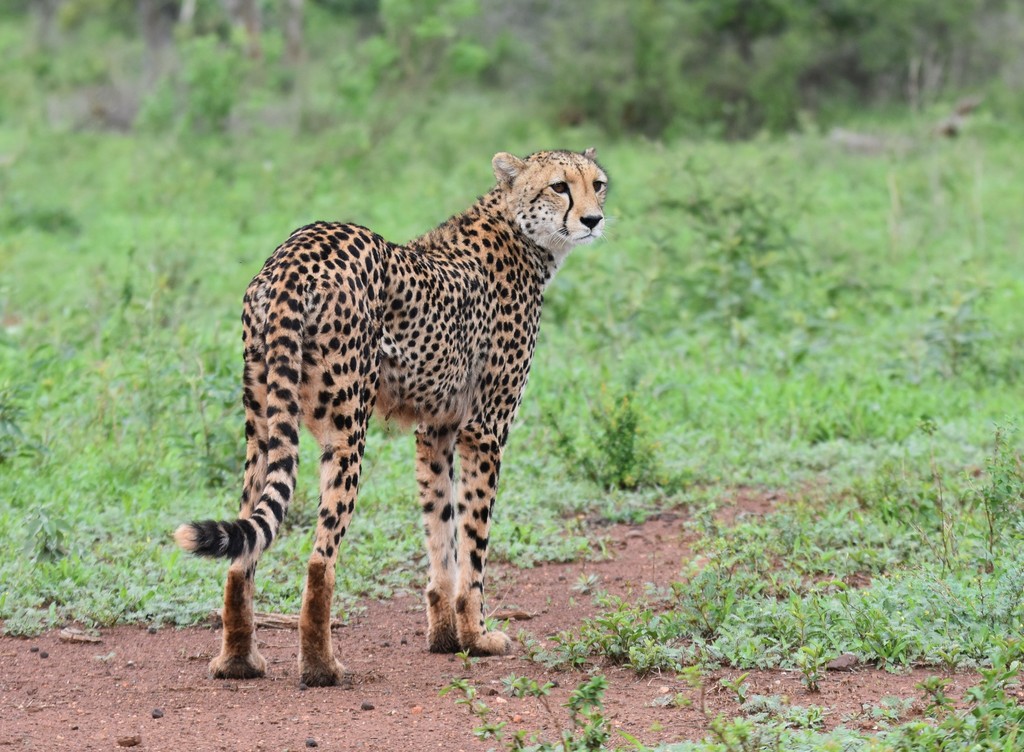
Cheetah
Photo © Justin Ponder
Photo © Justin Ponder — CC BY 4.0 — Source: iNaturalist photo #175608538Identification
The cheetah is instantly recognisable by its slender build and distinctive markings. Its tawny to creamy white or pale buff fur is adorned with evenly spaced, solid black spots that provide excellent camouflage in open habitats. The head is small and rounded with a notably short snout, and the most striking feature is the black tear-like streaks that run from its eyes to its mouth—a signature that distinguishes it from all other African cats.
Built for speed rather than strength, the cheetah is the fastest land animal, capable of running at 93–104 km/h (58–65 mph). Its body reflects this evolutionary specialisation: powerful hindlimb muscles, long limbs, and a flexible spine work together to achieve extraordinary acceleration. Adults reach 67–94 cm at the shoulder, with a head-and-body length between 1.1 and 1.5 m, and weigh between 21 and 65 kg, making them notably lighter and more graceful than other large African predators.
Range & Habitat
Four subspecies of cheetah are native to Africa and central Iran, with an African subspecies recently introduced to India in 2022. Today, the species is distributed mainly in small, fragmented populations across northwestern, eastern and southern Africa, as well as central Iran—a range that reflects significant habitat loss over recent decades.
Cheetahs thrive in diverse open and semi-open habitats. They inhabit savannahs such as the Serengeti, arid mountain ranges in the Sahara, and hilly desert terrain. These habitats provide the open spaces essential for their pursuit hunting strategy and allow them to utilise their extraordinary speed to catch prey.
Behaviour & Diet
Cheetahs display fascinating social structures that vary by sex. Females lead nomadic lives, constantly searching for prey across large home ranges, while males are more sedentary and establish much smaller territories in areas rich with prey and female access. Some males form "coalitions" with other males, though solitary males also occur. The cheetah is primarily diurnal, with activity peaks at dawn and dusk when temperatures are cooler.
As a pursuit predator, the cheetah hunts small- to medium-sized prey, preferring medium-sized ungulates such as impala, springbok and Thomson's gazelles, typically weighing under 40 kg. The hunt follows a characteristic pattern: the cheetah stalks and approaches within 30–200 m before charging at high speed, using its dewclaw to strike down prey and delivering a killing throat bite. Breeding occurs throughout the year; after nearly three months of gestation, females give birth to three or four cubs, which are weaned at around four months and become independent by approximately 20 months. Cubs face significant predation pressure from lions and hyenas, which also routinely steal kills from adult cheetahs.
Best Time & Places to See It
The Serengeti in East Africa is among the premier destinations for viewing cheetahs in their natural habitat. The species' diurnal nature and preference for open terrain make daytime game drives during dawn and dusk the most productive times for encounters. Early morning offers the best light and conditions for photography, and the cheetah's activity peaks during these cooler hours.
Eastern and southern African reserves offer excellent viewing opportunities, as do certain protected areas in central Iran. However, visitors should be aware that cheetah populations are now fragmented across their range, so sightings cannot be guaranteed. Local guides familiar with individual cheetah territories and movement patterns greatly increase the likelihood of successful encounters.
Photography Tips
The cheetah's distinctive tear marks and spotted coat make for striking portraits, particularly in soft early morning or late afternoon light. Position yourself to capture the characteristic facial markings, which are a defining feature of the species. The animal's slender, elegant form is best photographed in profile or three-quarter view against open grassland or desert backdrop.
Capture the cheetah's hunting behaviour if possible—the explosive acceleration and low-slung pursuit of prey create dramatic action sequences. Use fast shutter speeds to freeze motion during hunts. Wide-angle shots showing the cheetah within its open habitat context convey both the animal's built-for-speed physiology and its dependence on open terrain. Patient observation during peak activity periods—dawn, dusk, and cooler daylight hours—yields the best photographic opportunities.
Serengeti National Park
Tanzania
+558 birds+57 mammals
Across Tanzania's northern plateau, where volcanic soils meet acacia woodland and open grassland, unfolds one of Earth's most dynamic ecosystems. The Serengeti National Park sprawls across…
VIEW NATIONAL PARKChobe National Park
Botswana
+446 birds+45 mammals
Where the Chobe River cuts a sinuous path through northern Botswana, the landscape transforms into one of Africa's most dynamic wetland-savanna mosaics. This national park encompasses…
VIEW NATIONAL PARKNxai Pan National Park
Botswana
+226 birds+16 mammals
Across the northwestern reaches of Botswana stretches a landscape of profound seasonal transformation—a sprawling pan system where shallow depressions fill and empty with the rains, creating…
VIEW NATIONAL PARKTsavo East National Park
Athi ward, Kenya
+468 birds+50 mammals
Across the semi-arid lowlands of southeastern Kenya, where acacia woodland fragments into scrubland and the landscape rolls toward the Indian Ocean horizon, lies one of Africa's…
VIEW NATIONAL PARKTsavo West National Park
Mwatate, Kenya
+513 birds+49 mammals
Where volcanic ridges and weathered lava flows meet the semi-arid lowlands of south-central Kenya, Tsavo West National Park unfolds across a landscape sculpted by fire and…
VIEW NATIONAL PARKAmboseli National Park
Etonet/Lenkism ward, Kenya
+501 birds+43 mammals
Where the Amboseli basin opens toward the Tanzanian frontier, a shallow alkaline lake mirrors vast skies across one of East Africa's most iconic savanna landscapes. The…
VIEW NATIONAL PARKTarangire National Park
Tanzania
+527 birds+50 mammals
Acacia woodland and grassland sweep across the Manyara Region where the Tarangire River carves through low hills and volcanic soils, creating one of East Africa's most…
VIEW NATIONAL PARKNgorongoro Conservation Area
Tanzania
+626 birds+55 mammals
Volcanic calderas and open grassland dominate this high plateau in northern Tanzania, where the landscape rises above 2,000 metres and ancient geological forces have shaped both…
VIEW WILDLIFE MANAGEMENT AREAGarden Route National Park
George, South Africa
+353 birds+54 mammals
Sweeping across the Western Cape's coastal and mountainous terrain, this sprawling national park encompasses over five thousand square kilometers of extraordinarily diverse landscape—from coastal limestone cliffs…
VIEW NATIONAL PARKPilanesberg National Park
Moses Kotane Local Municipality, South Africa
+364 birds+49 mammals
Granite peaks and volcanic ridges rise unexpectedly from the savanna floor across this 734-square-kilometre expanse in the North West province, creating a landscape of profound ecological…
VIEW NATIONAL PARKKruger National Park
Ba-Phalaborwa Local Municipality, South Africa
+540 birds+91 mammals
Across the low-lying savanna of northeastern South Africa unfolds one of Africa's largest and most ecologically intact protected areas, where acacia woodlands merge into mopane scrub…
VIEW NATIONAL PARKMountain Zebra National Park
Inxuba Yethemba Local Municipality, South Africa
+265 birds+35 mammals
Across the windswept plateaus and deeply incised valleys of the Eastern Cape's interior, Mountain Zebra National Park unfolds as a landscape of geological drama and ecological…
VIEW NATIONAL PARKAddo Elephant National Park
Sundays River Valley Local Municipality, South Africa
+388 birds+55 mammals
Where the Eastern Cape's semi-arid scrublands meet transitional woodland, Addo sprawls across 13,478 square kilometres of one of southern Africa's most biodiverse landscapes. The terrain rises…
VIEW NATIONAL PARKMarakele National Park
Modimolle Local Municipality, South Africa
+341 birds+36 mammals
Granite ridges and sprawling grasslands dominate this 1,176-square-kilometre reserve in Limpopo's heartland, where bushveld transitions between rocky outcrops and open savanna. The park's rugged topography creates…
VIEW NATIONAL PARKNamib-Naukluft National Park
Namibia
+217 birds+33 mammals
Across nearly 94,000 square kilometers of southwestern Namibia, a landscape of extremes unfolds where towering sand dunes meet rugged mountain ranges, and ancient riverbeds carve through…
VIEW NATIONAL PARKBwabwata National Park
Namibia
+377 birds+35 mammals
Where the Kavango River winds through northeastern Namibia, vast floodplains and dense riparian woodland create one of southern Africa's most ecologically dynamic protected landscapes. Spanning 14,249…
VIEW NATIONAL PARKEtosha National Park
Namibia
+356 birds+58 mammals
Across northern Namibia's stark semi-arid plateau, a vast shallow depression transforms seasonally into one of Africa's most dramatic wildlife theaters. Etosha National Park, encompassing more than…
VIEW NATIONAL PARKWaterberg Plateau National Park
Okambukonde, Namibia
+198 birds+27 mammals
Where ancient sandstone cliffs rise 200 metres above the surrounding bushveld, a fortress of geology creates one of southern Africa's most compelling ecosystems. The plateau's steep…
VIEW NATIONAL PARKMakgadikgadi Pans National Park
Gucta, Botswana
+272 birds+27 mammals
Where salt-crusted flatlands stretch endlessly toward a shimmering horizon, one of Africa's most extraordinary ecosystems awakens with the rains. The Makgadikgadi Pans comprise vast mineral-rich basins…
VIEW NATIONAL PARKMeru National Park
Igembe Central, Kenya
+408 birds+38 mammals
Granite outcrops and acacia woodland rise across the northern reaches of Meru, where semi-arid savanna transitions into drier scrubland under the fierce equatorial sun. The park's…
VIEW NATIONAL PARKSamburu National Reserve
Samburu, Kenya
+430 birds+42 mammals
Across the arid plains of northern Kenya, where scattered acacia woodland gives way to rocky outcrops and dry riverbeds, Samburu National Park unfolds as one of…
VIEW NATURE RESERVENo community photos yet. Log in to add the first one.
No community observations of this species yet.