Identification
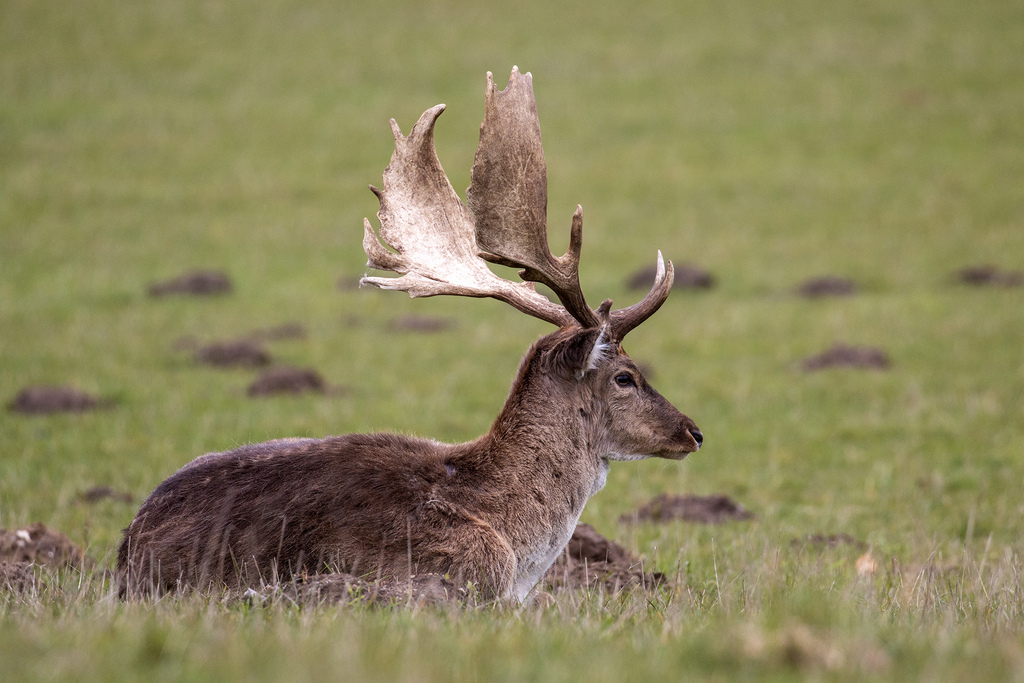
The common fallow deer is a medium-sized deer with striking seasonal variation. Adult bucks (males) typically stand 85–95 cm at the shoulder and weigh 60–100 kg, while does (females) are noticeably smaller at 75–85 cm and 30–50 kg. Only males bear antlers, which are distinctive broad and shovel-shaped (palmate) from three years of age; younger bucks display simple spikes. The species is renowned for its remarkable coat colour variation, with four main types: common (chestnut with white mottles, darker in winter), menil (more distinct spots year-round), melanistic (black or very dark, easily confused with sika deer), and leucistic (pure white but not albino, with dark eyes and nose).
Most herds display the common coat variation, though menil animals are frequent. Melanistic individuals are rarer, and leucistic (white) deer are exceptionally uncommon in the wild, though New Zealand populations often contain high percentages of dark individuals. Fawns are born in spring at around 30 cm long and weighing 3–4 kg, and the species typically lives 12–16 years.
Range & Habitat
Native to Eurasia, the common fallow deer historically inhabited Turkey and possibly the Italian Peninsula, Balkan Peninsula, and the island of Rhodes. During the Pleistocene, the species ranged across much of Europe, as far north as the British Isles, but its range collapsed during the Last Glacial Period. Today, Turkey remains the only country with definitively natural populations, though these are severely endangered. The only extant wild population known to be undoubtedly natural survives in Düzlerçami Game Reserve within Mount Güllük-Termessos National Park in southern Turkey, though this population is largely fenced. The species has been reintroduced to much of its prehistoric range and introduced worldwide by humans.
Fallow deer favour mixed woodland combined with open grassland. They are highly adaptable and occupy diverse habitats across their reintroduced range.
Behaviour & Diet
Fallow deer are agile and fast, capable of running at up to 50 km/h over short distances and jumping as high as 1.75 m or as far as 5 m in length. They are naturally less muscular than other cervids and typically remain in herds of up to 150 individuals. During the rutting season, this grouping behaviour changes dramatically, with bucks spreading out and females moving between them, resulting in relatively ungrouped populations compared to other times of year.
The diet is highly flexible and adapts to local conditions. A detailed study of British populations found they are selective mixed feeders, consuming primarily grass, herbs, and browse during spring and summer (March–September), then shifting to acorns and other mast from September through December. Winter foods include grass, shrubs such as brambles, bilberry, heather, and holly, plus ivy and coniferous material.
Best Time & Places to See It
The most reliable location for seeing genuinely wild common fallow deer is Düzlerçami Game Reserve in Mount Güllük-Termessos National Park in southern Turkey, though access may be limited due to fencing. However, the species is far more commonly encountered in its reintroduced range across Europe and other regions worldwide, where established populations are more accessible.
The rutting season offers compelling viewing opportunities, as bucks become more visible and active during this period. Spring is excellent for observing young fawns alongside does.
Photography Tips
The variation in coat colour across the species makes fallow deer exceptionally photogenic. Seek out herds containing multiple colour variants—common, menil, melanistic, and potentially rare leucistic individuals—for striking comparative images. The bucks' distinctive palmate antlers photograph well in profile, particularly during the rut when they are more spread out and less obscured by herd members.
Capture seasonal changes in coat colour by revisiting locations across the year; the common variant's transition from spotted chestnut in summer to darker, unspotted coats in winter provides dramatic before-and-after opportunities. Early morning and late afternoon light are ideal for highlighting the distinctive white rump patch and tail markings that characterize several colour forms.