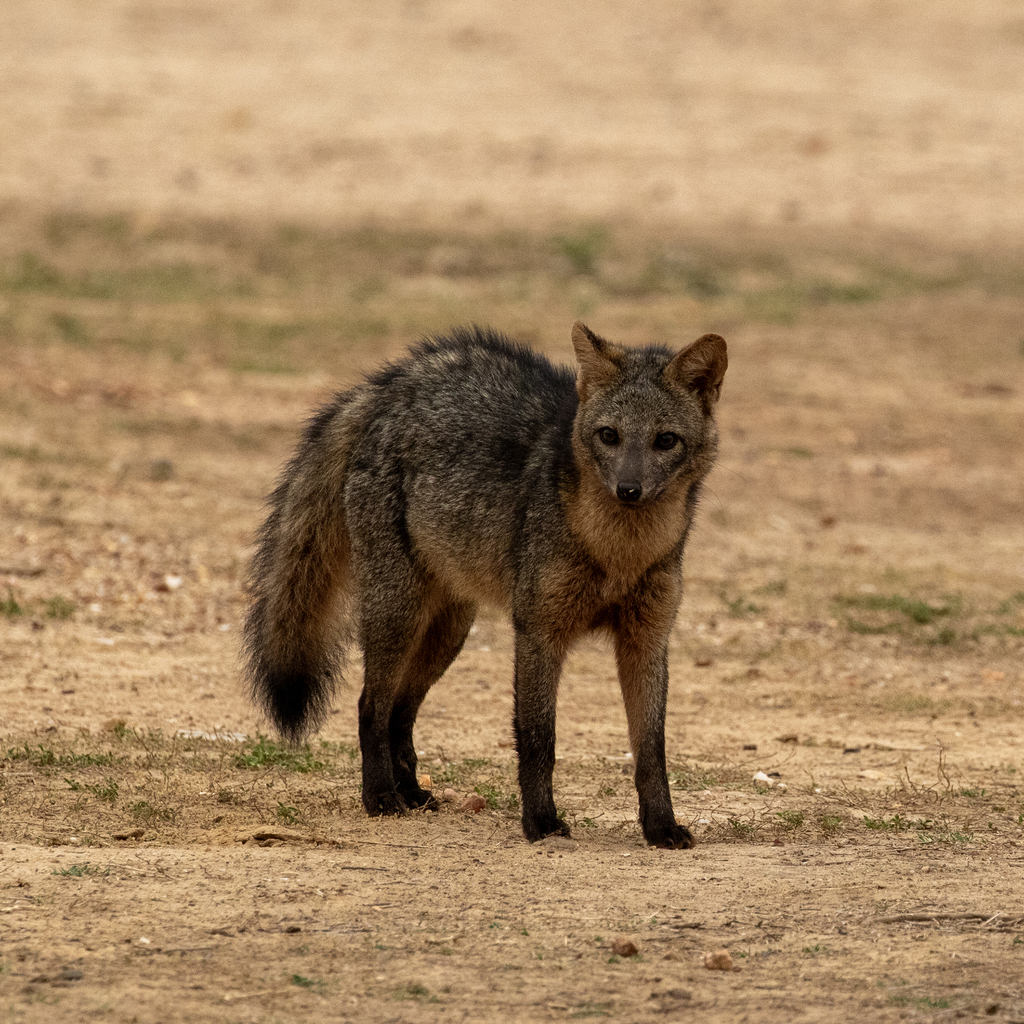
Crab-eating Fox
Photo © Dan Vickers
Photo © Dan Vickers — CC BY 4.0 — Source: iNaturalist #256924448Identification
The crab-eating fox is a medium-sized canid with a distinctive greyish-brown coat marked by reddish areas on the face and legs, black-tipped ears, and a long, bushy tail with a black tip. The head and body measure approximately 64.3 centimetres, with a tail averaging 28.5 centimetres, and the animal typically weighs between 4.5 and 7.7 kilograms. Its most characteristic features are short but powerful legs, wide rounded ears, and a black stripe running along the spine with black streaking on the back legs. Coat coloration varies considerably between populations, ranging from very dark to light grey-yellow, with a short, thick texture. The muzzle, ears, and paws display more reddish fur than the body.
Despite its name suggesting a close relationship to true foxes, the crab-eating fox is not closely related to them and belongs to a distinct South American canid lineage. It is the sole living representative of its genus, Cerdocyon, with all close relatives now extinct. Its nearest living relative is theorized to be the short-eared dog, though this relationship awaits confirmation through molecular studies.
Range & Habitat
The crab-eating fox ranges throughout central South America, from Colombia and southern Venezuela in the north to Paraguay, Uruguay, and northern Argentina in the south, with recent sightings recorded in Panama since the 1990s. This species occupies diverse habitats including savannas, woodlands, subtropical and tropical forests, shrubby thickets, caatinga, plains, and campo environments. It also frequents wooded riverbanks and riparian forests but notably avoids rainforests, high mountains, and open grassy savannas. Seasonal movements are pronounced: during the rainy season, the foxes shift their range uphill where food becomes more abundant, while in drier periods they move to lower ground.
Behaviour & Diet
The crab-eating fox is primarily nocturnal, with peak activity during the middle of the night and early morning hours. It forms monogamic pairs for hunting, with groups of several pairs sometimes assembling during breeding season. These foxes are highly territorial during the dry season but relax territorial defense when food is abundant in the rainy season. They typically den in bushes and thick grass, creating multiple entrance holes per burrow and preferring to appropriate other animals' burrows over tunneling themselves. Communication involves characteristic vocalizations including barking, whirring, and howling, particularly when pairs lose contact.
As suggested by its name, the crab-eating fox hunts crabs on muddy floodplains during the wet season, though it is an opportunistic omnivore with a remarkably varied diet. It readily consumes insects, rodents, birds, other crustaceans, tortoises, turtle and bird eggs, lizards, fruits, and carrion. Seasonal dietary shifts occur, with crustaceans dominating wet-season diets and insects more prevalent during dry periods. This feeding behavior contributes valuable pest control, particularly of rodents and harmful insects.
Best Time & Places to See It
As a nocturnal species, the crab-eating fox is most active during night hours and early morning, making dawn and dusk the optimal times for observation. The animal is generally common throughout its range, with a stable population, though sighting difficulty varies by habitat. The wet season offers the best opportunity to locate individuals, as increased food availability brings them into more predictable, floodplain areas where they hunt crabs. Savannas, campo, and riparian woodlands—particularly in Colombia, Venezuela, Paraguay, and Argentina—offer the most reliable viewing prospects, though patience and nocturnal fieldwork are essential.
Photography Tips
Photograph this elusive canid during twilight hours or with infrared/night-vision equipment, as its nocturnal habits make daytime encounters rare. The fox's upright, bushy tail when excited provides distinctive compositional elements, and the contrast between its greyish-brown body and reddish facial markings photographs well in soft light. Wide-angle shots capturing the fox in its natural habitat—muddy floodplains, riparian zones, or shrubby campo—provide important ecological context. When documenting behavior, focus on hunting sequences on muddy ground during wet season, as this characterizes both the animal's ecology and its common name. Its small size and cautious nature require patient stalking and sufficient focal length to capture detail without disturbing the subject.
Emas National Park
Brazil
+333 birds+23 mammals
Across the high plateaux of central Brazil, where the cerrado grasslands roll toward distant horizons under an immense sky, Emas National Park anchors one of South…
VIEW NATIONAL PARKItatiaia National Park
Brazil
+519 birds+12 mammals
Where granite peaks pierce the Atlantic rainforest canopy in southeastern Brazil, Itatiaia National Park rises as one of the country's oldest and most ecologically vital protected…
VIEW NATIONAL PARKPantanal Matogrossense National Park
Brazil
+322 birds+17 mammals
Where the flooded forests of central Brazil meet vast seasonally inundated grasslands, Pantanal Matogrossense National Park sprawls across nearly 2,900 square kilometers of one of the…
VIEW NATIONAL PARKEl Palmar National Park
Distrito Sexto, Argentina
+244 birds+14 mammals
Across the Paraná River floodplain in northeastern Argentina, palms rise from wetland and grassland in a landscape shaped by water and time. El Palmar National Park…
VIEW NATIONAL PARKRío Pilcomayo National Park
Argentina
+271 birds+13 mammals
Where the Río Pilcomayo cuts through northeastern Argentina's subtropical lowlands, a sprawling mosaic of wetlands, grasslands, and seasonally flooded forests creates one of South America's most…
VIEW NATIONAL PARKCalilegua National Park
Municipio de Calilegua, Argentina
+288 birds+8 mammals
Where the eastern Andean slopes plunge into northwestern Argentina's humid subtropics, nearly 2,645 square kilometers of steep terrain and luxuriant forest compose one of South America's…
VIEW NATIONAL PARKNo community photos yet. Log in to add the first one.
No community observations of this species yet.