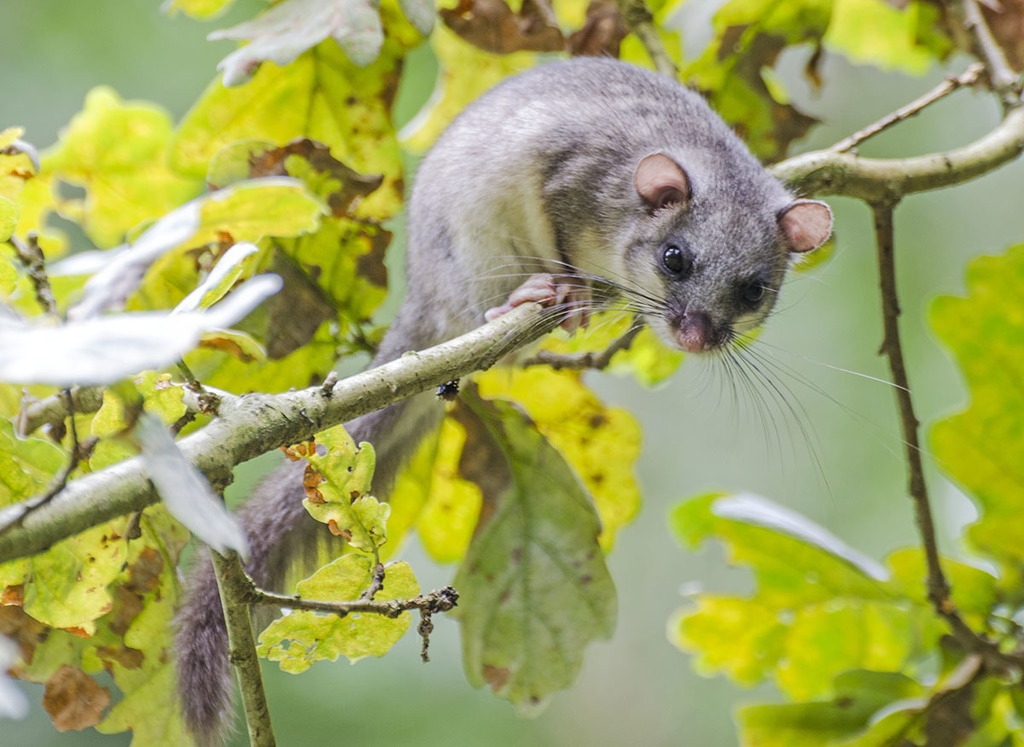
European Fat Dormouse
Photo © Kazimieras Martinaitis
Photo © Kazimieras Martinaitis — CC BY 4.0 — Source: iNaturalist photo #66529621Identification
The European fat dormouse is the largest of all living dormice, measuring 14 to 19 cm in head-body length with an 11 to 13 cm bushy tail. It has a distinctly squirrel-like body with small ears, short legs, and large feet. The fur is grey to greyish-brown on the back, while the underparts and inner leg surfaces are white to pale buff, with a well-defined line between these colours. Unlike most other dormice, it lacks dark facial markings except for faint rings around the eyes. The tail is long and bushy, slightly darker than the body fur. An unusual defensive adaptation allows the dormouse to shed its tail skin if grasped by a predator, exposing the vertebrae which then break off, allowing escape while the wound heals with fresh hair growth.
Range & Habitat
The European fat dormouse is found throughout much of mainland western Europe and across numerous Mediterranean islands including Sardinia, Corsica, Sicily, and Crete. It is more sparsely distributed in central and southeastern Europe, extending as far northeast as the upper Volga River in western Russia and the Zhiguli Mountains, as well as the Caucasus region. A notable isolated population exists in southeast England, established from animals that escaped from a private collection near Tring, Hertfordshire in 1902; this population now numbers around 10,000 individuals across a 200-square-mile triangle between Beaconsfield, Aylesbury, and Luton in the Chiltern Hills.
These dormice prefer deciduous forests dominated by oak and beech, from sea level up to 1,500 to 2,000 metres elevation. They favour dense forests with rocky cliffs and caves but may also inhabit maquis vegetation, orchards, and urban margins. They have been recorded in caves as deep as 400 metres, where they shelter from predators. Population densities vary from two to 22 individuals per hectare.
Behaviour & Diet
European fat dormice are strictly nocturnal, spending daylight hours in nests appropriated from birds or located in hollow trees and similar shelters. They are excellent climbers spending most time in trees, aided by sticky secretions from plantar glands that prevent them from falling on smooth surfaces. They are relatively poor jumpers and tend to remain within forests, avoiding open areas. They are not generally social animals.
Unlike most other dormice, the European fat dormouse is purely herbivorous. Beech mast is an excellent food source, rich in energy and protein, particularly important for young and lactating females. They consume large quantities of beech tree seeds, with a single large, mature seeding tree often producing enough resources to support an individual dormouse's reproductive needs. The presence and age of beech trees significantly influences where populations establish themselves.
Best Time & Places to See It
The best opportunities to observe European fat dormice are in extensive deciduous forests dominated by oak and beech in mainland Europe, particularly where old, mature trees are abundant. The Mediterranean islands of Corsica, Sardinia, Sicily, and Crete offer reliable locations. For travellers in Britain, the Chiltern Hills region around Hertfordshire, between Beaconsfield, Aylesbury, and Luton, offers the only wild European population outside continental Europe.
Since these are strictly nocturnal animals, night surveys are essential. Early summer, when females are raising young and feeding demands are highest, may offer the best viewing chances. Late summer and autumn are also promising, as dormice feed intensively before hibernation and may almost double their weight during this period.
Photography Tips
Photographing European fat dormice requires night-time work with appropriate lighting equipment. Focus on areas with mature beech and oak trees, particularly during evening hours when dormice become active. A macro or telephoto lens will help capture detail of their distinctive grey-brown fur, pale underparts, and characteristic faint eye-rings without disturbing the animals.
Position yourself near mature beech trees in dense forest habitat, as these are key feeding sites. Patience is essential—nocturnal activity means long waits, but the dormouse's slow, deliberate climbing style and arboreal habits provide extended opportunities for shots. Capturing their characteristic bushy tail and the contrast between their dark dorsal fur and pale underparts will best showcase this species' distinctive appearance.
Harz National Park
Harz (LK Goslar), Germany
+141 birds+38 mammals
Where granite peaks rise above beech and spruce forests, the Harz unfolds as one of Germany's most biodiverse upland landscapes. Straddling the border between Lower Saxony…
VIEW NATIONAL PARKSaxon Switzerland National Park
Sebnitz, Germany
+118 birds+9 mammals
Sandstone cliffs and narrow gorges define this corner of eastern Saxony, where the Elbe River has carved a dramatic landscape of towering rock formations and densely…
VIEW NATIONAL PARKRedes Natural Park
Arrobio, Spain
+163 birds+16 mammals
Where the Picos de Europa cast their shadow westward, the Redes Nature Park sprawls across nearly 600 square kilometres of Asturian limestone and schist, a wild…
VIEW NATURAL PARKCévennes National Park
Vebron, France
+187 birds+63 mammals
Where granite gorges slice through the limestone plateaux of southern France, the Cévennes Cœur National Park unfolds across nearly 3,500 square kilometres of one of Europe's…
VIEW NATIONAL PARKMercantour National Park
Isola, France
+146 birds+32 mammals
Where alpine meadows surrender to vertiginous limestone cliffs, the Mercantour's beating heart pulses with Mediterranean and Alpine rhythms. This 4,221-square-kilometre sanctuary straddles France's southeastern border, its…
VIEW NATIONAL PARKÉcrins National Park
La Chapelle-en-Valgaudémar, France
+143 birds+36 mammals
Where granite peaks and Alpine meadows converge across nearly 2,100 square kilometres, Écrins National Park forms one of the wildest mountainous strongholds of the French Alps.…
VIEW NATIONAL PARKForêts National Park
Lucey, France
+140 birds+50 mammals
Across the rolling plateaux of central Burgundy, where limestone uplands give way to deep valleys carved by time and water, lies a landscape of profound ecological…
VIEW NATIONAL PARKAggtelek National Park
Szin, Hungary
+119 birds+13 mammals
Where limestone karst terrain rises and plunges across North Hungary's borderlands, Aggtelek National Park unfolds across 543 square kilometres of one of Europe's most geologically dramatic…
VIEW NATIONAL PARKDuna-Ipoly National Park
Dömös, Hungary
+208 birds+19 mammals
Where the Danube curves through central Hungary, the limestone hills and forested valleys of Duna-Ipoly National Park create a landscape that feels caught between seasons and…
VIEW NATIONAL PARKBükk National Park
Répáshuta, Hungary
+161 birds+15 mammals
Where forested limestone ridges rise across northern Hungary, Bükk National Park unfolds across nearly 900 square kilometres of temperate woodland, rocky gorges, and karst formations that…
VIEW NATIONAL PARKCadí Moixeró Natural Park
Bor, Spain
+172 birds+21 mammals
Cadí-Moixeró Natural Park is one of the largest and most spectacular protected areas in Catalonia, located in the heart of the eastern Pyrenees. Covering more than…
VIEW NATURAL PARKMontseny Natural Park
Viladrau, Spain
+156 birds+30 mammals
The Montseny Natural Park is one of Catalonia’s most remarkable protected areas, offering an extraordinary blend of biodiversity, scenic landscapes, and cultural heritage within easy reach…
VIEW NATURAL PARKValles Occidentales Natural Park
Siresa, Spain
+168 birds+20 mammals
Where granite gorges slice through the western Pyrenean foothills, steep valleys carved by ancient rivers create a mosaic of Mediterranean scrubland, beech forests, and alpine meadows.…
VIEW NATURAL PARKCamargue Regional Nature Park
Saintes-Maries-de-la-Mer, France
+378 birds+48 mammals
Where the Rhône Delta sprawls into the Mediterranean, a landscape of stark and haunting beauty emerges—vast salt marshes punctuated by shallow lagoons, reed beds, and scrubland…
VIEW NATURAL PARKRegional Park of the Catalan Pyrenees
Olette, France
+244 birds+63 mammals
Where granite peaks thrust skyward above cloud-laden valleys, a wild tapestry of Mediterranean and alpine ecosystems interweaves across the Franco-Spanish frontier. These Pyrenean slopes harbour extraordinary…
VIEW NATURE RESERVESchwarzwald National Park
Baiersbronn, Germany
+120 birds+18 mammals
Where dense spruce forests give way to ancient beech woodlands and windswept moorlands, one of Central Europe's most ecologically vital landscapes unfolds across the Black Forest.…
VIEW NATIONAL PARKStrandzha Nature Park
Kondolovo, Bulgaria
+215 birds+19 mammals
Where the Rhodope Mountains descend toward the Black Sea coast, ancient forests rise above limestone plateaus in a tapestry of ecological richness rarely found elsewhere in…
VIEW NATURAL PARKVratsa Balkan
Zgorigrad, Bulgaria
+128 birds+10 mammals
Where limestone cliffs plunge into deep river canyons and beech forests give way to rocky karst plateaus, one of Bulgaria's most dramatic mountain landscapes unfolds across…
VIEW NATURE RESERVEPollino National Park
Viggianello, Italy
+125 birds+9 mammals
Where limestone ridges rise abruptly from the Basilicatan foothills, Pollino National Park enfolds a landscape of profound ecological character—one defined by steep valleys, alpine meadows clinging…
VIEW NATIONAL PARKSila National Park
San Giovanni in Fiore, Italy
+125 birds+11 mammals
Where the Calabrian Apennines rise inland from the Ionian coast, Sila National Park preserves a landscape of high plateaus and beech-dominated forests that feel more Central…
VIEW NATIONAL PARKForeste Casentinesi, Monte Falterona and Campigna National Park
Santa Sofia, Italy
+92 birds+13 mammals
Where the northern Apennines rise above the Tuscan-Emilian divide, beech and fir forests cloak the slopes of Monte Falterona in a mantle of temperate woodland that…
VIEW NATIONAL PARKGran Sasso and Monti della Laga National Park
Pietracamela, Italy
+155 birds+12 mammals
Where the Apennines rise in their most dramatic form, the Gran Sasso e Monti della Laga National Park unfolds across nearly 70,000 hectares of limestone peaks,…
VIEW NATIONAL PARKCilento, Vallo di Diano and Alburni National Park
Campora, Italy
+145 birds+12 mammals
Where the southern Apennines descend toward the Tyrrhenian coast, the landscape transforms into a mosaic of limestone plateaus, deep ravines, and Mediterranean scrubland that defines Cilento,…
VIEW NATIONAL PARKDolomiti Bellunesi National Park
Sospirolo, Italy
+76 birds+11 mammals
Where the Dolomites descend into the Veneto foothills near Sospirolo, a landscape of limestone massifs, forested valleys, and rushing waterways creates one of northern Italy's most…
VIEW NATIONAL PARKAspromonte National Park
Careri, Italy
+89 birds+5 mammals
Where the Aspromonte massif rises sharply from Calabria's Tyrrhenian coast, ancient beech and mixed temperate forests cloak the upper slopes, giving way at lower elevations to…
VIEW NATIONAL PARKMagura National Park
Kotań, Poland
+133 birds+14 mammals
Where the Pieniny Mountains rise in soft folds across the Subcarpathian landscape, Magura National Park spans 635 square kilometres of mixed deciduous and coniferous woodland, limestone…
VIEW NATIONAL PARKBieszczady National Park
Bieszczady County, Poland
+131 birds+16 mammals
Where the Carpathian foothills roll across southeastern Poland, a vast upland wilderness of beech and spruce forest unfolds across nearly 1,575 square kilometres, sheltering one of…
VIEW NATIONAL PARKRoztocze National Park
Obrocz, Poland
+117 birds+4 mammals
Where the Lublin Upland plateaus meet their gentler eastern slopes, Roztocze National Park unfolds across 272 square kilometres of Central European woodland mosaic—a landscape where glacial…
VIEW NATIONAL PARKSomiedo Natural Park
Pola de Somiedo, Spain
+165 birds+25 mammals
Where granite gorges cleave through the Cantabrian Mountains of northern Spain, alpine meadows roll toward beech and oak forests in a landscape virtually untouched by industrial…
VIEW NATURAL PARKPindos National Park
Ioannina Regional Unit, Greece
+163 birds+12 mammals
Where limestone peaks rise abruptly from the Pindus range in northwestern Greece, a landscape of dramatic gorges, alpine meadows, and dense beech forests creates one of…
VIEW NATIONAL PARKButrint National Park
Vagalat, Albania
+140 birds+3 mammals
Where the Ionian coast meets ancient alluvial plains, Butrint National Park spans a landscape of extraordinary ecological complexity that has shaped human settlement for three millennia.…
VIEW NATIONAL PARKPyrénées National Park
Hautes Pyrenees, France
+150 birds+35 mammals
Where alpine meadows give way to limestone cliffs and rushing torrents carve through ancient stone, the Pyrénées National Park spans a landscape of austere beauty along…
VIEW NATIONAL PARKCalanques National Park
Bouches-du-Rhône, France
+233 birds+42 mammals
Where limestone cliffs plunge dramatically into crystalline Mediterranean waters, Calanques National Park preserves one of Europe's most striking coastal landscapes. These steep-sided inlets, carved by erosion…
VIEW NATIONAL PARKAbruzzo, Lazio and Molise National Park
Pescasseroli, Italy
+139 birds+18 mammals
Where the central Apennines rise in dramatic limestone and clay ridges, the Gran Sasso e Monti della Laga National Park unfolds across one of Italy's most…
VIEW NATIONAL PARKVal Grande National Park
Verbano-Cusio-Ossola, Italy
+81 birds+6 mammals
Granite peaks and plunging ravines define this Alpine wilderness where the Toce River carves through one of Italy's most remote mountain landscapes. Straddling the Verbano-Cusio-Ossola district…
VIEW NATIONAL PARKNo community photos yet. Log in to add the first one.
No community observations of this species yet.