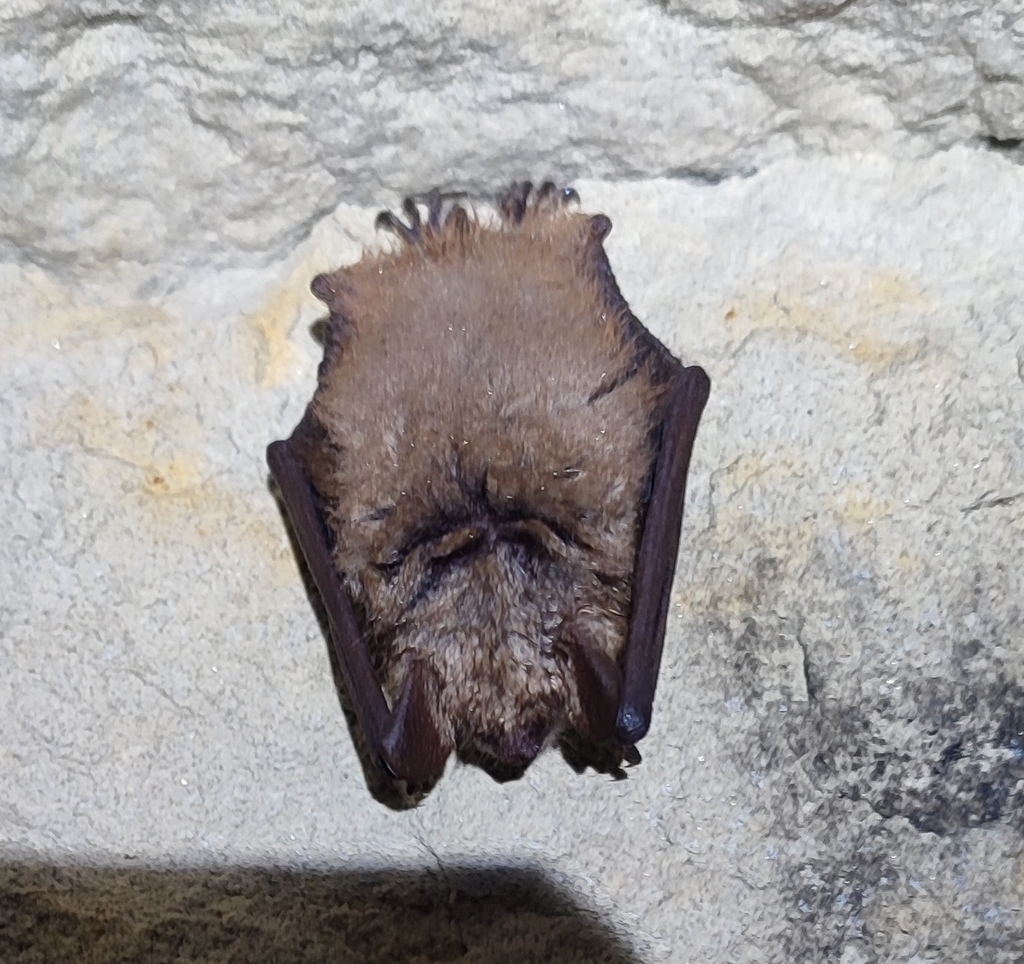
Geoffroy’s Myotis
Photo © Samuel GUIRAUDOU
Photo © Samuel GUIRAUDOU — CC BY 4.0 — Source: iNaturalist photo #255565474Identification
Geoffroy's myotis, also known as the notch-eared bat, is a medium-sized vesper bat distinguished by its long, woolly fur. Adults display rust-brown to fox-red coloring on their dorsal side, contrasting with a poorly delineated pale yellowish-brown ventral surface, while young animals are almost fully grey. The face is light brown, and the most distinctive feature is the ears: brown with an almost right-angled notch at the outer edge and many scattered, wart-like growths on the auricle. The tragus tip does not reach the notch. The bat has broad brown wings and a tail membrane supported by a straight calcar with short, straight, and soft hairs along its edge.
Range & Habitat
Geoffroy's myotis has an extensive range across Eurasia, from western Europe through the Mediterranean and into Central Asia, occurring in over 40 countries from Afghanistan to Portugal and from Germany to Oman. A remarkable 2012 sighting in southern England marked an unusual northern occurrence. The species shows habitat flexibility across its range: in Iberia it favors broad-leaved and mixed forests and Mediterranean olive plantations; in northwestern populations it frequents riparian forests and grasslands; and across its range it commonly roosts in underground sites and human buildings, often alongside Rhinolophus species. It also regularly visits cattle sheds, attracted to parasitic fly populations.
Behaviour & Diet
Geoffroy's myotis is a specialized insectivore with a diet dominated by spiders and flies. The bat employs a gleaning strategy, foraging by plucking prey from hard surfaces and leaves rather than catching insects in flight—a behavior reflecting its preferred prey of flightless spiders and non-nocturnal muscid flies such as stable flies and face flies. Regional diet varies seasonally and geographically: in southern Belgium, blood-feeding muscid flies constitute up to 72% of intake, while in southern Basque Country, web-building spiders—particularly the orb-web spider *Araneus diadematus*—can comprise 80% of diet by August. The bat's preference for dense habitats is driven by its dependence on complex vertical structures where web-building spiders construct their webs.
Best Time & Places to See It
Observers seeking Geoffroy's myotis should focus on suitable habitats within its broad Eurasian range. In Mediterranean regions, olive plantations offer reliable viewing opportunities. Northwestern European populations are best encountered near riparian forests, grasslands, and cattle sheds—the latter particularly productive for observing feeding activity. The species is nocturnal, so night surveys using bat detectors or emergence watches at known roosts (caves, buildings, and underground sites) are most effective. Regional diet composition suggests that areas with abundant spider webs and muscid flies will attract feeding activity.
Photography Tips
Photographing Geoffroy's myotis presents considerable challenges due to its small size, nocturnal habits, and fast, maneuverable flight. High-speed flash equipment and infrared triggers are essential for capturing sharp images. Focus on roosting sites such as caves, church lofts, and cattle sheds during daytime, where the bat's distinctive notched ears and woolly fur texture can be documented without disturbance. Emergence photography at dusk requires fast film speeds and anticipatory positioning. The bat's preference for gleaning close to surfaces and vegetation means that foraging observations may occur near ground level or within complex forest structure, offering opportunities for behavioral documentation.
Cévennes National Park
Vebron, France
+187 birds+63 mammals
Where granite gorges slice through the limestone plateaux of southern France, the Cévennes Cœur National Park unfolds across nearly 3,500 square kilometres of one of Europe's…
VIEW NATIONAL PARKForêts National Park
Lucey, France
+140 birds+50 mammals
Across the rolling plateaux of central Burgundy, where limestone uplands give way to deep valleys carved by time and water, lies a landscape of profound ecological…
VIEW NATIONAL PARKAggtelek National Park
Szin, Hungary
+119 birds+13 mammals
Where limestone karst terrain rises and plunges across North Hungary's borderlands, Aggtelek National Park unfolds across 543 square kilometres of one of Europe's most geologically dramatic…
VIEW NATIONAL PARKBükk National Park
Répáshuta, Hungary
+161 birds+15 mammals
Where forested limestone ridges rise across northern Hungary, Bükk National Park unfolds across nearly 900 square kilometres of temperate woodland, rocky gorges, and karst formations that…
VIEW NATIONAL PARKCamargue Regional Nature Park
Saintes-Maries-de-la-Mer, France
+378 birds+48 mammals
Where the Rhône Delta sprawls into the Mediterranean, a landscape of stark and haunting beauty emerges—vast salt marshes punctuated by shallow lagoons, reed beds, and scrubland…
VIEW NATURAL PARKRegional Park of the Catalan Pyrenees
Olette, France
+244 birds+63 mammals
Where granite peaks thrust skyward above cloud-laden valleys, a wild tapestry of Mediterranean and alpine ecosystems interweaves across the Franco-Spanish frontier. These Pyrenean slopes harbour extraordinary…
VIEW NATURE RESERVEStrandzha Nature Park
Kondolovo, Bulgaria
+215 birds+19 mammals
Where the Rhodope Mountains descend toward the Black Sea coast, ancient forests rise above limestone plateaus in a tapestry of ecological richness rarely found elsewhere in…
VIEW NATURAL PARKCentral Balkan National Park
Zhidov dol, Bulgaria
+135 birds+16 mammals
Where granite peaks pierce the Bulgarian highlands, ancient beech and conifer forests blanket mountains that rise dramatically from the Balkan range's heart. This wilderness encompasses three…
VIEW NATIONAL PARKVratsa Balkan
Zgorigrad, Bulgaria
+128 birds+10 mammals
Where limestone cliffs plunge into deep river canyons and beech forests give way to rocky karst plateaus, one of Bulgaria's most dramatic mountain landscapes unfolds across…
VIEW NATURE RESERVEForeste Casentinesi, Monte Falterona and Campigna National Park
Santa Sofia, Italy
+92 birds+13 mammals
Where the northern Apennines rise above the Tuscan-Emilian divide, beech and fir forests cloak the slopes of Monte Falterona in a mantle of temperate woodland that…
VIEW NATIONAL PARKPort-Cros National Park
Hyères, France
+271 birds+29 mammals
Where Mediterranean granite islands rise from crystalline waters off the Provençal coast, Port-Cros National Park protects one of Europe's most intact marine and terrestrial ecosystems. The…
VIEW NATIONAL PARKCalanques National Park
Bouches-du-Rhône, France
+233 birds+42 mammals
Where limestone cliffs plunge dramatically into crystalline Mediterranean waters, Calanques National Park preserves one of Europe's most striking coastal landscapes. These steep-sided inlets, carved by erosion…
VIEW NATIONAL PARKNo community photos yet. Log in to add the first one.
No community observations of this species yet.