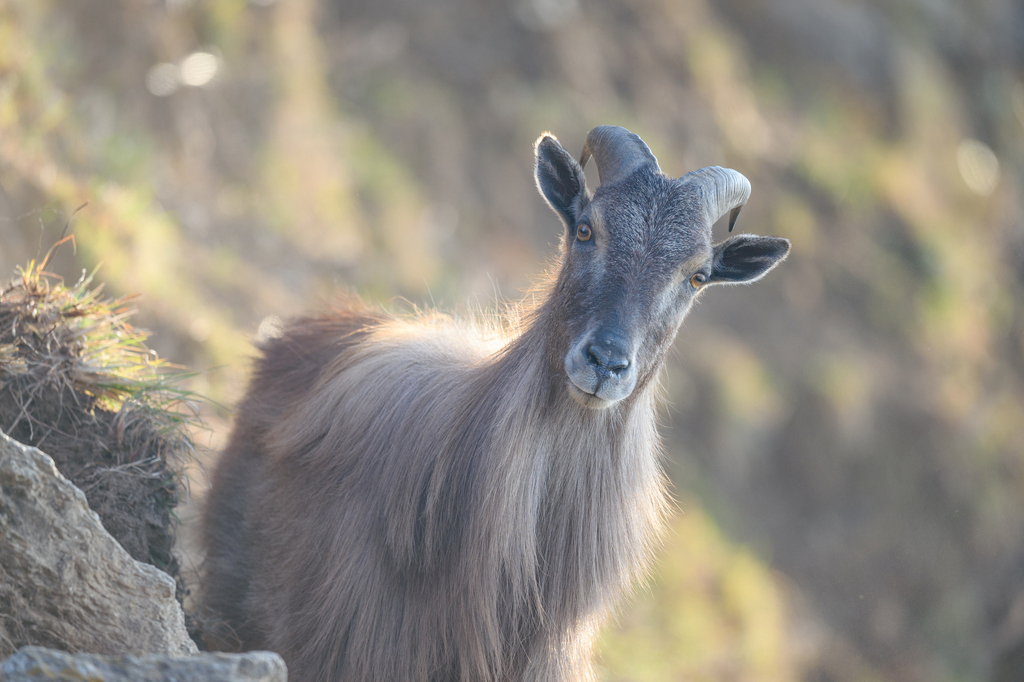
Himalayan Tahr
Photo © Morten Ross
Photo © Morten Ross — CC BY 4.0 — Source: iNaturalist photo #221583829Identification
The Himalayan tahr is a large even-toed ungulate with a compact build, small head, small pointed ears, and large eyes. Males are significantly larger than females, weighing around 73 kg compared to females at 36 kg. Both sexes sport thick, reddish wool coats with dense undercoats adapted to harsh mountain winters; these coats thin and lighten as spring arrives. The most distinctive feature is their backward-curved horns, which reach up to 46 cm in length on males but are considerably shorter on females. This horn curvature serves an important function during mating season, preventing injury during the intense headbutting contests between competing males.
The tahr's hooves are specially adapted mountaineering equipment: they possess a rubber-like core for gripping smooth rock surfaces and keratin-rimmed edges for durability on rough terrain. This unique adaptation gives them exceptional mobility across steep, rocky slopes. Taxonomically, the Himalayan tahr belongs to subfamily Caprinae and is classified as a wild goat, making sheep and goats its closest living relatives.
Range & Habitat
Native to the Himalayas, the Himalayan tahr is found in southern Tibet, northern India, western Bhutan, and Nepal. The species has also been introduced to Argentina, New Zealand, South Africa, and the United States. In their native range, they typically inhabit mountainous slopes between 2,500 and 5,000 meters elevation, though they descend to lower altitudes during winter when snow covers vegetation at higher elevations.
Tahrs favour steep, rocky terrain where vegetation is accessible for browsing and grazing. They often occupy steeper slopes and more rocky ground than competing livestock, demonstrating their exceptional adaptation to extreme alpine conditions. Currently listed as Near Threatened, their population is declining due to hunting pressure and habitat loss.
Behaviour & Diet
Himalayan tahrs are herbivores spending most of their time grazing on grasses and browsing on leaves, shrubs, and fruits. Remarkably, approximately 75% of their diet consists of natural grasses, making them primarily grazers despite their ability to browse. Their relatively short legs are an advantage when reaching for vegetation on steep slopes, allowing them to maintain balance while feeding on shrub leaves and small tree foliage.
Snow leopards are their primary predator. The species exhibits strong sexual dimorphism not only in size but also in behaviour, particularly during the breeding season. Males engage in intense competition, with larger, heavier males and those with higher testosterone levels dominating access to females. Interestingly, coat colour influences reproductive success—males with lighter coats mate more frequently. During the rut, competing males engage in ritualistic headbutting and fighting, losing substantial fat reserves in the process. Females produce precocious young after a gestation period of 180–242 days, typically giving birth to a single kid that can stand shortly after birth. In the wild, Himalayan tahrs typically live 14–15 years, with females often outliving males; the oldest known individual reached 22 years in captivity.
Best Time & Places to See It
Observing Himalayan tahrs requires access to remote alpine terrain in the Himalayas. Winter months offer opportunities to spot them on lower-altitude slopes where they descend to find exposed vegetation beneath the snow line. The species' mobility increases during nighttime hours, so early morning and late afternoon observations on accessible slopes may prove most rewarding.
Their presence in Kedarnath Wildlife Sanctuary in India is well documented. Given their preference for steep, rocky terrain and remote elevations, visitors should be prepared for challenging mountain conditions and should work with experienced local guides familiar with tahr distribution patterns.
Photography Tips
Photograph Himalayan tahrs in their preferred steep, rocky habitat to capture their remarkable adaptation to mountainous terrain. Early morning light reveals the rich reddish tones of their thick winter coats beautifully. Males with lighter-coloured coats are particularly striking subjects and may offer opportunities to document the sexual dimorphism so important to their breeding behaviour.
Winter and early spring provide the best photographic opportunities when thick coats are most prominent and animals are concentrated at lower elevations. Capture the distinctive backward-curved horns and their powerful leg muscles as they navigate steep terrain. If photographing during the rut, be cautious as competing males are highly aggressive and territorial.
Langtang National Park
Helambu, Nepal
+364 birds+14 mammals
Where the southern slopes of the Himalayan highlands descend toward the subtropical valleys of central Nepal, Langtang National Park sprawls across one of the subcontinent's most…
VIEW NATIONAL PARKSagarmatha National Park
Khumjung, Nepal
+219 birds+7 mammals
Soaring peaks and deep glacial valleys define this alpine wilderness in northeastern Nepal, where the terrain rises from forested foothills into a realm of high-altitude tundra…
VIEW NATIONAL PARKNanda Devi National Park
Garpak, India
+218 birds+5 mammals
Where the Himalayas surge into their most dramatic alpine amphitheater, a wilderness of raw geological power unfolds across 624 square kilometers of pristine terrain. Nanda Devi,…
VIEW NATIONAL PARKNo community photos yet. Log in to add the first one.
No community observations of this species yet.