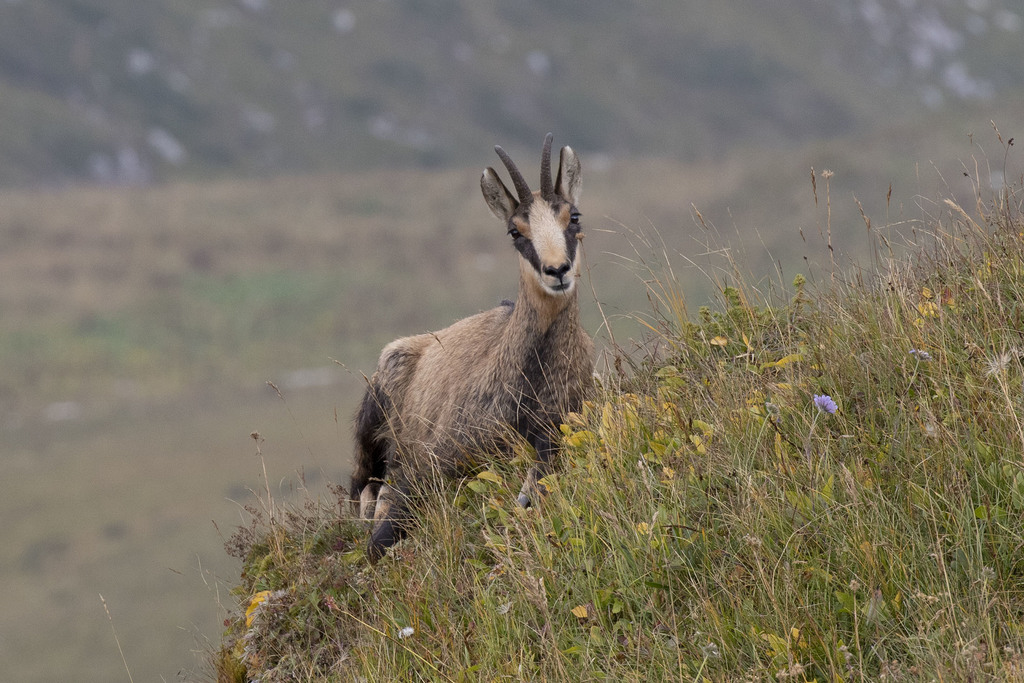
Northern Chamois
Photo © Kristof Zyskowski
Photo © Kristof Zyskowski — CC BY 4.0 — Source: iNaturalist photo #52149518Identification
The Northern Chamois is a small, agile goat-antelope standing just 70–80 cm tall and weighing 25–60 kg, with males noticeably larger than females. Both sexes sport short, straightish horns that hook backwards at the tip, though males have thicker horns. The animal's most striking feature is its seasonal coat change: in summer, the fur displays a rich brown colour, while winter brings a distinctive light grey. Year-round, chamois are marked by white patches on the sides of their head, pronounced black stripes below the eyes, a white rump, and a black stripe running along the back.
Range & Habitat
Native to Europe and Western Asia, the Northern Chamois inhabits the mountain ranges from the Pyrenees and Alps through the Apennines, Carpathians, Balkans, and Caucasus, with introduced populations in New Zealand's South Island. These animals favour precipitous, rugged, rocky terrain at moderately high elevations, reaching at least 3,600 metres.
In Europe, chamois follow a predictable seasonal migration: they spend summer in alpine meadows above the tree line, then descend to around 800 metres during winter to shelter in pine-dominated forests. This vertical migration represents an elegant adaptation to the alpine environment.
Behaviour & Diet
Female chamois are highly social, living in herds of 15–30 individuals together with their young, while adult males are typically solitary. During the rut in late November and early December, males engage in fierce battles for breeding rights. Kids are born singly (rarely in twins) around May or June after a 170-day gestation, weaned at six months, and reach full size within a year, though sexual maturity comes later at three to four years old.
Primarily diurnal, chamois are active grazers that eat highland grasses and herbs in summer, switching to conifers, bark, and needles in winter. They may also forage during moonlit nights. These animals are remarkable athletes, capable of running at 50 km/h and jumping up to 2 metres vertically or 6 metres horizontally, which they use to evade predators through speed and evasion rather than confrontation.
Best Time & Places to See It
Summer is the ideal season for observing Northern Chamois, when they gather in alpine meadows above the tree line across their range in the Alps, Pyrenees, Carpathians, and other European mountain systems. Early morning and evening offer the best viewing opportunities, as chamois are most active while feeding at these times. Winter sightings are possible at lower elevations around 800 metres in pine forests, though the animals are more dispersed. Hunters have long known that chamois tend to look for danger from below, making them vulnerable to approach from above—a useful tip for patient wildlife watchers and photographers.
Photography Tips
Position yourself above chamois when possible, as they naturally scan for threats from below and are less likely to detect you on higher ground. Plan to be active during dawn and dusk when chamois feed most actively and light is often dramatic for photography. The striking seasonal coat changes—rich brown in summer, pale grey in winter—offer contrasting photographic opportunities throughout the year. Capture the distinctive white facial patches and black eye stripes in close-ups, and the white rump is particularly eye-catching when animals bound away. Given their agility and speed, a telephoto lens is essential, and patience is required to capture behaviour shots, particularly during the late autumn rut when males are most visible and active.
Picos de Europa National Park
Posada de Valdeón, Spain
+166 birds+26 mammals
Where limestone massifs rise abruptly from the Castilian plateau, the Picos de Europa create one of Spain's most dramatic mountain wilderness areas. The park's jagged peaks,…
VIEW NATIONAL PARKCévennes National Park
Vebron, France
+187 birds+63 mammals
Where granite gorges slice through the limestone plateaux of southern France, the Cévennes Cœur National Park unfolds across nearly 3,500 square kilometres of one of Europe's…
VIEW NATIONAL PARKMercantour National Park
Isola, France
+146 birds+32 mammals
Where alpine meadows surrender to vertiginous limestone cliffs, the Mercantour's beating heart pulses with Mediterranean and Alpine rhythms. This 4,221-square-kilometre sanctuary straddles France's southeastern border, its…
VIEW NATIONAL PARKÉcrins National Park
La Chapelle-en-Valgaudémar, France
+143 birds+36 mammals
Where granite peaks and Alpine meadows converge across nearly 2,100 square kilometres, Écrins National Park forms one of the wildest mountainous strongholds of the French Alps.…
VIEW NATIONAL PARKVanoise National Park
Val-Cenis, France
+107 birds+29 mammals
Where the French Alps rise in serrated ranks above the Maurienne valley, Vanoise National Park sprawls across more than 1,700 square kilometres of high-altitude wilderness—a realm…
VIEW NATIONAL PARKPirin National Park
Bansko, Bulgaria
+124 birds+10 mammals
Where jagged limestone peaks pierce the Macedonian sky, ancient glacial valleys cradle some of Bulgaria's most pristine wilderness. This southwestern corner of the Balkans rises to…
VIEW NATIONAL PARKRila National Park
Mala tsarkva, Bulgaria
+138 birds+4 mammals
Where granite peaks pierce the Balkan skyline, pristine conifer forests blanket steep mountain slopes in an ecological tapestry that has remained largely undisturbed for centuries. Bulgaria's…
VIEW NATIONAL PARKCentral Balkan National Park
Zhidov dol, Bulgaria
+135 birds+16 mammals
Where granite peaks pierce the Bulgarian highlands, ancient beech and conifer forests blanket mountains that rise dramatically from the Balkan range's heart. This wilderness encompasses three…
VIEW NATIONAL PARKStelvio National Park
Valfurva, Italy
+116 birds+17 mammals
Where granite peaks rise above three thousand metres and alpine meadows give way to rocky scree, Stelvio National Park guards one of Europe's most dramatically vertical…
VIEW NATIONAL PARKGran Paradiso National Park
Cogne, Italy
+120 birds+16 mammals
Where the western Alps rise steeply above the Aosta Valley, granite ridges and alpine meadows converge in a landscape shaped as much by glacial history as…
VIEW NATIONAL PARKDolomiti Bellunesi National Park
Sospirolo, Italy
+76 birds+11 mammals
Where the Dolomites descend into the Veneto foothills near Sospirolo, a landscape of limestone massifs, forested valleys, and rushing waterways creates one of northern Italy's most…
VIEW NATIONAL PARKTatra National Park
Zakopane, Poland
+126 birds+17 mammals
Where the High Tatras rise abruptly from the Carpathian foothills, Tatra National Park protects one of Europe's most dramatic mountain landscapes across its 507 square kilometres.…
VIEW NATIONAL PARKPindos National Park
Ioannina Regional Unit, Greece
+163 birds+12 mammals
Where limestone peaks rise abruptly from the Pindus range in northwestern Greece, a landscape of dramatic gorges, alpine meadows, and dense beech forests creates one of…
VIEW NATIONAL PARKVikos–Aoos National Park
Ioannina Regional Unit, Greece
+136 birds+4 mammals
Where limestone gorges plunge through the Pindus Mountains, the Vikos–Aoos National Park guards one of Greece's most dramatic inland wilderness areas. The park's defining feature is…
VIEW NATIONAL PARKOlympos National Park
Pieria Regional Unit, Greece
+137 birds+3 mammals
Where the Thessalian plains give way to soaring limestone massifs, Olympos National Park rises as one of the Aegean's most dramatic mountain wilderness areas. This IUCN…
VIEW NATIONAL PARKCalanques National Park
Bouches-du-Rhône, France
+233 birds+42 mammals
Where limestone cliffs plunge dramatically into crystalline Mediterranean waters, Calanques National Park preserves one of Europe's most striking coastal landscapes. These steep-sided inlets, carved by erosion…
VIEW NATIONAL PARKBelluno Dolomites National Park
Sospirolo, Italy
+72 birds+10 mammals
Where the Dolomites' pale limestone ramparts rise above the Veneto plain, the Belluno Dolomites National Park encompasses a landscape of profound ecological diversity. The park's subarctic-style…
VIEW NATIONAL PARKVal Grande National Park
Verbano-Cusio-Ossola, Italy
+81 birds+6 mammals
Granite peaks and plunging ravines define this Alpine wilderness where the Toce River carves through one of Italy's most remote mountain landscapes. Straddling the Verbano-Cusio-Ossola district…
VIEW NATIONAL PARKNo community photos yet. Log in to add the first one.
No community observations of this species yet.