Southern Lechwe
Photo © Timothy Whitehead
Photo © Timothy Whitehead — CC BY 4.0 — Source: iNaturalist #187600843Identification
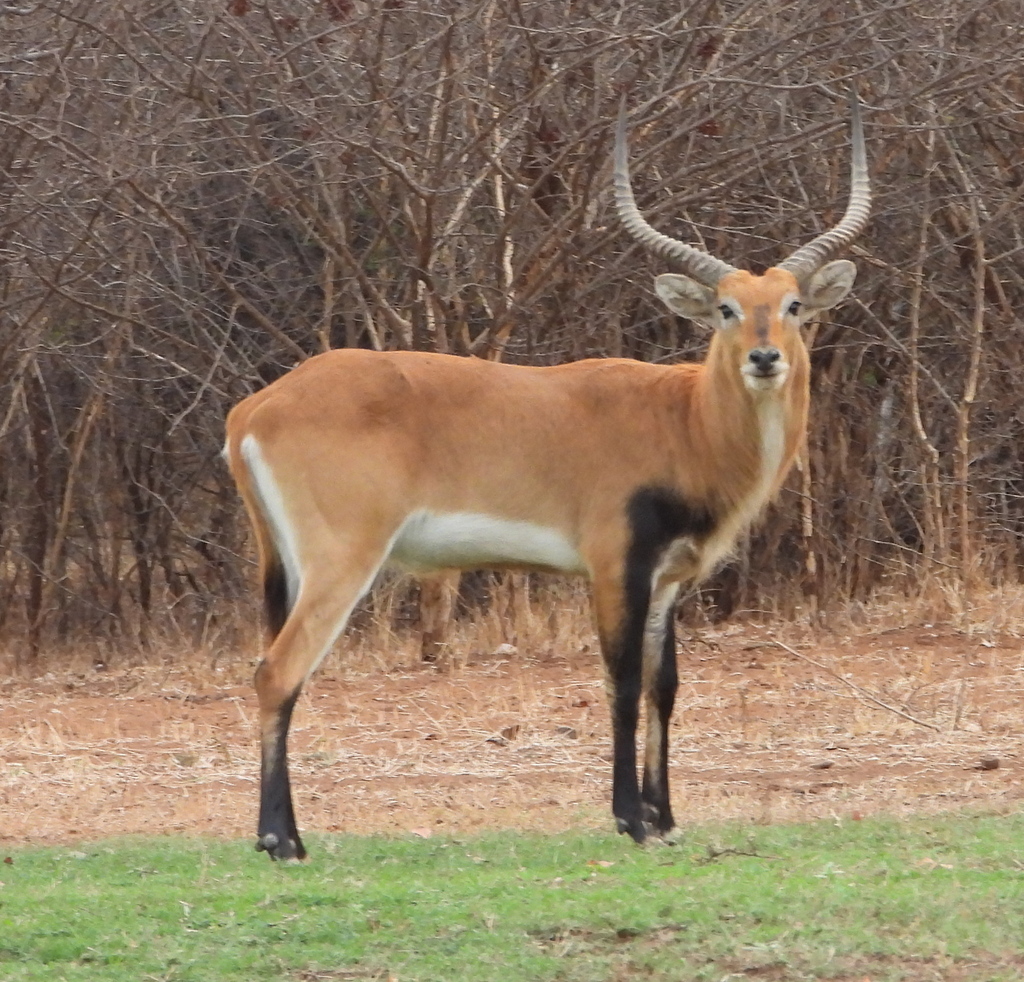
The southern lechwe is a medium-sized antelope standing 90 to 100 cm at the shoulder and weighing between 50 and 120 kg, with males considerably larger than females. They are characterized by their golden-brown colouration with distinctive white bellies. Males are notably darker than females, with varying amounts of blackish markings on the front legs, chest, and body depending on subspecies. The most striking feature is the males' long, spiral horns with a vaguely lyre-shaped curve—females lack horns entirely.
An adaptation to their aquatic lifestyle, lechwe have proportionally longer hind legs compared to other antelopes, facilitating rapid movement across marshy terrain. Their legs are covered in a water-repellant substance that allows them to run at considerable speed even in knee-deep water, a crucial advantage in their wetland habitat.
Range & Habitat
The southern lechwe is native to the wetlands of south-central Africa, occurring in Botswana, Zambia, southeastern Democratic Republic of the Congo, northeastern Namibia, and eastern Angola. Key populations inhabit the Okavango Delta, Kafue Flats, and Bangweulu Wetlands. Four subspecies are recognized across this range, each with distinct distributions and characteristics.
Lechwe are specialist inhabitants of marshy areas where they play an important ecological role as herbivores of aquatic plants and grasses in flooded meadows. They exploit knee-deep water as protection from predators, making wetlands with appropriate water depth essential to their survival and behaviour.
Behaviour & Diet
These antelopes are diurnal herbivores that feed on aquatic plants and grasses found in flooded meadows. Lechwe are intensely gregarious, gathering in herds that can number many thousands of individuals. Remarkably, herds are usually composed of individuals of a single sex, though males and females mix during the mating season, which occurs from November to February during the rainy season.
Calves are primarily born from July to September following a gestation period of seven to eight months. The timing of breeding is closely synchronized with seasonal rainfall patterns, ensuring optimal conditions for calf survival and maternal nutrition.
Best Time & Places to See It
The Okavango Delta in Botswana, the Kafue Flats in Zambia, and the Bangweulu Wetlands offer the best opportunities to encounter southern lechwe in their natural habitat. The mating season from November to February provides opportunities to observe mixed herds and breeding behaviour, while the calving season from July to September offers chances to see young animals alongside adults.
Lechwe are fairly common in zoos and wild animal farms, but wild populations are most active and visible in their wetland habitats during the wet season when water levels support their preferred ecological conditions.
Photography Tips
Photograph lechwe during early morning or late afternoon when light is optimal and animals are most active in the wetlands. The contrast between their golden-brown bodies and white bellies makes for compelling composition, especially when captured against wetland backgrounds. Males' impressive lyre-shaped horns are a striking photographic subject and are easier to capture when animals are alert and moving.
Large herds offer opportunities for dramatic landscape photography incorporating multiple individuals. Capturing them in their characteristic knee-deep water habitat emphasizes their adaptations and ecological role. Patient positioning near known grazing or gathering areas will reward photographers with excellent documentary and artistic images of these specialized antelope.
Chobe National Park
Botswana
+446 birds+45 mammals
Where the Chobe River cuts a sinuous path through northern Botswana, the landscape transforms into one of Africa's most dynamic wetland-savanna mosaics. This national park encompasses…
VIEW NATIONAL PARKNkasa Rupara National Park
Namibia
+283 birds+17 mammals
Where the Zambezi's floodplains spill across the border between Namibia and Botswana, Nkasa Rupara National Park unfolds across 518 square kilometers of wetland and woodland mosaic.…
VIEW NATIONAL PARKBwabwata National Park
Namibia
+377 birds+35 mammals
Where the Kavango River winds through northeastern Namibia, vast floodplains and dense riparian woodland create one of southern Africa's most ecologically dynamic protected landscapes. Spanning 14,249…
VIEW NATIONAL PARKWaterberg Plateau National Park
Okambukonde, Namibia
+198 birds+27 mammals
Where ancient sandstone cliffs rise 200 metres above the surrounding bushveld, a fortress of geology creates one of southern Africa's most compelling ecosystems. The plateau's steep…
VIEW NATIONAL PARKNo community photos yet. Log in to add the first one.
No community observations of this species yet.