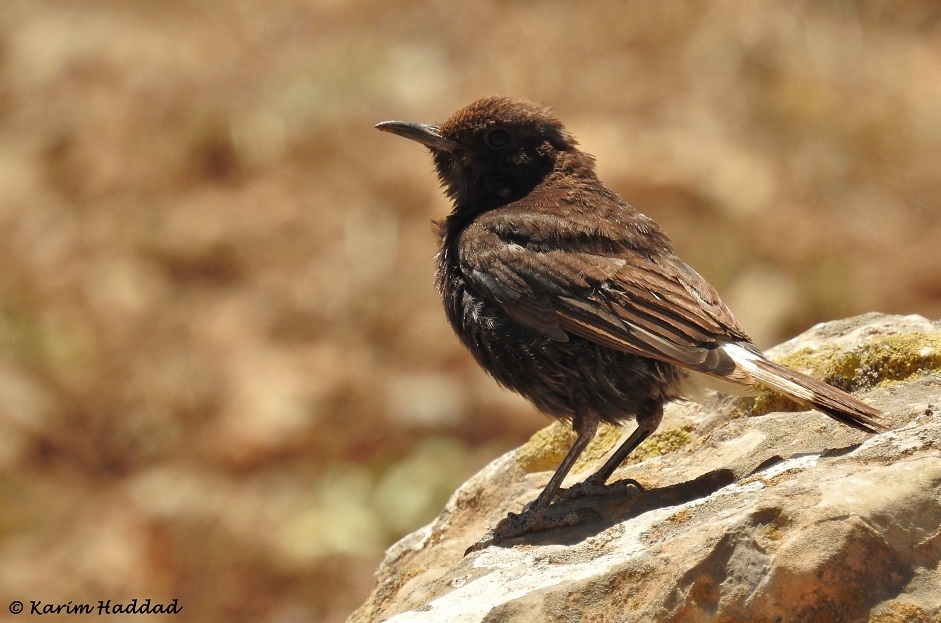
Black Wheatear
Photo © Karim Haddad
Photo © Karim Haddad — CC BY 4.0 — Source: iNaturalist photo #25774274Identification
The Black Wheatear is a large wheatear, measuring 16–18 cm in length. Males are striking birds, appearing almost entirely black except for a distinctive white rump and predominantly white tail. The white tail is marked with a black inverted "T" shape, a key identifying feature. Females are similar in pattern but darker brown rather than pure black. The species has a loud, thrush-like song that carries well across rocky terrain.
The Black Wheatear can be confused with the White-crowned Wheatear, which shares part of its African range. However, the Black Wheatear's diagnostic black inverted "T" marking on its white tail distinguishes it from the White-crowned Wheatear, which has only a black centre to its tail. Additionally, the Black Wheatear never displays a white crown, whereas young White-crowned Wheatears may also lack this feature.
Range & Habitat
The Black Wheatear is found in the Iberian Peninsula and western North Africa. Two subspecies are recognized: O. l. leucura occurs in Portugal, Spain, and southern France, while O. l. riggenbachi is found in northwest Africa. Notably, the species no longer breeds in southern France, representing a range contraction in that region.
This wheatear inhabits cliffs and rocky slopes, preferring the dramatic, exposed terrain typical of Mediterranean and North African mountainous regions. These rocky habitats provide the crevices in which the species nests and the vantage points from which it hunts.
Behaviour & Diet
The Black Wheatear is largely resident throughout its range, meaning populations remain in their territories year-round rather than undertaking long migrations. The species nests in rock crevices, where females typically lay clutches of 3–6 eggs. The loud, thrush-like song is a characteristic behaviour, particularly during the breeding season when males defend territories across the rocky slopes.
The diet of the Black Wheatear consists mainly of insects, which it hunts among the rocky terrain and sparse vegetation of its cliff and slope habitats.
Best Time & Places to See It
The Black Wheatear can be found year-round in its range, as the species is largely resident. However, the breeding season, when birds are most vocal and active, offers excellent viewing opportunities. The species is found in the Iberian Peninsula—particularly Portugal and Spain—and in rocky regions of northwest Africa, where suitable cliff and slope habitats exist.
Photography Tips
Photographers should focus on capturing the striking contrast between the male's black plumage and white rump and tail, particularly the diagnostic black inverted "T" marking on the tail. The bird's preference for rocky, open terrain means good lighting conditions are often available. The loud, thrush-like song means birds are often conspicuous and vocal, making them easier to locate. Patience and a telephoto lens are recommended for capturing details of the tail pattern and plumage from a distance, as the species frequents exposed cliff faces and rocky slopes.
Monfragüe National Park
Torrejón el Rubio, Spain
+219 birds+10 mammals
Where the Tagus River cuts through limestone plateaus in central Extremadura, Monfragüe National Park rises as a fortress of Mediterranean and Atlantic woodland, its dramatic rocky…
VIEW NATIONAL PARKSerra D’Irta Natural Park
Alcossebre, Spain
+122 birds+13 mammals
Where Mediterranean limestone cliffs meet the Balearic Sea, Serra d'Irta unfolds as a tapestry of dramatic coastal terrain and diverse terrestrial habitats. This Category 5 protected…
VIEW NATURAL PARKL’Albufera Natural Park
València, Spain
+321 birds+18 mammals
Where shallow lagoons meet Mediterranean coastal marshland, L'Albufera Nature Park unfolds as one of Spain's most vital wetland complexes. This protected landscape, designated under IUCN Category…
VIEW NATURAL PARKSierra Mágina Natural Park
Bélmez de la Moraleda, Spain
+114 birds+2 mammals
Where limestone ridges rise abruptly from the Jaén countryside, Sierra Mágina unfolds as one of Andalusia's most underrated natural treasures. This protected landscape, anchored by the…
VIEW NATURAL PARKSierra Nevada National Park
Válor, Spain
+137 birds+7 mammals
Where granite ridges rise above 3,000 metres across the Alpujarra foothills, Sierra Nevada National Park crowns southern Spain's most dramatic mountain landscape. The park encompasses a…
VIEW NATIONAL PARKTablas de Daimiel National Park
Daimiel, Spain
+246 birds+6 mammals
Where the Guadiana River spreads into a labyrinth of shallow lagoons and reed beds across the sun-baked plains of central Spain, Tablas de Daimiel National Park…
VIEW NATIONAL PARKCabo de Gata-Níjar Natural Park
San José, Spain
+274 birds+11 mammals
Where volcanic ridges plunge toward the Mediterranean, Cabo de Gata-Níjar Nature Park unfolds across one of Europe's most arid coastlines, a landscape sculpted by tectonic violence…
VIEW NATURAL PARKCabañeros National Park
Retuerta del Bullaque, Spain
+183 birds+8 mammals
Cabañeros National Park is one of Spain’s finest wildlife destinations and one of the best-preserved examples of Mediterranean forest and scrubland in Europe. Located in the…
VIEW NATIONAL PARKSierra de las Nieves National Park
Tolox, Spain
+159 birds+7 mammals
Where limestone summits pierce the Mediterranean sky above Andalusia's coastal ranges, Sierra de las Nieves National Park unfolds across nearly 500 square kilometres of dramatically folded…
VIEW NATIONAL PARKTúria Natural Park
València, Spain
+150 birds+21 mammals
Where the Túria riverbed winds through the lowlands south of Valencia, a sprawling natural park of nearly 440 square kilometres unfolds across one of Spain's most…
VIEW NATURAL PARKSierra de Cazorla, Segura y las Villas Nature Park
Las Canalejas, Spain
+176 birds+21 mammals
Where granite gorges slice through mountainous terrain in eastern Andalusia, the Sierra de Cazorla, Segura y las Villas Nature Park sprawls across more than 5,200 square…
VIEW NATURAL PARKParc del Garraf
Rat-Penat, Spain
+190 birds+15 mammals
Where limestone ridges rise abruptly from the Mediterranean coastal plain, Parc Natural del Garraf unfolds across 319 square kilometers of one of Catalonia's most dramatic protected…
VIEW NATURAL PARKSierra de Andújar Natural Park
Our Lady of Cabeza, Spain
+198 birds+19 mammals
Where granite gorges slice through Mediterranean scrubland and cork forests cascade down Andalusian hillsides, one of Spain's most pristine wilderness areas unfolds across 74,000 hectares of…
VIEW NATURAL PARKEspacio Natural Remolar-Filipinas
El Prat del Llobregat, Spain
+297 birds+7 mammals
Where the Llobregat River delta meets the Mediterranean, a patchwork of salt marshes, reed beds, and shallow lagoons creates one of Catalonia's most dynamic wetland ecosystems.…
VIEW NATURE RESERVESierra de Gredos Regional Park
Candeleda, Spain
+180 birds+18 mammals
Where granite peaks claw at 2,592 metres and alpine meadows give way to cork oak scrubland, Spain's central highlands reveal a landscape of remarkable vertical drama.…
VIEW NATURE RESERVEDirigida Laguna de Gallocanta Nature Reserve
Las Cuerlas, Spain
+250 birds+7 mammals
Where continental steppe meets the vast mirror of inland water, Spain's largest natural lagoon reveals a landscape of haunting beauty. The shallow alkaline lake, cradled in…
VIEW NATURE RESERVEPorts Natural Park
Alfara de Carles, Spain
+157 birds+13 mammals
Where the eastern Catalan ranges descend toward the Mediterranean, a sprawling mosaic of Mediterranean scrubland, pine woodland, and rocky limestone terrain defines Ports Natural Park, a…
VIEW NATURAL PARKSierra y Cañones de Guara Natural Park
Casbas de Huesca/Casbas de Uesca, Spain
+175 birds+10 mammals
Where limestone gorges slice through the pre-Pyrenean foothills of Aragon, the Sierra y Cañones de Guara sprawls across nearly 940 square kilometers of one of Spain's…
VIEW NATURE RESERVESerra de Mariola Natural Park
Bocairent, Spain
+164 birds+19 mammals
Where limestone ridges rise above the Valencian interior, Serra de Mariola unfolds across 225 square kilometers of Mediterranean mountain terrain that shifts between dense evergreen woodland,…
VIEW NATURE RESERVEEstrecho Natural Park
Pedro Valiente, Spain
+281 birds+20 mammals
Where Mediterranean pine forests meet wind-sculpted coastal cliffs, one of Europe's most dynamic ecological crossroads unfolds across the Strait of Gibraltar. Spanning 686 square kilometers of…
VIEW NATURAL PARKSierras Subbéticas Natural Park
Algar, Spain
+156 birds+10 mammals
Where limestone ridges rise abruptly from the Córdoba countryside, the Sierras Subbéticas Nature Park sprawls across nearly 583 square kilometres of one of Andalusia's most rugged…
VIEW NATURAL PARKSierra de Castril Natural Park
Castril, Spain
+110 birds+13 mammals
Where limestone walls rise abruptly from the Guadalentín valley, carving passages of breathtaking drama through Andalusia's interior, one encounters the raw geological theatre of this protected…
VIEW NATURE RESERVENo community photos yet. Log in to add the first one.
No community observations of this species yet.