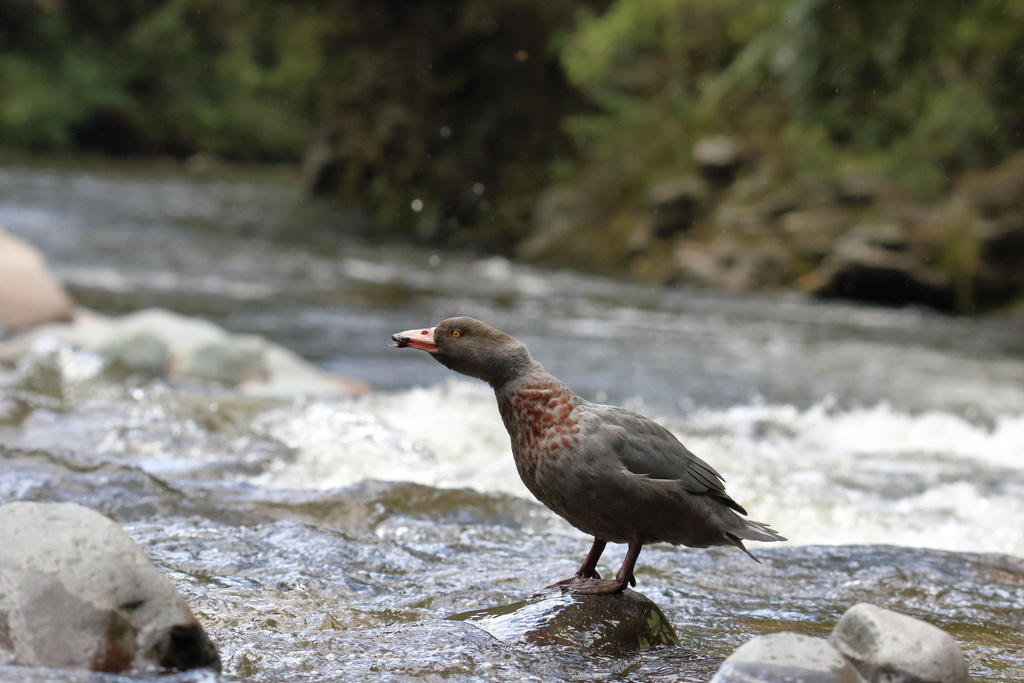
Blue Duck
Photo © Jacob Littlejohn
Photo © Jacob Littlejohn — CC BY-SA 4.0 — Source: iNaturalist photo #119294122Identification
The blue duck, known in New Zealand English by its Māori name whio (pronounced FEE-oh), is a medium-sized duck measuring 50–55 cm in length. Males are noticeably larger than females, weighing 820–970 grams compared to females at 680–870 grams. The most striking feature is its dark slate-grey plumage with a greenish sheen on the head and a chestnut-flecked breast, though females show slightly less chestnut colouration. The bird's distinctive pinkish-white bill has unusual fleshy flaps of skin hanging from its sides—a unique characteristic that gives the species its scientific name malacorhynchos, meaning "soft bill." The outer wing feathers are tipped with white, while the inner secondaries have black margins. The sexes are otherwise similar in appearance.
Range & Habitat
The blue duck is endemic to New Zealand, found nowhere else in the world. Two subspecies are recognized: one in the central and south North Island, and a slightly larger nominate subspecies in the west South Island. The species is strongly associated with cold, fast-flowing, well-oxygenated mountain streams and rivers. Blue ducks are remarkably sedentary, with juveniles typically establishing territories near their natal catchment, rarely venturing beyond it. This territorial fidelity creates populations with high genetic similarity within individual river systems.
Behaviour & Diet
Blue ducks are found year-round as territorial pairs along rivers, with males holding their territories for life. Single males occasionally attempt to establish new territories between existing pairs. The whio's common name derives from the male's distinctive high-pitched, wheezy whistle, while females produce rattling growls or low-pitched grating calls. The species feeds almost entirely on aquatic invertebrate larvae, particularly midge and caddisfly larvae, supplemented with mayfly, crane fly, and stonefly larvae. They also consume silt, periphyton, and berries from riverside plants.
Blue ducks forage primarily by dabbling on invertebrates in their fast-flowing stream habitat, with a distinctive foraging technique involving scouring rocks rather than surface dabbling. They also occasionally dive to feed. Adult territorial birds show increased foraging activity during early morning and late evening, capitalizing on invertebrate drift—the natural downstream movement of invertebrates washed from rocks—which renews the food resource. These ducks employ both visual and tactile foraging techniques, using forward-facing eyes to locate mobile prey such as mayfly larvae on rock surfaces.
Best Time & Places to See It
Blue ducks are present year-round in their river territories, making them potentially viewable at any season. However, their strongly territorial and sedentary nature means they occupy specific stretches of mountain rivers and streams, particularly in the North Island's central regions and the South Island's western areas. Visitors should focus on cold, clear, fast-flowing mountain waterways where the species has established territories. The whio's iconic status in New Zealand is reflected in its appearance on the reverse of the country's $10 banknote.
Photography Tips
Photographing blue ducks requires patience and knowledge of their specific river territories. Since they are year-round residents, timing is flexible, but early morning and late evening offer the best opportunities when territorial birds exhibit peak foraging activity. The distinctive slate-grey plumage with greenish head sheen and chestnut breast markings photograph well in natural light, and the unique fleshy bill lobes are a key identifying feature worth capturing. The species' preference for cold, clear mountain streams means these photogenic habitats provide excellent compositional opportunities. Approach quietly along river edges, as these territorial ducks are sensitive to disturbance, and use longer focal lengths to maintain distance while capturing behavioural details of foraging and interaction with their stream environment.
Abel Tasman National Park
Arthur’s Pass National Park
Egmont National Park
Fiordland National Park
Kahurangi National Park
Mount Aspiring National Park
Nelson Lakes National Park
Paparoa National Park
Te Urewera
Nothing matches these filters.
No community photos yet. Log in to add the first one.
No community observations of this species yet.