Hide 9 Pins
Iberian Green Woodpecker · Great Spotted Woodpecker+17
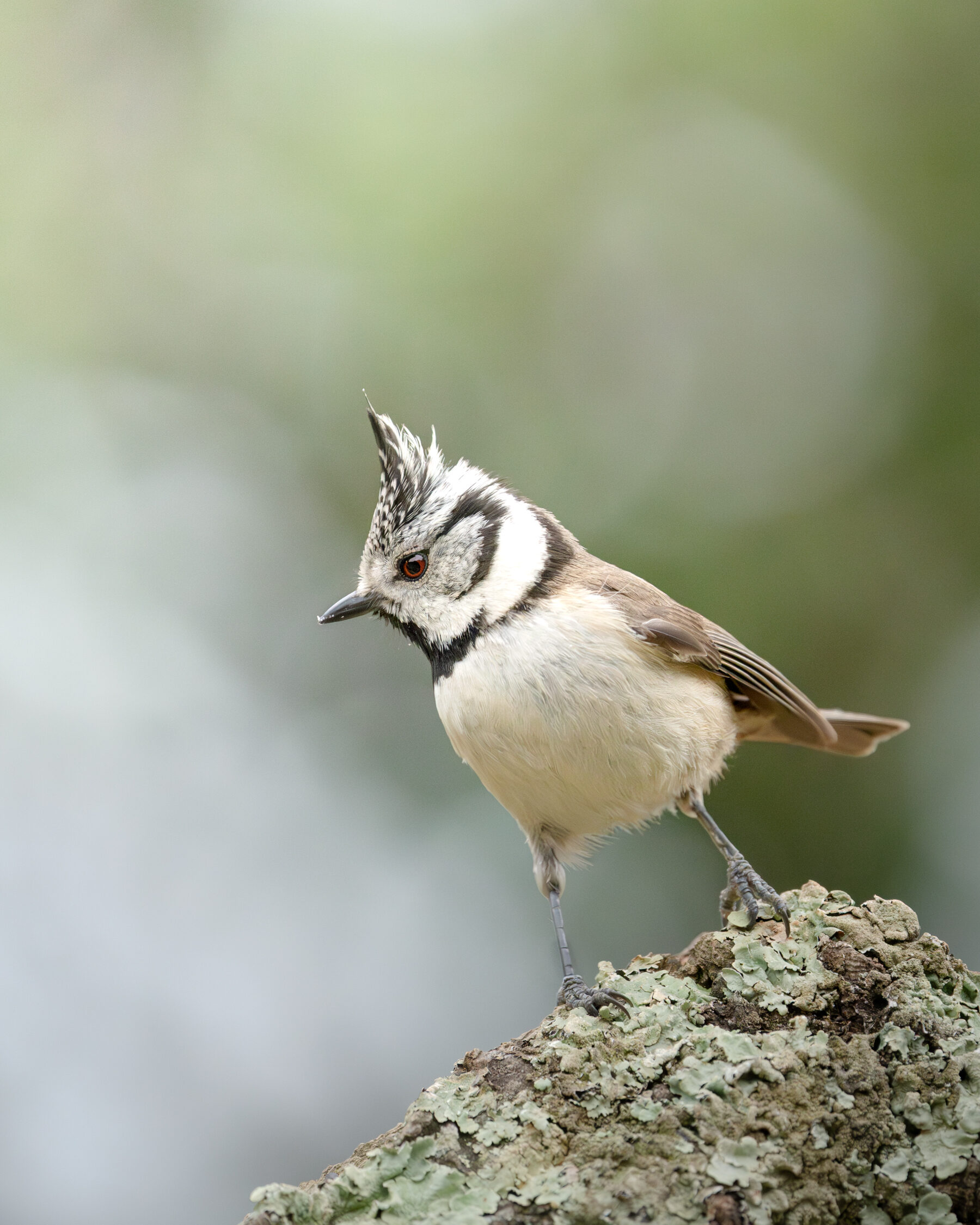
The Crested Tit is instantly recognizable among European tits thanks to its distinctive erectile crest, whose tip is often recurved or curved backward, giving the bird a characteristic silhouette. Beyond this striking head feature, look for the bird's gorget (throat patch) and collar markings, which are equally diagnostic. Like other members of the tit family, the Crested Tit is a talkative species, producing a constant, distinctive "zee, zee, zee" call that resembles that of the Coal Tit and can aid identification by ear as well as sight.
This widespread and common resident breeder is found throughout central and northern Europe, where it inhabits coniferous forests as its primary habitat. In France and the Iberian Peninsula, it also frequents deciduous woodlands, showing greater habitat flexibility in these regions. In Great Britain, the species is mainly restricted to the ancient pinewoods of Inverness and Strathspey in Scotland, where it rarely strays far from these established territories. Vagrant individuals have occasionally been recorded in England, though sightings remain rare.
The Crested Tit is resident throughout its range, meaning most individuals do not migrate and remain in their territories year-round, making it a reliable species for observation within its established range.
The Crested Tit is a social bird typically found in pairs, though it will join mixed flocks of other tit species during winter months. Despite being talkative and reasonably approachable, the species is not always easily observed, as it often forages low down in trees where dense foliage can obscure views. The bird nests in holes within rotting stumps and fallen wood, relying on natural cavities for breeding sites.
Like other tits, the Crested Tit is an opportunistic forager with a varied diet comprising both insects—including caterpillars—and seeds. This dietary flexibility, combined with its year-round residency, allows the species to persist in northern forests even during harsh winters.
For travellers and photographers seeking the Crested Tit in Great Britain, Scotland's ancient pinewoods around Inverness and Strathspey offer the most reliable opportunities. Elsewhere in Europe, coniferous forests throughout central and northern regions, as well as mixed and deciduous woodlands in France and the Iberian Peninsula, are productive locations. Since the species is resident year-round and does not migrate, it can be encountered at any season, though winter months may offer better visibility as birds become more active in flocks.
Photographing the Crested Tit requires patience and attention to its favoured microhabitats. Focus your efforts on conifers and mixed woodlands, and listen for the distinctive "zee, zee, zee" call to locate birds. The species often forages low in trees, so position yourself to capture the characteristic crest and gorget markings in good light. Early morning or late afternoon typically offers the best light in forest environments. Since the bird is not always easily approached despite being relatively tame, use a longer lens and move slowly to avoid flushing birds from their feeding areas.
Nothing matches these filters.
Nothing matches these filters.
Nothing matches these filters.
No community observations of this species yet.
We'd love to hear from you. We'll reply as soon as possible.
Found an error? Have a suggestion? We read every message.
A compact view of how this species lives, moves and responds to its environment.
Select a card to explore the details.
Please confirm the photo rights and credit terms first.
I'm the author of this photo or hold the rights to it, and I keep full ownership. I grant Wild Atlas Guide a free, non-exclusive licence to display it on the site and in Wild Atlas Guide's own channels, including social media, always credited to me by my display name or the Instagram handle I choose to provide. I confirm it does not reveal a sensitive wildlife location or a recognisable person without their permission. I can withdraw future social use for this photo or ask for it to be removed at any time.
Please accept the photo rights and credit terms to continue.
Uploading…
We use cookies to measure traffic and improve Wild Atlas Guide. You decide. Privacy policy