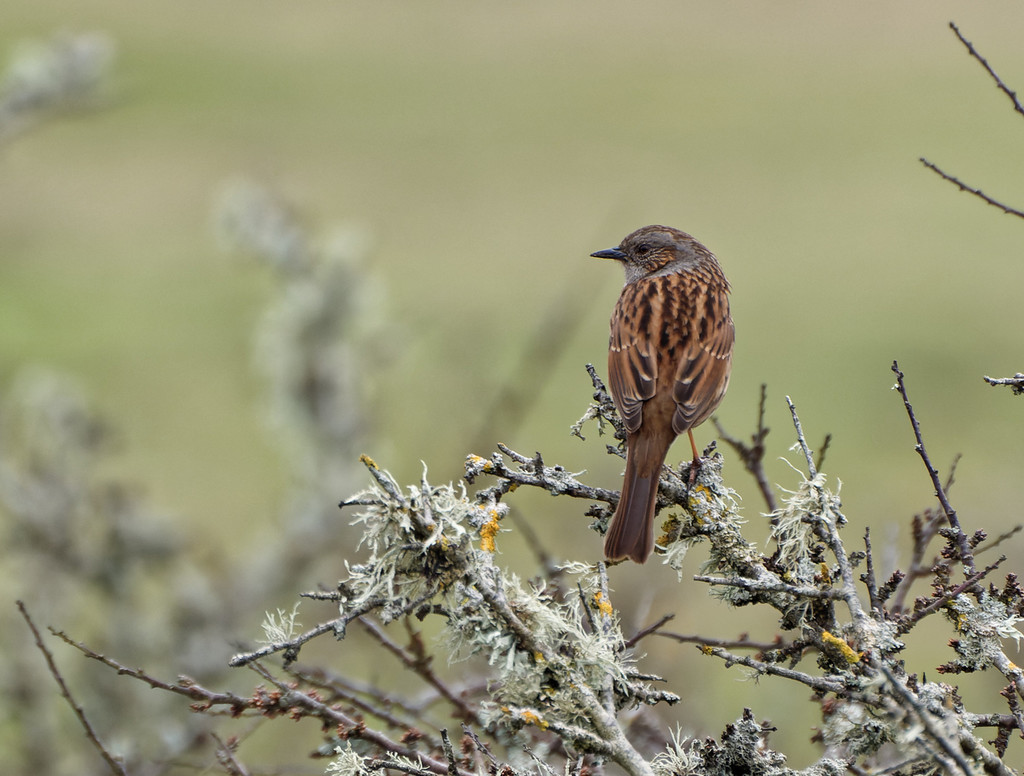
Dunnock
Photo © Donald Davesne
Photo © Donald Davesne — CC BY 4.0 — Source: iNaturalist #70224393Identification
The dunnock is a robin-sized bird, measuring 13–14.5 cm in length, with a drab brown back streaked with black that resembles a small house sparrow. Its inconspicuous plumage—brownish underneath with a dull grey head—may have evolved as camouflage to avoid predation. Both sexes are similarly coloured, though juveniles appear browner on the head with looser, fluffier feathering and more obvious streaking. A fine pointed bill distinguishes it from other small brown European birds. The dunnock's most distinctive behavioural feature is its frequent wing flicking, particularly during territorial disputes or mating competition, earning it the old nickname "shufflewing." Its shrill, persistent tseep call and short, weak trilling note reveal its otherwise inconspicuous presence, while its song is rapid, thin and tinkling—a sweet warble that belies its modest appearance.
Range & Habitat
The dunnock is found throughout temperate Europe and into Asian Russia, inhabiting much of Eurasia including Lebanon, northern Iran, and the Caucasus. It is the most widespread member of the accentor family and the only accentor commonly found in temperate lowland areas; most other accentors are restricted to mountain or subarctic habitats. The species favours woodlands, shrubs, gardens, and hedgerows where it typically forages on the ground. Dunnocks were intentionally introduced to New Zealand during the 19th century and are now widely distributed across the country and some offshore islands.
Behaviour & Diet
Dunnocks are highly territorial birds that may engage in conflict with others encroaching on their nests. They exhibit complex social and mating systems: males sometimes share territories with a strict dominance hierarchy, though this social rank does not guarantee reproductive success. Females are often polyandrous, breeding with two or more males simultaneously—a trait rare among birds. This multiple mating system drives intense sperm competition, with males attempting to ensure paternity through cloaca pecking to stimulate ejection of rivals' sperm. DNA fingerprinting has shown that chicks within a single brood often have different fathers. Female territorial ranges are typically exclusive, while male ranges vary according to food distribution and female availability. The birds feed primarily on the ground, seeking out detritivores as food.
Best Time & Places to See It
Dunnocks are found year-round throughout their range in Europe and Asia, making them accessible to travellers and birdwatchers in any season. They are common in gardens, parks, woodlands, and hedgerows across the British Isles, continental Europe, and into Russia. In New Zealand, they have become widespread and may be encountered in suitable habitats throughout the country and offshore islands. Their preference for dense vegetation and ground-feeding behaviour means they are often seen skulking among shrubs and undergrowth rather than in open areas.
Photography Tips
The dunnock's drab plumage and preference for dense shrubby habitats present a challenge for wildlife photographers. Position yourself near hedgerows, garden borders, or woodland edges where dunnocks forage. Early morning or late afternoon light will help reveal the subtle grey tones of the head and the blackish streaking on the brown back. Watch for their distinctive wing-flicking behaviour, especially during spring when territorial disputes and mating activities intensify—these moments provide dynamic photo opportunities. Their ground-feeding habits mean low camera angles can be effective. Patience is essential, as their inconspicuous nature means they spend much time concealed; wait quietly near suitable habitat and you may be rewarded with views of this modest but fascinating species.
12 Days Birds & Wine Programme in Portugal
Nothing matches these filters.
Abel Tasman National Park
Abruzzo, Lazio and Molise National Park
Aggtelek National Park
Alpilles Regional Nature Park
Alta Murgia National Park
Aoraki / Mount Cook National Park
Appennino Lucano Val d’Agri Lagonegrese National Park
Appennino Tosco-Emiliano National Park
Arthur’s Pass National Park
Nothing matches these filters.
No community photos yet. Log in to add the first one.
No community observations of this species yet.