Identification
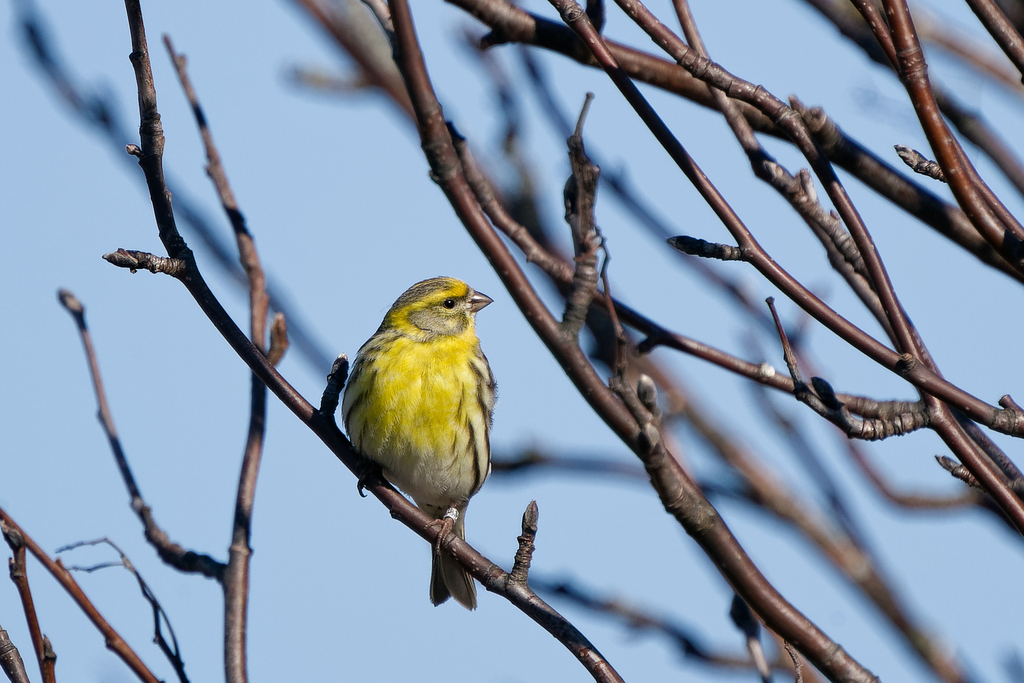
The European serin is the smallest member of the finch family, measuring just 11–12 cm in length with a characteristically short tail. Males are particularly striking, displaying a bright yellow face and breast with yellow wing bars and yellow sides to the tail. Both sexes show a distinctive yellow rump contrasting with dark-streaked, greyish-green upper parts, while the yellow breast and white belly are heavily streaked. The bird's song is a distinctive buzzing trill, a familiar sound throughout Mediterranean regions.
Range & Habitat
The European serin breeds across southern and central Europe and North Africa. Southern and Atlantic coast populations are largely resident year-round, while northern breeders migrate further south in Europe during winter months. The species favours open woodland and cultivated areas, often where conifers are present. It typically builds its nest in shrubs or trees, laying 3–5 eggs per breeding season.
Behaviour & Diet
This active and conspicuous bird is highly mobile and gregarious outside the breeding season, often forming flocks that may mix with other finch species. The diet consists mainly of seeds throughout the year, supplemented with insects during the breeding season when feeding demands are highest. The serin's close relationship to the Atlantic canary is reflected in both its appearance and feeding ecology.
Best Time & Places to See It
Year-round residents can be found in southern and Atlantic coastal regions throughout the year. For visitors to central and northern European breeding areas, late spring through early autumn offers the best opportunities, before northern populations migrate southward for winter. Mediterranean countries provide the most reliable and conspicuous sightings, where the bird's buzzing trill song makes it both visually and aurally detectable.
Photography Tips
The male's bright yellow plumage and contrasting facial markings make it a rewarding subject for photographers. Look for the bird in open woodland margins and cultivated areas with scattered conifers, where it often perches openly while feeding or singing. The short tail and compact shape require moderate telephoto lenses, while the bird's active nature demands quick focusing and fast shutter speeds to capture its movements among vegetation.