Little Bustard
Photo © MATVEY KALACHEV
Photo © MATVEY KALACHEV — CC BY 4.0 — Source: iNaturalist photo #655964047Identification
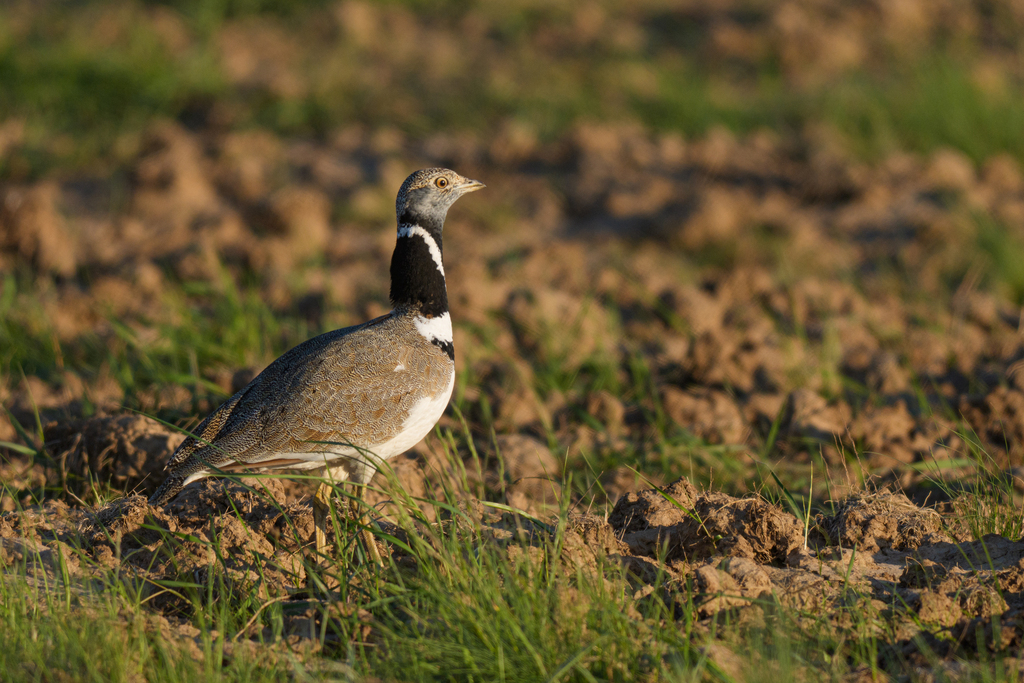
The little bustard is the smallest Palearctic bustard, yet still substantial at 42–45 cm long with a wingspan of 90–110 cm. In flight, its long wings display extensive white patches, making it instantly recognisable against open landscapes. The breeding male is particularly striking: brown upperparts contrast sharply with white underparts, a grey head, and a distinctive black neck bordered above and below by white stripes. Females and non-breeding males lack this dramatic neck pattern and are marked darker below, while immature birds resemble females. Both sexes typically remain silent, though males produce a distinctive "raspberry-blowing" call—a sharp prrt sound.
Range & Habitat
This species breeds across Southern Europe and Western and Central Asia, with southernmost European populations being largely resident while others migrate further south during winter. The little bustard favours open grassland and undisturbed cultivation where vegetation provides adequate cover. Sadly, the species is in decline throughout its range due to habitat loss; populations that once extended as far north as Poland and Hungary have disappeared. It remains only a rare vagrant to Great Britain, despite breeding populations in France.
Behaviour & Diet
Little bustards are omnivorous, feeding on seeds, insects, rodents and reptiles. They are characteristically gregarious, especially in winter, and display a stately, slow walk across open ground, preferring to run rather than fly when disturbed. Males undertake nocturnal migrations, making frequent stopovers in both non-irrigated and irrigated croplands to reach more productive agricultural areas after breeding.
During the breeding season, males perform spectacular flamboyant displays involving foot stamping and dramatic leaps into the air to attract females. Females lay 3 to 5 eggs directly on the ground, following the typical bustard breeding strategy.
Best Time & Places to See It
To encounter little bustards, focus on open grasslands and cultivated areas across Southern Europe and Western and Central Asia where their preferred habitats remain intact. Southernmost populations may be found year-round, while northern populations are best sought during the breeding season when males are most visible and vocal during their displays. Winter months may offer opportunities to observe gregarious flocks in their wintering grounds further south.
Photography Tips
Photograph breeding males during their spectacular leaping displays for dramatic action shots showcasing their distinctive black and white neck pattern and grey head. In flight, capture the striking white wing patches that make this species unmistakable. Early morning or late afternoon light will best highlight the contrast between their brown upperparts and white underparts. Exercise patience in open grassland habitats where their preference for running over flying may provide extended viewing opportunities before they disappear into vegetation.
Monfragüe National Park
Torrejón el Rubio, Spain
+219 birds+10 mammals
Where the Tagus River cuts through limestone plateaus in central Extremadura, Monfragüe National Park rises as a fortress of Mediterranean and Atlantic woodland, its dramatic rocky…
VIEW NATIONAL PARKDoñana National Park
Hinojos, Spain
+300 birds+13 mammals
Where the Guadalquivir River delta spreads into the Atlantic, vast marshes, cork woodlands, and coastal dunes converge to create one of southwestern Europe's most biodiverse wetland…
VIEW NATIONAL PARKTablas de Daimiel National Park
Daimiel, Spain
+246 birds+6 mammals
Where the Guadiana River spreads into a labyrinth of shallow lagoons and reed beds across the sun-baked plains of central Spain, Tablas de Daimiel National Park…
VIEW NATIONAL PARKDelta de l’Ebre Natural Park
Eucaliptus, Spain
+341 birds+18 mammals
Where the Ebro River spreads into a vast labyrinth of shallow lagoons, reed beds, and brackish marshes before surrendering to the Mediterranean, one of southern Europe's…
VIEW NATURAL PARKDanube Delta Biosphere Reserve
Tulcea, Romania
+277 birds+27 mammals
Where the Danube surrenders to the Black Sea, a vast labyrinth of channels, reed beds, and freshwater lakes sprawls across nearly 13,400 square kilometers of eastern…
VIEW NATIONAL PARKCabañeros National Park
Retuerta del Bullaque, Spain
+183 birds+8 mammals
Cabañeros National Park is one of Spain’s finest wildlife destinations and one of the best-preserved examples of Mediterranean forest and scrubland in Europe. Located in the…
VIEW NATIONAL PARKCévennes National Park
Vebron, France
+187 birds+63 mammals
Where granite gorges slice through the limestone plateaux of southern France, the Cévennes Cœur National Park unfolds across nearly 3,500 square kilometres of one of Europe's…
VIEW NATIONAL PARKHortobágy National Park
Hortobágy, Hungary
+260 birds+17 mammals
Across the North Great Plain of Hungary stretches one of Europe's most expansive semi-natural grassland systems, where horizon-wide vistas of steppe and wetland create a landscape…
VIEW NATIONAL PARKCamargue Regional Nature Park
Saintes-Maries-de-la-Mer, France
+378 birds+48 mammals
Where the Rhône Delta sprawls into the Mediterranean, a landscape of stark and haunting beauty emerges—vast salt marshes punctuated by shallow lagoons, reed beds, and scrubland…
VIEW NATURAL PARKDirigida Laguna de Gallocanta Nature Reserve
Las Cuerlas, Spain
+250 birds+7 mammals
Where continental steppe meets the vast mirror of inland water, Spain's largest natural lagoon reveals a landscape of haunting beauty. The shallow alkaline lake, cradled in…
VIEW NATURE RESERVEEstrecho Natural Park
Pedro Valiente, Spain
+281 birds+20 mammals
Where Mediterranean pine forests meet wind-sculpted coastal cliffs, one of Europe's most dynamic ecological crossroads unfolds across the Strait of Gibraltar. Spanning 686 square kilometers of…
VIEW NATURAL PARKZakaznik Stepnoy/Tinguta
Лиманский муниципальный округ, Russia
+52 birds+3 mammals
Where the Volga Delta meets the Caspian steppe, roughly 1,205 square kilometres of protected landscape unfold across Liman Municipality in Astrakhan Oblast—a mosaic of reed beds,…
VIEW NATIONAL PARKKerkini Lake National Park
Serres, Greece
+291 birds+18 mammals
Where the Strymon River widens into a sprawling freshwater lake hemmed by the Rhodope Mountains, Kerkini National Park unfolds across northern Greece as one of southeastern…
VIEW NATIONAL PARKCabo Peñas
Susacasa, Spain
+303 birds+21 mammals
Where sea cliffs rise sheer from the Bay of Biscay, Susacasa's observation point commands one of Asturias's most dramatic coastal vistas. The landscape here is defined…
VIEW OBSERVATION POINTNo community photos yet. Log in to add the first one.
No community observations of this species yet.