Identification
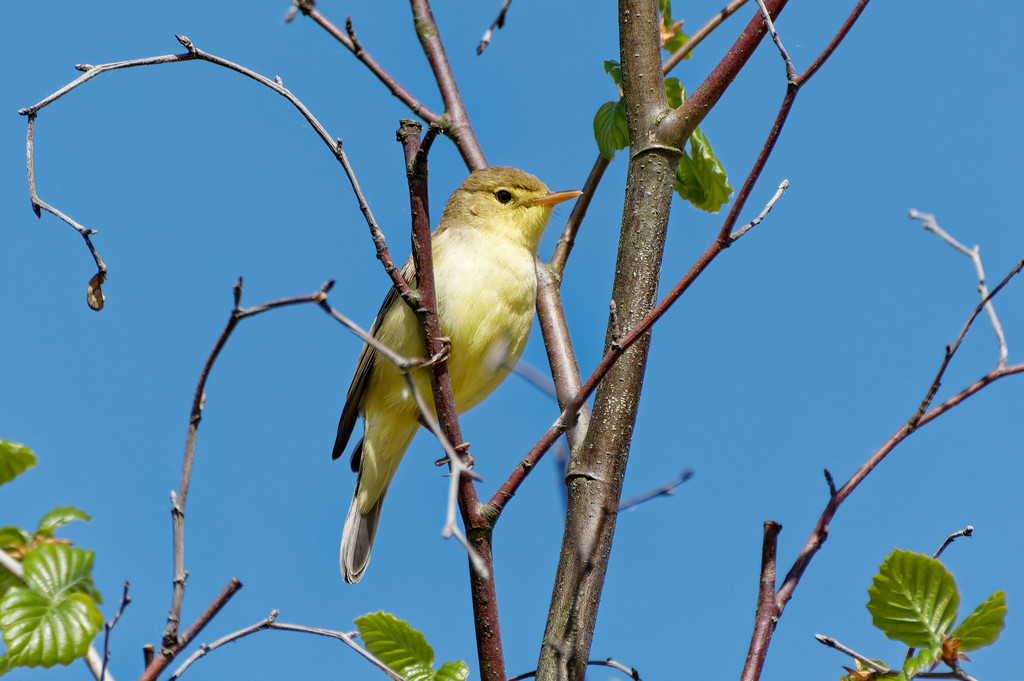
The melodious warbler is a medium-sized warbler, measuring 12 to 13 cm in length. Adults display a plain brown back and wings contrasted with distinctly yellowish underparts, giving them a warm, subtle appearance. Compared to their close eastern relative, the icterine warbler, melodious warblers have rather browner upper parts and yellower underparts. Both sexes are identical in plumage, though young birds appear paler on the belly. The bird sports a strong, pointed bill and brown legs, typical features of the warbler family.
Range & Habitat
The melodious warbler is a migratory species with a broad breeding range across southwest Europe and northwest Africa. Their breeding territory extends from the Iberian Peninsula eastwards through France to Germany and Italy, while in North Africa they occupy Western Sahara, Mauritania, Algeria, Morocco and Tunisia. They are common birds throughout much of their wide range and are rated as "least concern" for conservation.
These warblers favour open woodland with dense bushes and thickets. They are equally at home in forest edges, riverside vegetation, orchards and gardens—any habitat offering good cover and abundant insects. Their wintering grounds lie in sub-Saharan Africa, principally in West Africa, making them true long-distance migrants.
Behaviour & Diet
The melodious warbler is primarily insectivorous but will supplement its diet with small berries and other food items as available. Like most warblers, it is an active forager, gleaning insects from vegetation throughout its habitat.
The bird's vocalizations are distinctive and rather charming. Its song is a pleasant, fluent and sustained babbling that is more continuous than that of the icterine warbler, though notably less varied and without the mimicked sounds found in its eastern cousin. Other calls include a rattling "trrrr" reminiscent of a house sparrow, a quiet "tuk", and a chattering "chret-chet". Breeding birds lay three to five eggs in carefully constructed nests woven from fine grasses, stems, soft twigs, bark flakes and lichen, typically positioned in trees or bushes.
Best Time & Places to See It
Spring and early summer are the optimal times to encounter melodious warblers on their breeding grounds in southwest Europe and North Africa. Look for them in suitable bushy habitats from the Iberian Peninsula through France, Germany and Italy, or in the North African breeding areas. They are common throughout their range, making them a reliably achievable sighting for travellers visiting appropriate habitat during the breeding season.
Photography Tips
The melodious warbler's plain plumage and preference for dense vegetation present typical warbler photography challenges. Position yourself near flowering or fruiting bushes and scrubby woodland where these birds actively forage. Early morning often brings the most activity and better light. The yellowish underparts and brown upperparts provide subtle but sufficient contrast for photography, though a patient approach is essential—these are active, restless birds that rarely stay still for long.