Identification
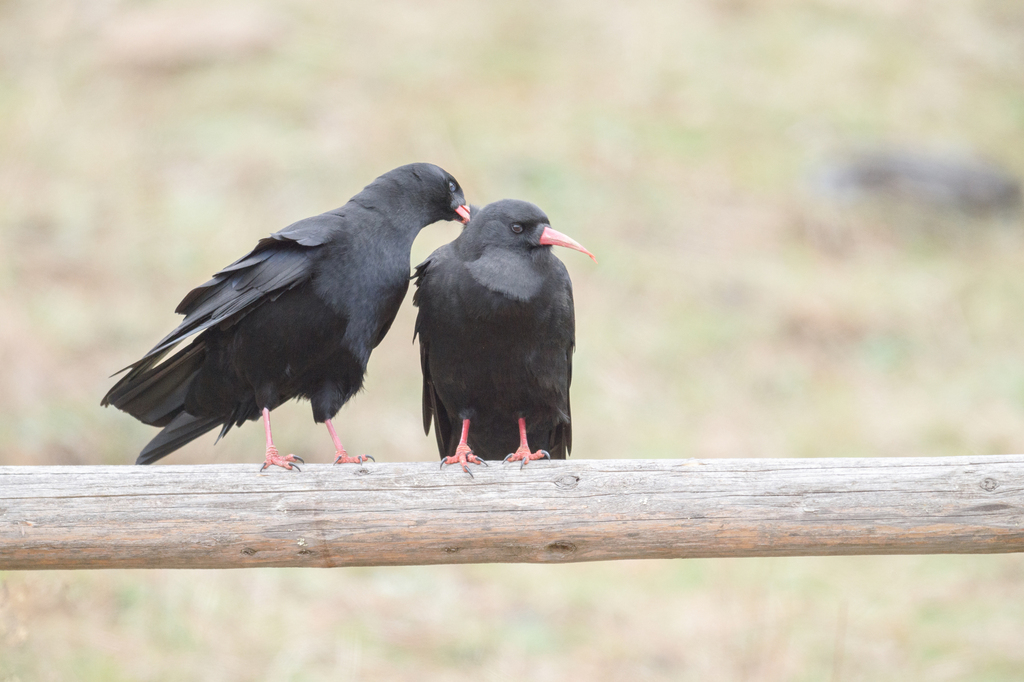
The red-billed chough is a striking member of the crow family, immediately recognisable by its glossy black plumage combined with a distinctive long curved red bill and matching red legs. The bird's feathers display a subtle green gloss across the body, giving it an iridescent quality in good light. Adults of the nominate subspecies measure 39–40 centimetres in length with a wingspan of 73–90 centimetres. The sexes are similar in appearance, making field identification straightforward: the bold red bill and legs are diagnostic among European corvids.
Eight subspecies exist across the bird's range, with subtle variations in size and plumage tone. Some eastern populations show blue or purple-blue glossed feathers, while African forms tend toward duller plumage. The bird's most characteristic feature remains its loud, ringing call, which echoes across cliff faces and open country where it forages.
Range & Habitat
The red-billed chough breeds across mountains and coastal cliffs from the western coasts of Ireland and Britain east through southern Europe, North Africa, the Middle East, Central Asia, and extending to India and China. The nominate subspecies is restricted to Ireland, the Isle of Man, and western regions of Wales, southwest Scotland, and Cornwall—notably recolonising Cornwall in 2001 after an absence of 50 years. Other subspecies occupy distinct ranges: North African and Canary Island populations, Ethiopian highlands, continental European regions from Greece to Afghanistan, and extensive Asian distributions from the Himalayas to Siberia and China.
The species favours short grazed grassland adjacent to cliff faces, caves, and crevices where it breeds and roosts. This habitat preference makes it vulnerable to changes in agricultural practices, which have driven population declines and range fragmentation in Europe, though the species remains widespread globally.
Behaviour & Diet
Red-billed choughs are highly social birds that often feed in flocks on short grazed grassland, foraging primarily for invertebrate prey. They are renowned for their buoyant, acrobatic flight, characterised by widely spread primaries that allow remarkable manoeuvrability as they traverse cliff faces and open terrain. Their loud, ringing call is a familiar sound in their habitat.
The species exhibits strong site fidelity, with pairs bonding for life and returning to the same breeding sites, typically caves or crevices in cliff faces. They build wool-lined stick nests and typically lay three eggs per clutch. Although subject to predation and parasitism, their primary conservation challenge stems from agricultural intensification, which has reduced suitable foraging habitat across their European range.
Best Time & Places to See It
The red-billed chough is most readily observed in areas with suitable cliff habitat and adjacent grassland. In Britain and Ireland, the western coasts of Wales, southwest Scotland, and the recolonised populations of Cornwall offer the best opportunities for northern European travellers. The bird's recovery in Cornwall since 2001 represents a notable conservation success, making this historic stronghold increasingly reliable for sightings.
Continental populations can be encountered across southern Europe, particularly in mountainous and coastal regions with suitable habitat. The species' preference for open country and cliffs makes it relatively easy to spot when present, particularly when birds are foraging in flocks across grassland during daylight hours.
Photography Tips
The red-billed chough's glossy black plumage, red bill, and red legs provide excellent contrast for photography, particularly in bright conditions that emphasise the iridescent green gloss on the body feathers. The bird's acrobatic flight and buoyant wing-beats offer dynamic shooting opportunities as it manoeuvres along cliff faces. Position yourself with cliff faces as a backdrop to capture the bird's characteristic aerial displays.
Early morning light is ideal for revealing the subtle plumage details and glossy texture. The bird's habit of foraging in flocks on open grassland provides opportunities for wider landscape shots that convey the dramatic coastal or mountain habitat it favours. Patience near known breeding cliffs or regular foraging areas will reward photographers with close approaches to feeding birds.