Identification
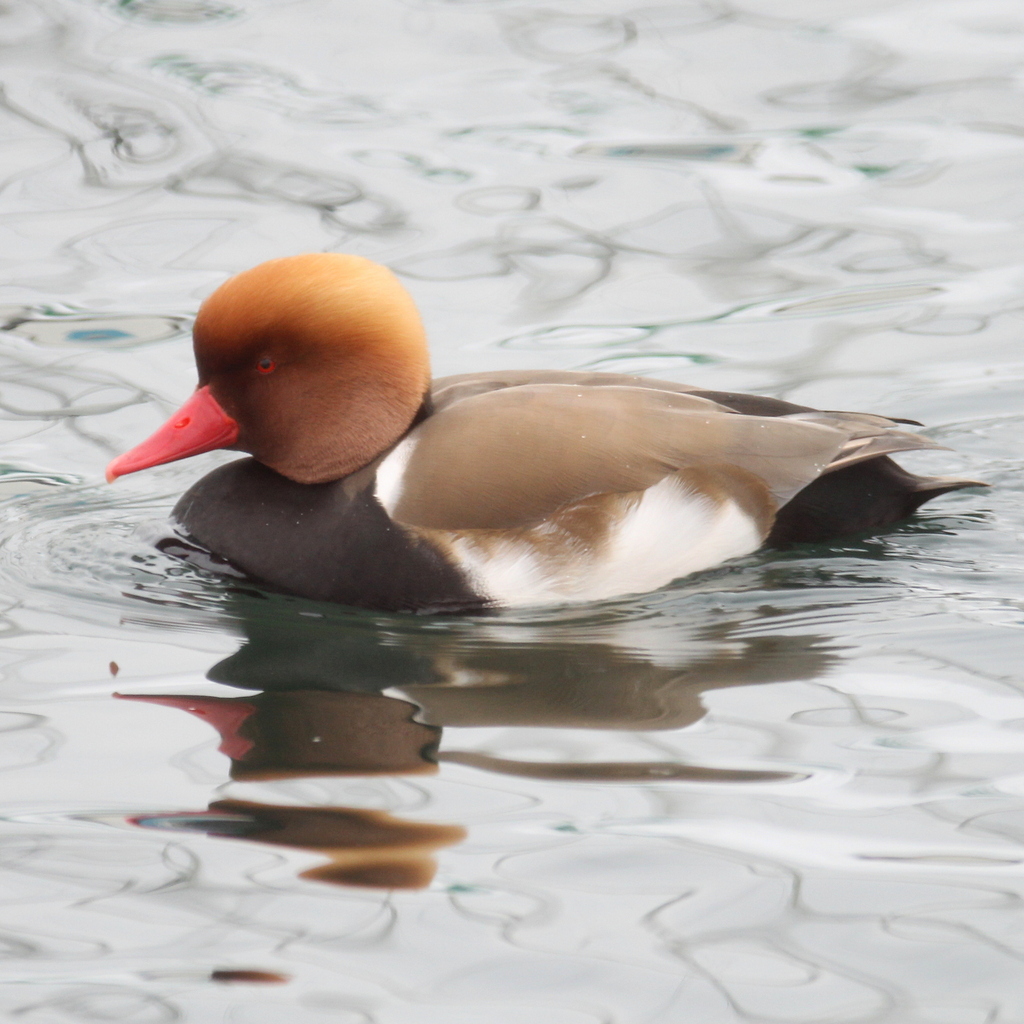
The red-crested pochard is a large diving duck with striking sexual dimorphism. The adult male is unmistakable, featuring a rounded orange head, bright red bill, and black breast. Its flanks are white, the back is brown, and the tail is black. This combination of colours makes males instantly recognizable even from a distance. The female is considerably more subdued in appearance, being mainly pale brown with a darker back and crown, though she retains a distinctive whitish face. Eclipse males resemble females but retain their characteristic red bills, providing a useful identification feature during this transitional plumage phase.
Range & Habitat
Red-crested pochards breed in lowland marshes and lakes across southern Europe, with their range extending from the steppe and semi-desert areas around the Black Sea through to Central Asia and Mongolia. They are somewhat migratory, with populations wintering in the Indian subcontinent and Africa. Northern breeding birds typically winter further south into north Africa. In the British Isles, the species' status is complicated by numerous historical escapes and deliberate releases from captivity, though the majority of individuals present are now thought to result from such introductions rather than natural migration. Where they do occur naturally, they are most numerous around areas including Gloucestershire, Oxfordshire, Northamptonshire, and Leicestershire.
Behaviour & Diet
Red-crested pochards are notably gregarious birds, forming large flocks during winter, often mixing freely with other diving ducks such as common pochards. Their feeding behaviour is flexible: they obtain food both by diving and by dabbling, and they typically upend for food more frequently than most other diving ducks. Their diet consists primarily of aquatic plants. Males produce a distinctive wheezing "veht" call, while females give series of hoarse "vrah-vrah-vrah" calls, making them audible even when not directly observed.
Best Time & Places to See It
Winter is the best season to observe red-crested pochards, particularly in areas where large flocks congregate. In their natural range, lowland marshes and lakes in southern Europe and Central Asia offer the best opportunities. For those in the British Isles, winter visits to traditional haunts in Gloucestershire, Oxfordshire, and Northamptonshire provide the most reliable sightings, especially where they gather in mixed flocks with other diving ducks.
Photography Tips
The male's vibrant plumage—the glowing orange head and red bill contrasting with black and white markings—makes for exceptionally photogenic subjects, particularly in good light. Winter flocks provide opportunities for capturing behavioural shots, including diving sequences and the characteristic upending posture used when feeding. The contrast between the striking male and more subtle female plumage allows for interesting comparative compositions. Early morning light will bring out the metallic sheen on the male's head to best effect.