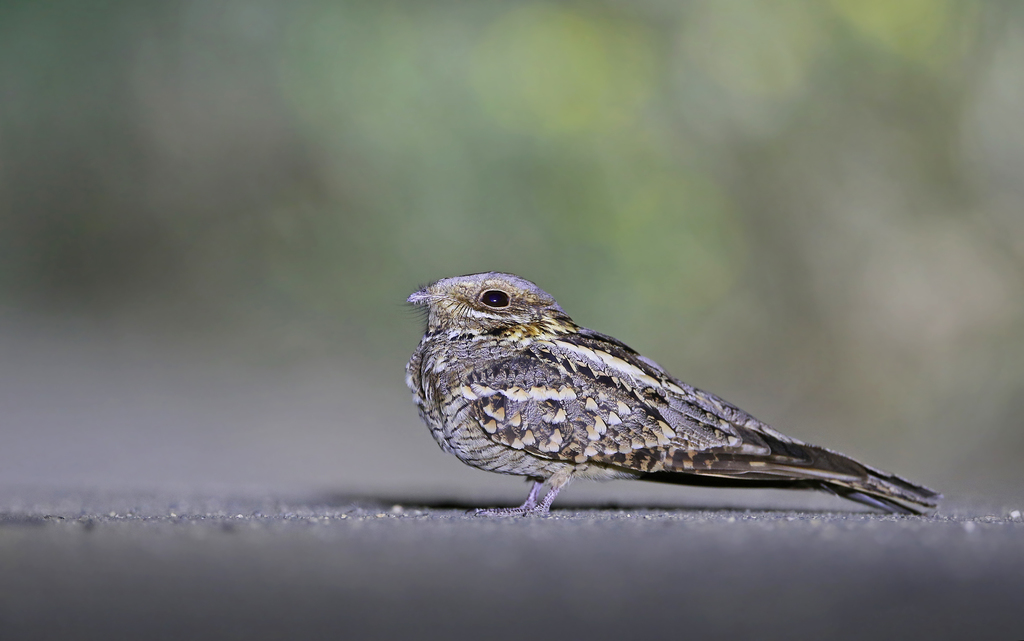
Red-necked Nightjar
Photo © Christoph Moning
Photo © Christoph Moning — CC BY 4.0 — Source: iNaturalist photo #135125994Identification
The red-necked nightjar is the largest nightjar species occurring in Europe. Its variegated plumage of lichen-grey, barred and streaked with buff, chestnut and black provides excellent camouflage during daylight hours, when the bird resembles a lichen-covered twig or fragment of bark. The species measures 32 cm in length with a 64 cm wingspan, making it noticeably larger and longer-tailed than the more widespread European nightjar. A distinctive rufous neck-collar gives the species its name, while both sexes display white wing spots, tail sides and throat patches. Like all nightjars, it possesses a characteristically wide gape, long wings, and soft downy plumage.
Two subspecies exist: the nominate ruficollis breeds in Iberia and is darker with narrower orange bands on primary feathers, while the North African desertorum is paler with more balanced dark and orange banding on the primary feathers. During daylight, the bird lies motionless on the ground, virtually invisible to the untrained eye.
Range & Habitat
The red-necked nightjar breeds in Iberia and North Africa, then winters in tropical West Africa. The Iberian race (ruficollis) and the North African form (desertorum) follow distinct migratory patterns, with the species being a late migrant that seldom arrives in breeding areas before late April or early May.
This crepuscular species favours open sandy heaths with scattered trees or bushes. It is rarely seen during the day, spending daylight hours concealed and motionless on the ground. The species has occurred as a vagrant in northern Europe on rare occasions, including records from Britain and Denmark, though such sightings remain exceptional.
Behaviour & Diet
The red-necked nightjar is strictly nocturnal and crepuscular, most active at dusk, particularly around sundown. It flies with distinctive elegance, alternating strong and deliberate wingbeats with graceful sweeps and wheels executed with motionless wings—a silent, moth-like flight that perfectly suits its hunting strategy. The bird feeds on crepuscular insects, primarily moths.
Its call is a distinctive repetitive mechanical kyok-kyok-kyok that rises and falls as the bird turns its head from side to side. During churring displays, the bird lies or crouches along a branch or rail, though it may also sing from a post. During courtship and occasionally at other times, it produces a sharp cracking sound by clapping its wings together over its back—a mechanical signal unique among nightjar displays.
Best Time & Places to See It
The red-necked nightjar is best observed during the breeding season from late April through summer in Iberian and North African locations. The species is most active during crepuscular hours, particularly around dusk and into the early evening. Visitors should search open sandy heaths with scattered trees and bushes, remaining silent and patient as the bird's camouflage makes daytime observation extremely challenging.
Listening for the characteristic kyok-kyok-kyok call or the mechanical cracking wing-clap during courtship displays provides the best chance of detection. Early evening excursions to suitable open heathland habitat offer the greatest opportunity for encountering this elusive species.
Photography Tips
Photographing the red-necked nightjar presents significant challenges due to its strictly nocturnal habits and cryptic daytime behaviour. The species' remarkable camouflage means that locating a roosting bird in daylight is extremely difficult. Photographers should focus on the crepuscular period around dusk, when the bird becomes active and may be photographed in flight using fast film and sensitive equipment capable of capturing movement in low-light conditions.
Night photography with appropriate infra-red or flash equipment may be necessary to capture detailed images. Audio recording of the distinctive kyok-kyok-kyok call and the mechanical wing-clapping display can complement visual documentation. Patience, knowledge of suitable habitat, and timing visits for the breeding season from late April onwards will maximise opportunities for successful encounters with this large and distinctive European nightjar.
Monfragüe National Park
Torrejón el Rubio, Spain
+219 birds+10 mammals
Where the Tagus River cuts through limestone plateaus in central Extremadura, Monfragüe National Park rises as a fortress of Mediterranean and Atlantic woodland, its dramatic rocky…
VIEW NATIONAL PARKSerra D’Irta Natural Park
Alcossebre, Spain
+122 birds+13 mammals
Where Mediterranean limestone cliffs meet the Balearic Sea, Serra d'Irta unfolds as a tapestry of dramatic coastal terrain and diverse terrestrial habitats. This Category 5 protected…
VIEW NATURAL PARKMarjal Pego-Oliva Natural Park
Molinell, Spain
+219 birds+2 mammals
Where the Valencian littoral flattens into wetland and reed-bed, Marjal Pego-Oliva straddles the boundary between the Mediterranean and its inland margins, a mosaic of shallow lagoons,…
VIEW NATURAL PARKL’Albufera Natural Park
València, Spain
+321 birds+18 mammals
Where shallow lagoons meet Mediterranean coastal marshland, L'Albufera Nature Park unfolds as one of Spain's most vital wetland complexes. This protected landscape, designated under IUCN Category…
VIEW NATURAL PARKSierra Nevada National Park
Válor, Spain
+137 birds+7 mammals
Where granite ridges rise above 3,000 metres across the Alpujarra foothills, Sierra Nevada National Park crowns southern Spain's most dramatic mountain landscape. The park encompasses a…
VIEW NATIONAL PARKDoñana National Park
Hinojos, Spain
+300 birds+13 mammals
Where the Guadalquivir River delta spreads into the Atlantic, vast marshes, cork woodlands, and coastal dunes converge to create one of southwestern Europe's most biodiverse wetland…
VIEW NATIONAL PARKTablas de Daimiel National Park
Daimiel, Spain
+246 birds+6 mammals
Where the Guadiana River spreads into a labyrinth of shallow lagoons and reed beds across the sun-baked plains of central Spain, Tablas de Daimiel National Park…
VIEW NATIONAL PARKSierra de Tejeda, Almijara y Alhama Natural Park
Frigiliana, Spain
+128 birds+8 mammals
Where limestone ridges rise sharply from the Axarquía lowlands, the Sierra de Tejeda, Almijara y Alhama Nature Park unfolds across a dramatic landscape of white-rock massifs,…
VIEW NATURAL PARKCabo de Gata-Níjar Natural Park
San José, Spain
+274 birds+11 mammals
Where volcanic ridges plunge toward the Mediterranean, Cabo de Gata-Níjar Nature Park unfolds across one of Europe's most arid coastlines, a landscape sculpted by tectonic violence…
VIEW NATURAL PARKLagunas de Archidona Nature Reserve
Archidona, Spain
+142 birds+4 mammals
Where shallow freshwater lagoons merge with reed beds and Mediterranean scrub, Lagunas de Archidona in Andalusia creates a wetland mosaic of profound ecological importance. These interconnected…
VIEW NATURE RESERVEDelta de l’Ebre Natural Park
Eucaliptus, Spain
+341 birds+18 mammals
Where the Ebro River spreads into a vast labyrinth of shallow lagoons, reed beds, and brackish marshes before surrendering to the Mediterranean, one of southern Europe's…
VIEW NATURAL PARKCap de Creus Natural Park
Roses, Spain
+245 birds+23 mammals
Where the Pyrenees tumble into the Mediterranean, Cap de Creus Nature Park unfolds across 300 square kilometres of one of northeastern Spain's most dramatic coastal wilderness…
VIEW NATURAL PARKCabañeros National Park
Retuerta del Bullaque, Spain
+183 birds+8 mammals
Cabañeros National Park is one of Spain’s finest wildlife destinations and one of the best-preserved examples of Mediterranean forest and scrubland in Europe. Located in the…
VIEW NATIONAL PARKSierra de las Nieves National Park
Tolox, Spain
+159 birds+7 mammals
Where limestone summits pierce the Mediterranean sky above Andalusia's coastal ranges, Sierra de las Nieves National Park unfolds across nearly 500 square kilometres of dramatically folded…
VIEW NATIONAL PARKSierra de Guadarrama National Park
Rascafría, Spain
+179 birds+13 mammals
Where granite peaks rise abruptly from the central Spanish plateau, the Sierra de Guadarrama National Park unfolds across more than eleven hundred square kilometres of montane…
VIEW NATIONAL PARKTúria Natural Park
València, Spain
+150 birds+21 mammals
Where the Túria riverbed winds through the lowlands south of Valencia, a sprawling natural park of nearly 440 square kilometres unfolds across one of Spain's most…
VIEW NATURAL PARKSierra de Cazorla, Segura y las Villas Nature Park
Las Canalejas, Spain
+176 birds+21 mammals
Where granite gorges slice through mountainous terrain in eastern Andalusia, the Sierra de Cazorla, Segura y las Villas Nature Park sprawls across more than 5,200 square…
VIEW NATURAL PARKParc del Garraf
Rat-Penat, Spain
+190 birds+15 mammals
Where limestone ridges rise abruptly from the Mediterranean coastal plain, Parc Natural del Garraf unfolds across 319 square kilometers of one of Catalonia's most dramatic protected…
VIEW NATURAL PARKCollserola Natural Park
Barcelona, Spain
+194 birds+20 mammals
Where Mediterranean scrubland rises steeply from Barcelona's urban edge, Collserola unfolds across 173 square kilometres of low mountains that form a crucial ecological buffer between city…
VIEW NATURAL PARKEspacio Natural Remolar-Filipinas
El Prat del Llobregat, Spain
+297 birds+7 mammals
Where the Llobregat River delta meets the Mediterranean, a patchwork of salt marshes, reed beds, and shallow lagoons creates one of Catalonia's most dynamic wetland ecosystems.…
VIEW NATURE RESERVESierra de Gredos Regional Park
Candeleda, Spain
+180 birds+18 mammals
Where granite peaks claw at 2,592 metres and alpine meadows give way to cork oak scrubland, Spain's central highlands reveal a landscape of remarkable vertical drama.…
VIEW NATURE RESERVECamargue Regional Nature Park
Saintes-Maries-de-la-Mer, France
+378 birds+48 mammals
Where the Rhône Delta sprawls into the Mediterranean, a landscape of stark and haunting beauty emerges—vast salt marshes punctuated by shallow lagoons, reed beds, and scrubland…
VIEW NATURAL PARKBosques de Plan
San Juan de Plan, Spain
+124 birds+4 mammals
Where granite peaks plunge into beech and fir forests, the Pyrenean valleys of Bosques de Plan unfold in dramatic tiers of ancient woodland. This wilderness in…
VIEW FOREST & JUNGLEDirigida Laguna de Gallocanta Nature Reserve
Las Cuerlas, Spain
+250 birds+7 mammals
Where continental steppe meets the vast mirror of inland water, Spain's largest natural lagoon reveals a landscape of haunting beauty. The shallow alkaline lake, cradled in…
VIEW NATURE RESERVEMontes de Málaga Natural Park
Málaga, Spain
+159 birds+7 mammals
Where cork oak and pine forest sweep across the rugged hills inland from the Costa del Sol, the Montes de Málaga Nature Park unfolds as a…
VIEW NATURAL PARKSerra de Mariola Natural Park
Bocairent, Spain
+164 birds+19 mammals
Where limestone ridges rise above the Valencian interior, Serra de Mariola unfolds across 225 square kilometers of Mediterranean mountain terrain that shifts between dense evergreen woodland,…
VIEW NATURE RESERVEEstrecho Natural Park
Pedro Valiente, Spain
+281 birds+20 mammals
Where Mediterranean pine forests meet wind-sculpted coastal cliffs, one of Europe's most dynamic ecological crossroads unfolds across the Strait of Gibraltar. Spanning 686 square kilometers of…
VIEW NATURAL PARKSierra de Castril Natural Park
Castril, Spain
+110 birds+13 mammals
Where limestone walls rise abruptly from the Guadalentín valley, carving passages of breathtaking drama through Andalusia's interior, one encounters the raw geological theatre of this protected…
VIEW NATURE RESERVEMontañas de Prades
Capafonts, Spain
+151 birds+13 mammals
Where granite peaks rise abruptly from the Tarragona hinterland, a wild mosaic of pine forests, scrubland, and limestone cliffs creates one of northeastern Spain's most biodiverse…
VIEW MOUNTAIN & ALPINENo community photos yet. Log in to add the first one.
No community observations of this species yet.