Identification
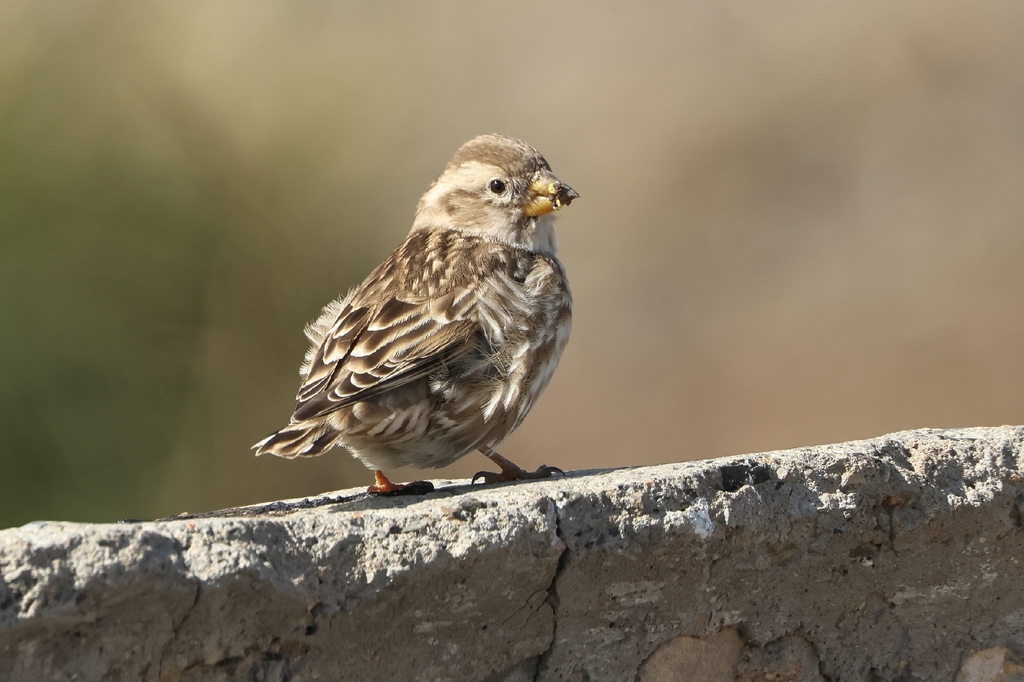
The rock sparrow is a small passerine measuring 15–17 cm in length, making it slightly larger on average than a house sparrow. Its most distinctive feature is a conspicuously larger, more conical bill. Look for a strong whitish supercilium (eyebrow stripe) and a weaker crown stripe running through the head. The bird's plumage is largely monochromatic, with a patterned brown back and wings and streaked underparts that blend into earthy tones. The most diagnostic feature—though often hard to spot in the field—is a bright yellow throat patch on the upper breast. This carotenoid-based marking appears in both males and females and contrasts starkly against the surrounding dull plumage. The species is known for its loud, wheezy song.
Range & Habitat
The rock sparrow breeds on barren rocky hills across a vast range extending from Madeira and the Canary Islands eastward through the Iberian Peninsula and western North Africa, across southern Europe, and through southwestern and central Asia to Mongolia and northern and central China. Seven subspecies are recognized across this distribution. Birds in the western part of the range are resident year-round, while some Asian populations migrate to lower altitudes or more southerly areas during winter. This gregarious species is also found in human settlements within suitable rocky terrain, though it remains a very rare vagrant north of its breeding range, with only a single confirmed record from Great Britain.
Behaviour & Diet
Rock sparrows nest in crevices in rocks or walls, typically laying four to five eggs. These birds display various mating patterns, with social monogamy being most common, though sequential and simultaneous polyandry also occur. Both sexes prefer mates with larger yellow breast patches, and studies show that male parental investment and brood defence increase with female ornamentation. Interestingly, parental care varies geographically: in alpine colonies, females perform most provisioning, while in Asian colonies males and females contribute equally.
For feeding, rock sparrows forage primarily on the ground. They eat seeds year-round and supplement with berries in autumn. During spring, their diet shifts to include invertebrates, particularly caterpillars and grasshoppers—foods that are also fed to developing young. Larger males tend to feed their young at higher rates, suggesting they occupy better territories and may be more attentive parents.
Best Time & Places to See It
The breeding season offers the best opportunities to observe rock sparrows on their barren rocky hill habitats throughout their extensive range from southern Europe to central Asia. Western populations are resident and can be found year-round, while Asian birds may be easier to locate during their breeding season or after migration to lower elevations. The species' gregarious nature means that finding one individual often leads to locating a group. Look in rocky, semi-arid regions and around human settlements in suitable country within the bird's range.
Photography Tips
The rock sparrow's diagnostic yellow breast patch, though small, makes a compelling photographic subject when well-lit. The bright carotenoid coloring contrasts beautifully against the bird's earthy plumage and provides excellent visual interest. Photograph the bird in strong side-lighting to emphasize the head pattern, including the whitish supercilium and crown stripe. Since rock sparrows forage on the ground and nest in rocky crevices, ground-level angles can provide natural habitat context. The bird's relatively large bill and distinctive facial markings also reward close-up photography.