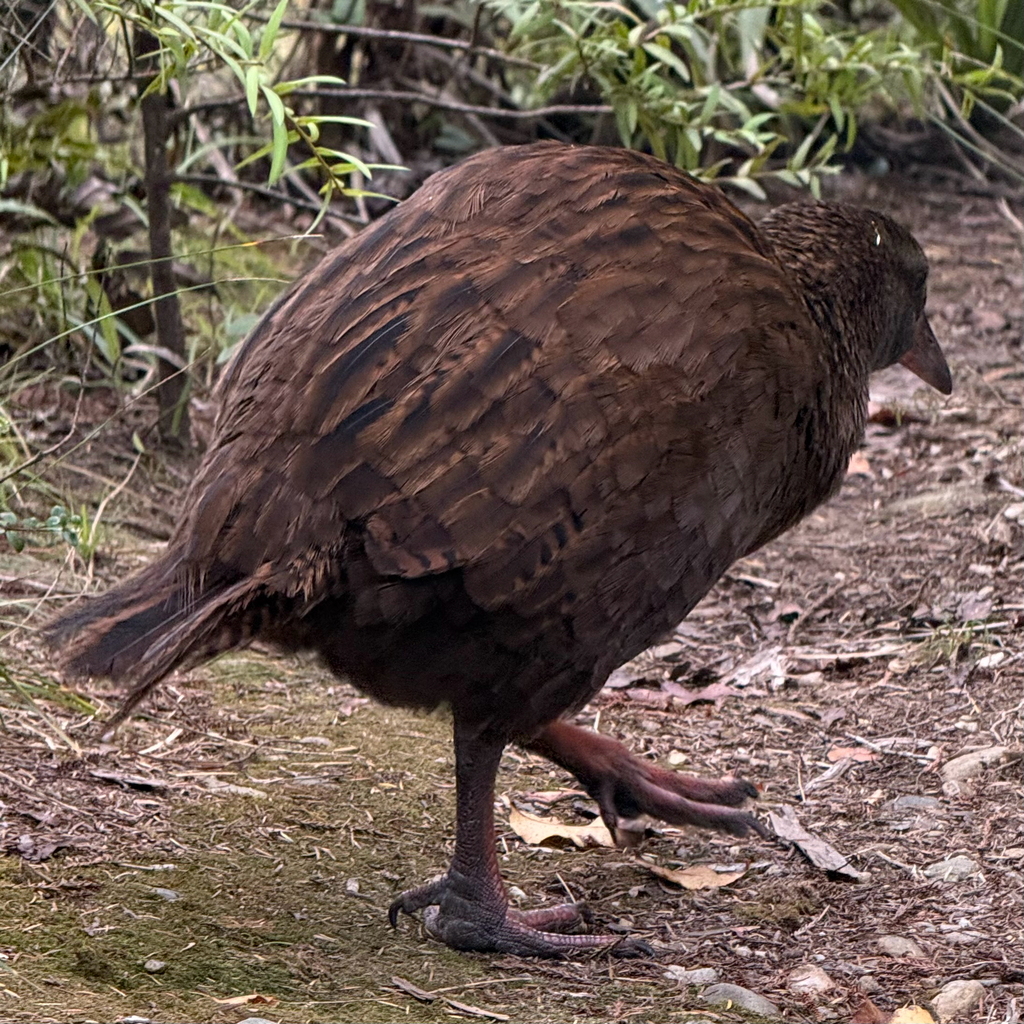
The weka, also known as the Māori hen or woodhen (Gallirallus australis) is a flightless bird species of the rail family. It is endemic to New Zealand. Some authorities consider it as the only extant member of the genus Gallirallus. Four subspecies are recognized but only two (northern/southern) are supported by genetic evidence. The weka are sturdy brown birds about the size of a chicken. As omnivores, they feed mainly on invertebrates and fruit. Weka usually lay eggs between August and January; both sexes help to incubate. == Description == Weka are large rails. They are predominantly rich brown mottled with black and grey; the brown shade varies from pale to dark depending on subspecies. The male is the larger sex at 50–60 cm (20–24 in) in length and 532–1,605 g (1.173–3.538 lb) in weight. Females measure 46–50 cm (18–20 in) in length and weigh 350–1,035 g (0.772–2.282 lb). The reduced wingspan ranges from 50 to 60 cm (20 to 24 in). The relatively large, reddish-brown beak is about 5 cm (2.0 in) long, stout and tapered, and used as a weapon. The pointed tail is near-constantly being flicked, a sign of unease characteristic of the rail family. Weka have…
Abel Tasman National Park
Arthur’s Pass National Park
Fiordland National Park
Kahurangi National Park
Mount Aspiring National Park
Nelson Lakes National Park
Paparoa National Park
Rakiura National Park
Te Urewera
Nothing matches these filters.
No community photos yet. Log in to add the first one.
No community observations of this species yet.