Identification
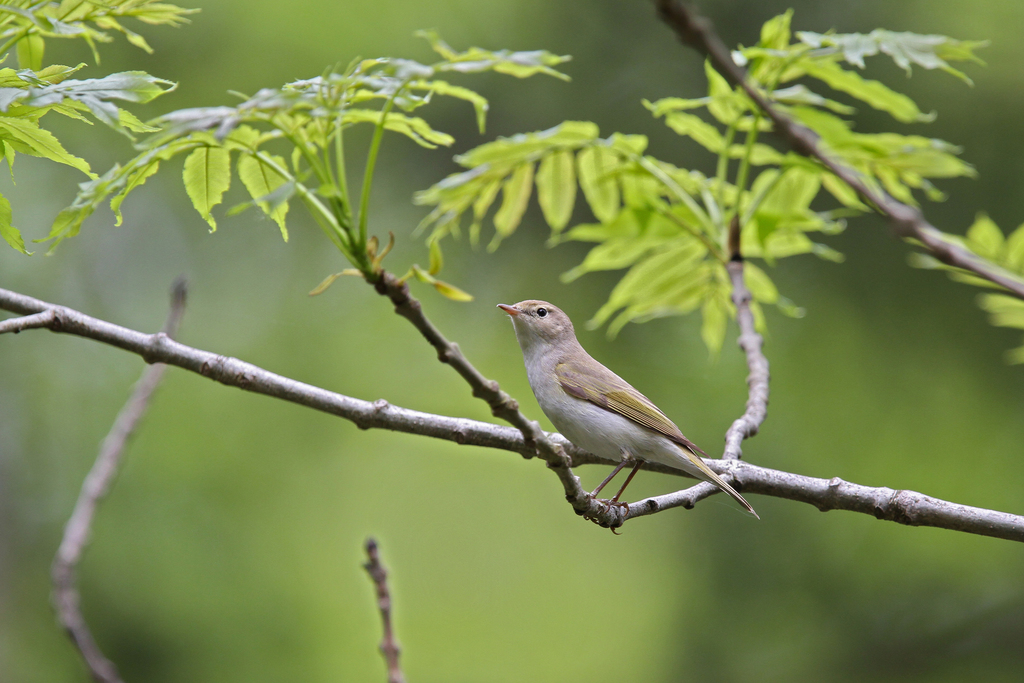
Western Bonelli's warbler is a small passerine with subtle plumage that rewards close observation. It displays a plain grey-green back, green-toned rump and wings, and whitish underparts. The bill is small and pointed, and the legs are brown. The sexes are identical, as with most warblers. It has a browner tinge to its upperparts compared to its eastern counterpart, making this a useful field distinction when ranges overlap or during migration.
The species is best distinguished from the eastern Bonelli's warbler by its calls rather than appearance. The western bird produces a disyllabic hu-it call, distinctly different from the eastern species' hard chup, which resembles a crossbill or house sparrow. The song is a fast monotone trill with some similarity to the wood warbler, though only slightly different from the eastern species' song.
Range & Habitat
Western Bonelli's warbler breeds in southwest Europe and north Africa, with a range that does not overlap with its eastern relative. The species is highly migratory, wintering in sub-Saharan Africa and undertaking substantial seasonal movements. It is a rare vagrant in Northern Europe, occasionally appearing well outside its normal range during migration periods.
The species inhabits forest and woodland environments where it forages among foliage for insects. These habitats provide the dense vegetation necessary for nesting and feeding throughout the breeding season.
Behaviour & Diet
Like most warblers, western Bonelli's warbler is strictly insectivorous, gleaning small invertebrates from foliage with its pointed bill. It nests on the ground, where the female lays clutches of 3-5 white eggs with reddish-brown markings. The incubation period lasts around 14 days, and chicks fledge after 10-14 days, a rapid developmental timeline typical of small warblers.
Breeding success faces significant threats from cuckoo nest predation and brood parasitism, which are major hazards affecting reproductive output. Despite these challenges, the species maintains sustainable populations across its breeding range.
Best Time & Places to See It
Western Bonelli's warbler is best observed during the breeding season in its southwest European and north African range. Target woodland and forest habitats where the species is resident. Spring and early summer offer the best opportunities, when males are actively singing to establish and maintain territories.
During migration periods, particularly in spring and autumn, watch for vagrants in Northern Europe, though sightings here remain rare. Winter observations require travel to sub-Saharan Africa where the species retreats during the non-breeding season.
Photography Tips
The subtle plumage of western Bonelli's warbler demands patience and attention to detail. Focus on capturing the grey-green back and contrasting whitish underparts in good light to reveal the species' understated elegance. The small size and active foraging behaviour necessitate a fast shutter speed and continuous autofocus to track movement through dense foliage.
Audio recording is invaluable for documentation and identification. Capture the distinctive disyllabic hu-it call and fast monotone trill song, which are often more reliable for species confirmation than visual features alone. Early morning during the breeding season yields the most vocal and active birds, maximizing photographic and recording opportunities.