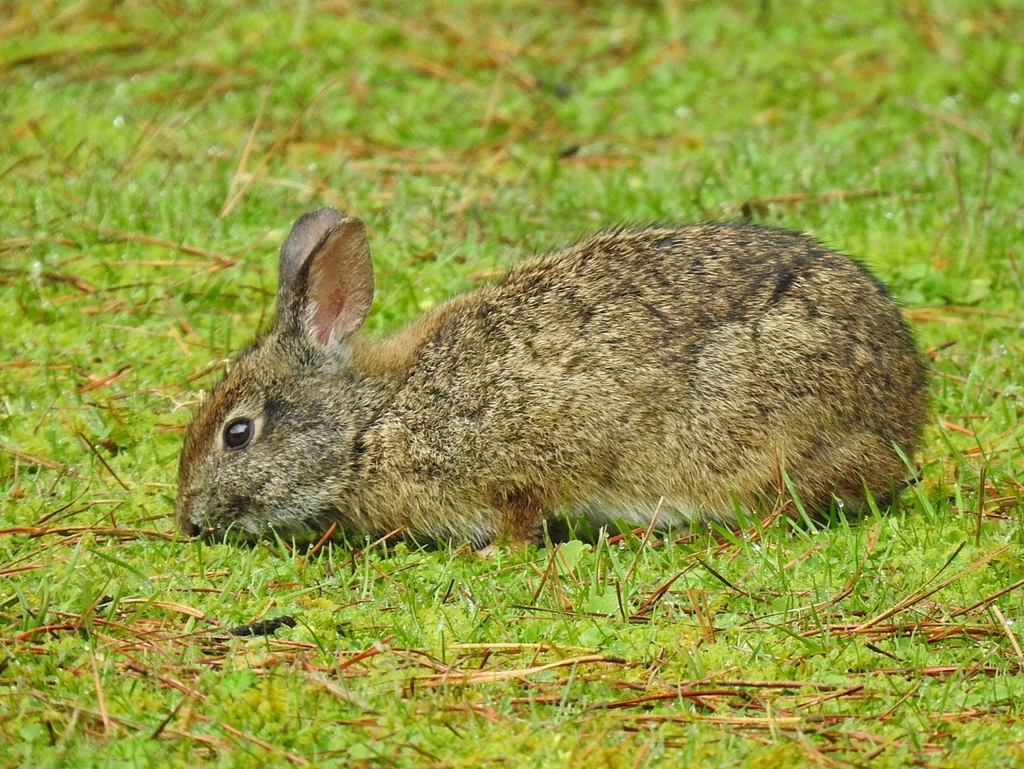
Common Tapeti
Photo © Esteban Poveda
Photo © Esteban Poveda — CC BY 4.0 — Source: iNaturalist photo #114976102Identification
The common tapeti is a small to medium-sized cottontail rabbit with distinctive features that help identify it in the field. It has a head-body length of around 13 inches, with notably short ears measuring just over 2 inches and short hind feet of approximately 2.8 inches. Its most characteristic feature is its small, dark tail. The animal's coloring is striking: its back is brown with a speckled appearance created by black-tipped hairs, and it bears a distinctive rufous (reddish-brown) spot on its neck. The belly and undersides of the tail are also rufous, providing useful identification marks when the animal is seen from below or in profile.
Range & Habitat
The common tapeti's range spans from southern Mexico through Central America and much of South America, extending as far south as Tucumán province in northern Argentina. The species occurs in tropical rainforests, deciduous forests, and second-growth forests across this vast area, as well as in disturbed habitats such as gardens and plantations. It is notably the only leporid species found in most of its range. The animal can be encountered from sea level up to 4,800 meters in elevation, making it adaptable to diverse environments, though it shows a preference for forested habitats close to swamps and river edges.
Behaviour & Diet
The common tapeti is a solitary animal that is strictly nocturnal or, more accurately, crepuscular—most active during twilight hours after nightfall or before dawn. Its diet consists primarily of grasses and browse, though it has also been recorded eating Harrya chromapes, a bolete mushroom. Breeding females construct nests from dry grasses above the ground, featuring a central chamber with three or four smaller chambers at the end of a corridor. Gestation periods and litter sizes vary geographically: animals in Chiapas, Mexico gestate for approximately 28 days with three to eight offspring, while Andean populations have longer gestation periods of 44 days but smaller average litter sizes of 1.2. Breeding occurs year-round in both populations.
Best Time & Places to See It
To observe the common tapeti, plan your visits for dusk or dawn when the animals are most active. Search in forested areas near water sources, particularly close to swamps and river edges where the habitat is dense. The species is also found in second-growth forests and even disturbed areas like gardens and plantations bordering primary forest. Since it is primarily nocturnal, patience and early morning or late evening expeditions will significantly improve your chances of encounters.
Photography Tips
Photographing the common tapeti requires preparation for low-light conditions, as the animal is most active during twilight hours. Use a camera capable of performing well at higher ISO settings, or bring a flash diffuser for subtle lighting that won't startle this solitary, wary animal. The rufous neck spot and colored tail undersides are distinctive field marks worth capturing. Move slowly and quietly through forested habitats near water sources, and consider setting up near known feeding areas during crepuscular hours to increase your chances of a successful photograph.
Itatiaia National Park
Brazil
+519 birds+12 mammals
Where granite peaks pierce the Atlantic rainforest canopy in southeastern Brazil, Itatiaia National Park rises as one of the country's oldest and most ecologically vital protected…
VIEW NATIONAL PARKIguaçu National Park
Brazil
+387 birds+17 mammals
Where the Paraná Plateau plunges toward the Atlantic watershed, six thousand square kilometers of subtropical rainforest cling to steep gorges and river valleys in this corner…
VIEW NATIONAL PARKIguazú National Park
Puerto Iguazú, Argentina
+346 birds+15 mammals
Where the Paraná Plateau plunges toward the Atlantic watershed, nearly 800 square kilometers of subtropical rainforest drape across Misiones Province in a landscape carved by millennia…
VIEW NATIONAL PARKCalilegua National Park
Municipio de Calilegua, Argentina
+288 birds+8 mammals
Where the eastern Andean slopes plunge into northwestern Argentina's humid subtropics, nearly 2,645 square kilometers of steep terrain and luxuriant forest compose one of South America's…
VIEW NATIONAL PARKNo community photos yet. Log in to add the first one.
No community observations of this species yet.