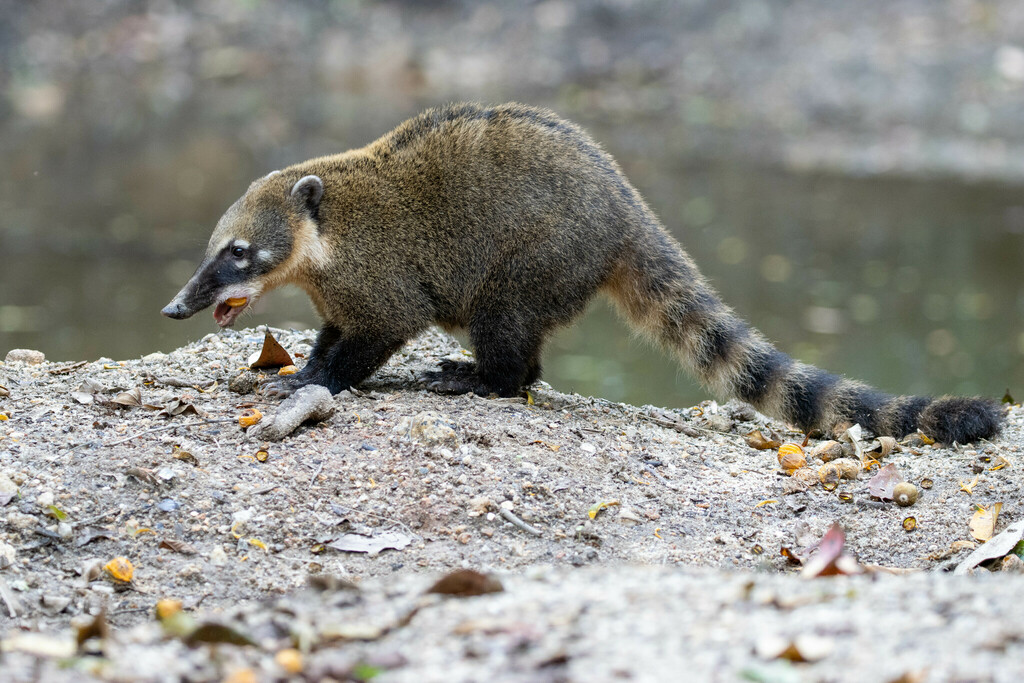
South American Coati
Photo © Thomaz de Carvalho Callado
Photo © Thomaz de Carvalho Callado — CC BY 4.0 — Source: iNaturalist photo #240416990Identification
The South American coati, also known as the ring-tailed coati or brown-nosed coati, is a member of the raccoon family and a distinctive tropical mammal. Adults typically weigh 2–7.2 kg (4.4–15.9 lb) and measure 85–113 cm (33–44 in) in total length, with the tail accounting for approximately half of this measurement. The species exhibits highly variable coloration, and while its tail bears rings that may be only somewhat visible, its most distinguishing feature is the absence of the largely white snout found in its northern relative, the white-nosed coati. The brown nose is therefore the field mark that separates this species from congeners.
Range & Habitat
The South American coati is widespread across tropical and subtropical South America, occurring in lowland forests east of the Andes from Colombia and the Guianas south to Uruguay and northern Argentina, reaching altitudes up to 2,500 m (8,200 ft). Occupancy is significantly positively related to forest cover and negatively related to elevation. The species has been recorded in western Ecuador and northern and western Colombia, and in Argentina from Santa Fe and Salta Provinces. It has also been introduced to the island of Mallorca, where it is considered invasive. The smaller mountain coati occupies higher elevations, though there is considerable range overlap.
Behaviour & Diet
The South American coati is diurnal and equally at home on the ground and in trees. It is omnivorous, feeding primarily on fruit, invertebrates, small animals, and bird eggs. The species forages in the high canopy for fruit and uses its distinctive snout to probe crevices for prey. It also searches for food by turning over rocks and ripping open logs with its claws. Females typically live in large social groups called bands of 15–30 individuals, while males are usually solitary—a behavioral difference that once led scientists to classify solitary males as a separate species called coatimundis. Group members produce soft whining sounds and distinctive alarm calls consisting of loud woofs and clicks. When alarmed, coatis climb trees before dropping to the ground and dispersing. The species typically sleeps in trees.
Best Time & Places to See It
South American coatis are most active during daylight hours and can be encountered in forested habitats throughout their range in Colombia, the Guianas, Ecuador, Peru, Bolivia, Brazil, Paraguay, Uruguay, and Argentina. They are particularly visible during fruiting seasons when they forage in the canopy and on the forest floor. Female bands are more easily observed than solitary males. Predators include foxes, jaguars, jaguarundis, and occasionally humans.
Photography Tips
The coati's habit of foraging on the ground and in trees provides excellent photographic opportunities in good daylight. Look for bands of females moving through the understory and along forest trails, particularly near fruiting trees. The distinctive ringed tail and brown nose are key identification features to capture in images. Early morning or late afternoon light is ideal for photographing these diurnal animals in their natural forest habitat.
Tijuca National Park
Brazil
+317 birds+13 mammals
Where the Atlantic forest rises steeply from Rio de Janeiro's urban edge, Tijuca National Park encompasses a landscape of dramatic granite peaks, cascading waterfalls, and closed-canopy…
VIEW NATIONAL PARKYasuní National Park
Aguarico, Ecuador
+601 birds+43 mammals
Where the western Amazon basin converges with Ecuador's Orellana Province, lowland rainforest reaches toward the horizon in an unbroken canopy of staggering botanical density. Yasuní National…
VIEW NATIONAL PARKCerros de Amotape National Park
District of San Jacinto, Ecuador
+246 birds+1 mammals
Arid mountains rise abruptly from Peru's northwestern frontier, their slopes clothed in xerophytic scrubland and seasonal deciduous forest that transforms these Andean foothills into one of…
VIEW NATIONAL PARKPodocarpus National Park
Zamora, Ecuador
+496 birds+6 mammals
Where the Andes descend toward the Amazon basin, Podocarpus National Park sprawls across nearly 2,800 square kilometres of the most biodiverse terrain in Ecuador's southern highlands.…
VIEW NATIONAL PARKAntisana National Park
Quijos, Ecuador
+432 birds+21 mammals
Where the eastern Andean slopes descend into the Amazon basin, Antisana National Park sprawls across roughly 2,500 square kilometers of some of South America's most dramatic…
VIEW NATIONAL PARKNatural Sierra de la Macarena National Park
Vista Hermosa, Colombia
+566 birds+15 mammals
Across nearly 20,000 square kilometres of Colombia's Meta Department, the terrain rises from lowland savanna into Andean foothills through a mosaic of gallery forests, palm-fringed wetlands,…
VIEW NATIONAL PARKItatiaia National Park
Brazil
+519 birds+12 mammals
Where granite peaks pierce the Atlantic rainforest canopy in southeastern Brazil, Itatiaia National Park rises as one of the country's oldest and most ecologically vital protected…
VIEW NATIONAL PARKIguaçu National Park
Brazil
+387 birds+17 mammals
Where the Paraná Plateau plunges toward the Atlantic watershed, six thousand square kilometers of subtropical rainforest cling to steep gorges and river valleys in this corner…
VIEW NATIONAL PARKSerra dos Órgãos National Park
Brazil
+446 birds+13 mammals
Granite peaks thrust skyward through the Atlantic Forest canopy in the mountains immediately north of Rio de Janeiro, their bare rock faces rising above a landscape…
VIEW NATIONAL PARKPantanal Matogrossense National Park
Brazil
+322 birds+17 mammals
Where the flooded forests of central Brazil meet vast seasonally inundated grasslands, Pantanal Matogrossense National Park sprawls across nearly 2,900 square kilometers of one of the…
VIEW NATIONAL PARKBrasília National Park
Plano Piloto, Brazil
+338 birds+15 mammals
Cerrado grassland and scattered woodland sweep across the central Brazilian plateau where this national park sprawls across more than a thousand square kilometres of the Federal…
VIEW NATIONAL PARKManu National Park
Manu, Peru
+892 birds+26 mammals
Across the eastern slopes of the Peruvian Andes, tropical rainforest descends into the Amazon basin with a complexity that few terrestrial ecosystems match. Manu National Park…
VIEW NATIONAL PARKRío Pilcomayo National Park
Argentina
+271 birds+13 mammals
Where the Río Pilcomayo cuts through northeastern Argentina's subtropical lowlands, a sprawling mosaic of wetlands, grasslands, and seasonally flooded forests creates one of South America's most…
VIEW NATIONAL PARKIguazú National Park
Puerto Iguazú, Argentina
+346 birds+15 mammals
Where the Paraná Plateau plunges toward the Atlantic watershed, nearly 800 square kilometers of subtropical rainforest drape across Misiones Province in a landscape carved by millennia…
VIEW NATIONAL PARKParque Provincial Pampa del Indio
Laguna Limpia, Argentina
+231 birds+4 mammals
Across the flat horizons of Chaco Province, where the Paraná River system spills into vast wetlands and grasslands, Parque Provincial Pampa del Indio protects one of…
VIEW NATURE RESERVEChaco National Park
Municipio de Presidencia de la Plaza, Argentina
+258 birds+7 mammals
Across the humid subtropical lowlands of northeastern Argentina, where the Paraná River basin feeds vast seasonal wetlands and gallery forests, Chaco National Park protects one of…
VIEW NATIONAL PARKNo community photos yet. Log in to add the first one.
No community observations of this species yet.