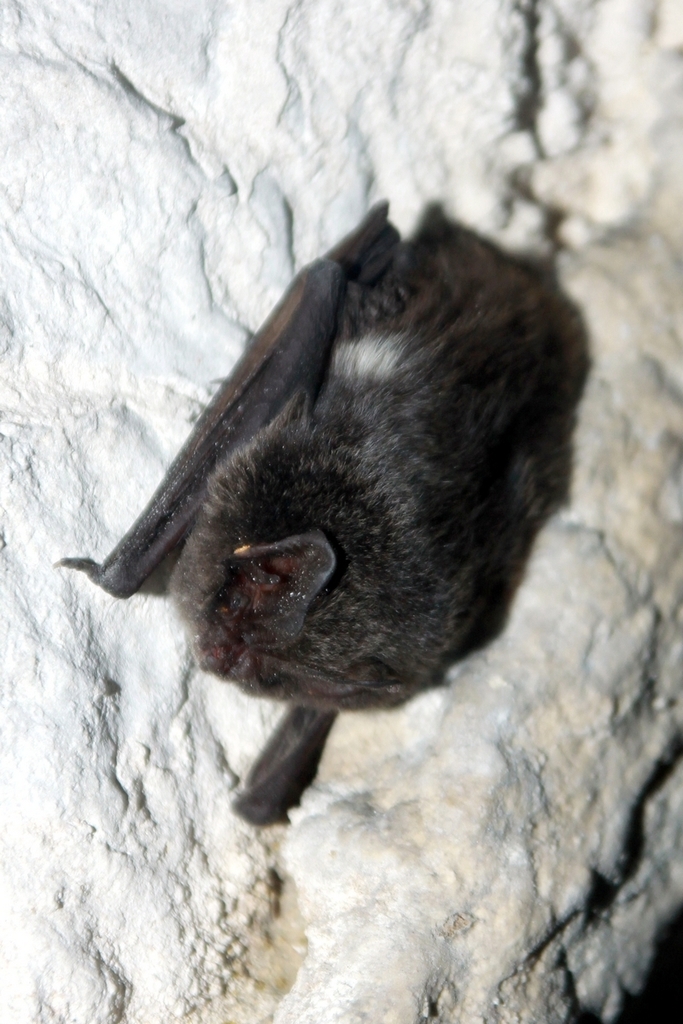
Western Barbastelle
Photo © Michal Sloviak
Photo © Michal Sloviak — CC BY 4.0 — Source: iNaturalist photo #44192347Identification
The western barbastelle is a medium-sized bat unmistakable for its distinctive pug-shaped nose and broad ears joined across the head by skin. The ears are covered in gingery-brown fur on their rear surface, and the triangular tragus (inner ear structure) is broad at the base with a nearly parallel tip. Head and body length ranges from 40 to 55 mm, with a wingspan of 26 to 29 cm and body mass of 6 to 13 g, making it a relatively small European bat.
Range & Habitat
This species is found across Europe from Portugal to Azerbaijan and from Sweden to the Canary Islands, where an endemic subspecies inhabits Tenerife and La Gomera. Two subspecies are recognized: the nominate form distributed from western Europe to the Caucasus (with isolated populations in Morocco), and B. b. guanchae endemic to the Canary Islands. Barbastelles roost in tree splits, behind loose bark, rock crevices, and human buildings, showing a strong preference for mature deciduous forests, particularly beech woodland. They migrate to underground sites—caves, basements, mines, and bunkers—for winter hibernation and are notably resistant to cold conditions.
Behaviour & Diet
Barbastelles are specialist hunters with one of the narrowest diets among European bats, feeding almost exclusively on moths (approximately 99% of prey by volume), supplemented occasionally by flies. They hunt as aerial-hawking bats, but unusually forage just above the forest canopy rather than in open airspace. Individual bats may travel up to 20 km per night while foraging, with non-reproductive females ranging farther than reproductive ones. They use two echolocation call types: type 1 at 30–38 kHz (peak energy 33 kHz) and type 2 at 29–47 kHz (peak energy 38 kHz).
Mating occurs at the end of summer, sometimes continuing into early spring. Females give birth to one or two young in May–June, nursing them for up to six weeks. Their narrow dietary specialization likely contributes to their current rarity across most of their range, making them vulnerable to declines in moth populations.
Best Time & Places to See It
Barbastelles are rare and typically declining throughout their range. Spring and summer offer the best opportunities, particularly in mature deciduous forests and beech woodlands such as those in Belgium's Sonian Forest, central Italy, and Switzerland. The Canary Islands subspecies is found only in Tenerife and La Gomera. Late summer is the period to observe mating behavior. Their preference for foraging above forest canopy rather than in open spaces makes them a challenging species to encounter, though their distinctive echolocation calls can aid detection in suitable habitat.
Photography Tips
Photographing barbastelles requires patience and knowledge of their preferred forest habitats. Night vision or thermal imaging equipment is essential, along with acoustic monitoring to locate feeding areas above the canopy. Set up near mature beech or other native deciduous trees where they are known to roost. The distinctive facial features—the pug-like nose and joined broad ears—make for compelling portraits if a hand-held or roosting individual can be approached. Capture their characteristic silhouette in flight against the night sky to showcase their relatively compact wingspan. Slow-motion video of their aerial-hawking technique just above the forest canopy demonstrates their unique hunting behavior.
Picos de Europa National Park
Posada de Valdeón, Spain
+166 birds+26 mammals
Where limestone massifs rise abruptly from the Castilian plateau, the Picos de Europa create one of Spain's most dramatic mountain wilderness areas. The park's jagged peaks,…
VIEW NATIONAL PARKStenshuvuds National Park
Skåne län, Sweden
+224 birds+19 mammals
Where limestone cliffs rise sharply above the Øresund Strait, Stenshuvuds National Park commands the southeastern tip of Skåne, a landscape carved by glaciation into rolling beech…
VIEW NATIONAL PARKSöderåsens National Park
Skåne län, Sweden
+136 birds+18 mammals
Steep beech-clad ravines and limestone escarpments carve through the landscape of southern Sweden's Skåne region, creating Söderåsens—a textbook example of temperate woodland gorge habitat. The park's…
VIEW NATIONAL PARKExmoor National Park
Somerset, United Kingdom
+159 birds+32 mammals
Where the Bristol Channel wind scours windswept moorland into rolling open heath, Exmoor rises from the Somerset coast as one of England's most rugged upland landscapes.…
VIEW NATIONAL PARKPembrokeshire Coast National Park
Pembrokeshire, United Kingdom
+250 birds+41 mammals
Where the Cambrian coastline meets the Celtic Sea, cliff-top moorland and hidden coves define a landscape carved by 300 million years of geological drama. Pembrokeshire Coast…
VIEW NATIONAL PARKBannau Brycheiniog National Park
Powys, United Kingdom
+178 birds+36 mammals
Where sandstone ridges rise above the rolling moorlands of mid-Wales, Bannau Brycheiniog National Park protects one of Britain's most compelling upland landscapes. The park's dramatic peaks,…
VIEW NATIONAL PARKSouth Downs National Park
Chichester, United Kingdom
+298 birds+45 mammals
Chalk downland ridges rise and fall across the South Downs, their open grasslands and beech hangers creating a mosaic of habitats that has shaped human settlement…
VIEW NATIONAL PARKCévennes National Park
Vebron, France
+187 birds+63 mammals
Where granite gorges slice through the limestone plateaux of southern France, the Cévennes Cœur National Park unfolds across nearly 3,500 square kilometres of one of Europe's…
VIEW NATIONAL PARKÉcrins National Park
La Chapelle-en-Valgaudémar, France
+143 birds+36 mammals
Where granite peaks and Alpine meadows converge across nearly 2,100 square kilometres, Écrins National Park forms one of the wildest mountainous strongholds of the French Alps.…
VIEW NATIONAL PARKForêts National Park
Lucey, France
+140 birds+50 mammals
Across the rolling plateaux of central Burgundy, where limestone uplands give way to deep valleys carved by time and water, lies a landscape of profound ecological…
VIEW NATIONAL PARKDuna-Ipoly National Park
Dömös, Hungary
+208 birds+19 mammals
Where the Danube curves through central Hungary, the limestone hills and forested valleys of Duna-Ipoly National Park create a landscape that feels caught between seasons and…
VIEW NATIONAL PARKBükk National Park
Répáshuta, Hungary
+161 birds+15 mammals
Where forested limestone ridges rise across northern Hungary, Bükk National Park unfolds across nearly 900 square kilometres of temperate woodland, rocky gorges, and karst formations that…
VIEW NATIONAL PARKCadí Moixeró Natural Park
Bor, Spain
+172 birds+21 mammals
Cadí-Moixeró Natural Park is one of the largest and most spectacular protected areas in Catalonia, located in the heart of the eastern Pyrenees. Covering more than…
VIEW NATURAL PARKValles Occidentales Natural Park
Siresa, Spain
+168 birds+20 mammals
Where granite gorges slice through the western Pyrenean foothills, steep valleys carved by ancient rivers create a mosaic of Mediterranean scrubland, beech forests, and alpine meadows.…
VIEW NATURAL PARKRegional Park of the Catalan Pyrenees
Olette, France
+244 birds+63 mammals
Where granite peaks thrust skyward above cloud-laden valleys, a wild tapestry of Mediterranean and alpine ecosystems interweaves across the Franco-Spanish frontier. These Pyrenean slopes harbour extraordinary…
VIEW NATURE RESERVECentral Balkan National Park
Zhidov dol, Bulgaria
+135 birds+16 mammals
Where granite peaks pierce the Bulgarian highlands, ancient beech and conifer forests blanket mountains that rise dramatically from the Balkan range's heart. This wilderness encompasses three…
VIEW NATIONAL PARKSłowiński National Park
Smołdzino, Poland
+217 birds+16 mammals
Where the Baltic shoreline surrenders to vast inland dunes and freshwater lagoons, Słowiński National Park spans nearly 610 square kilometres of one of Europe's most dynamic…
VIEW NATIONAL PARKBiebrza National Park
Goniądz, Poland
+242 birds+33 mammals
Where the Narew River sprawls across northeastern Poland's flatlands, Biebrza National Park unfolds as one of Europe's largest and most ecologically vital wetland complexes. Encompassing roughly…
VIEW NATIONAL PARKNo community photos yet. Log in to add the first one.
No community observations of this species yet.