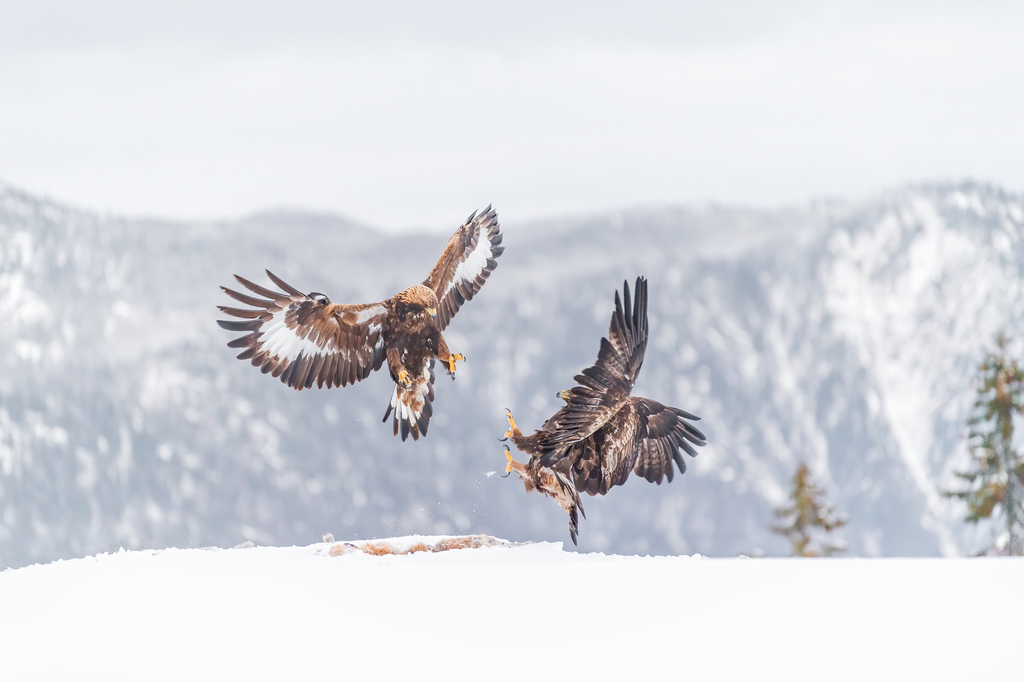
Identification
The golden eagle is one of the most formidable birds of prey in the Northern Hemisphere. Adults are dark brown with distinctive lighter golden-brown plumage on their napes, giving the species its evocative name. Immature eagles are particularly striking, typically displaying white on the tail and often white markings on the wings, making them easier to identify in flight before they attain their sober adult plumage. These are large, powerfully built raptors with massive feet equipped with large, sharp talons—adaptations perfectly suited to their predatory lifestyle.
Range & habitat
Once widespread across the Holarctic, the golden eagle is still the most widely distributed species of eagle, present in sizeable stretches of Eurasia, North America, and parts of North Africa. However, it has disappeared from many areas heavily populated by humans, making it uncommon or extirpated in portions of its former range. Despite these losses, it remains a prominent raptor across much of the Northern Hemisphere and is notably the largest and least populous of the five species of true accipitrids occurring as breeding species in both the Palearctic and Nearctic regions.
Behaviour & diet
Golden eagles are formidable hunters that rely on remarkable agility and speed combined with their powerful talons to pursue diverse prey, with hares, rabbits, marmots, and other ground squirrels forming the bulk of their diet. These birds maintain enormous home ranges or territories that may cover as much as 200 square kilometres. They are monogamous and build large nests in cliffs and other elevated sites, often returning to the same nest for multiple breeding seasons or even for life.
Breeding typically peaks in spring, with females laying up to four eggs and incubating them for six weeks. Usually only one or two young survive to fledge approximately three months later. Juvenile golden eagles attain independence in autumn and wander extensively before establishing their own territories—a process that typically takes four to five years.
Best time & places to see it
Golden eagles are most active during their breeding season in spring, making this an excellent time to observe courtship displays and hunting behaviour. Their presence across the Western United States and Western Palearctic makes these regions particularly rewarding for viewing, as the species has been extensively studied there. Look for them hunting over open terrain and near cliff faces, where they establish their spectacular nest sites.
Photography tips
Photographing golden eagles requires patience and positioning near known territory or nesting sites. Immature birds with their white tail and wing markings offer striking contrast and are often easier to identify in flight. Golden eagles are most visible when actively hunting or patrolling their vast territories, so early morning activity offers the best opportunities. The species' size and powerful silhouette make dramatic subjects, particularly when captured against open sky or mountainous terrain.