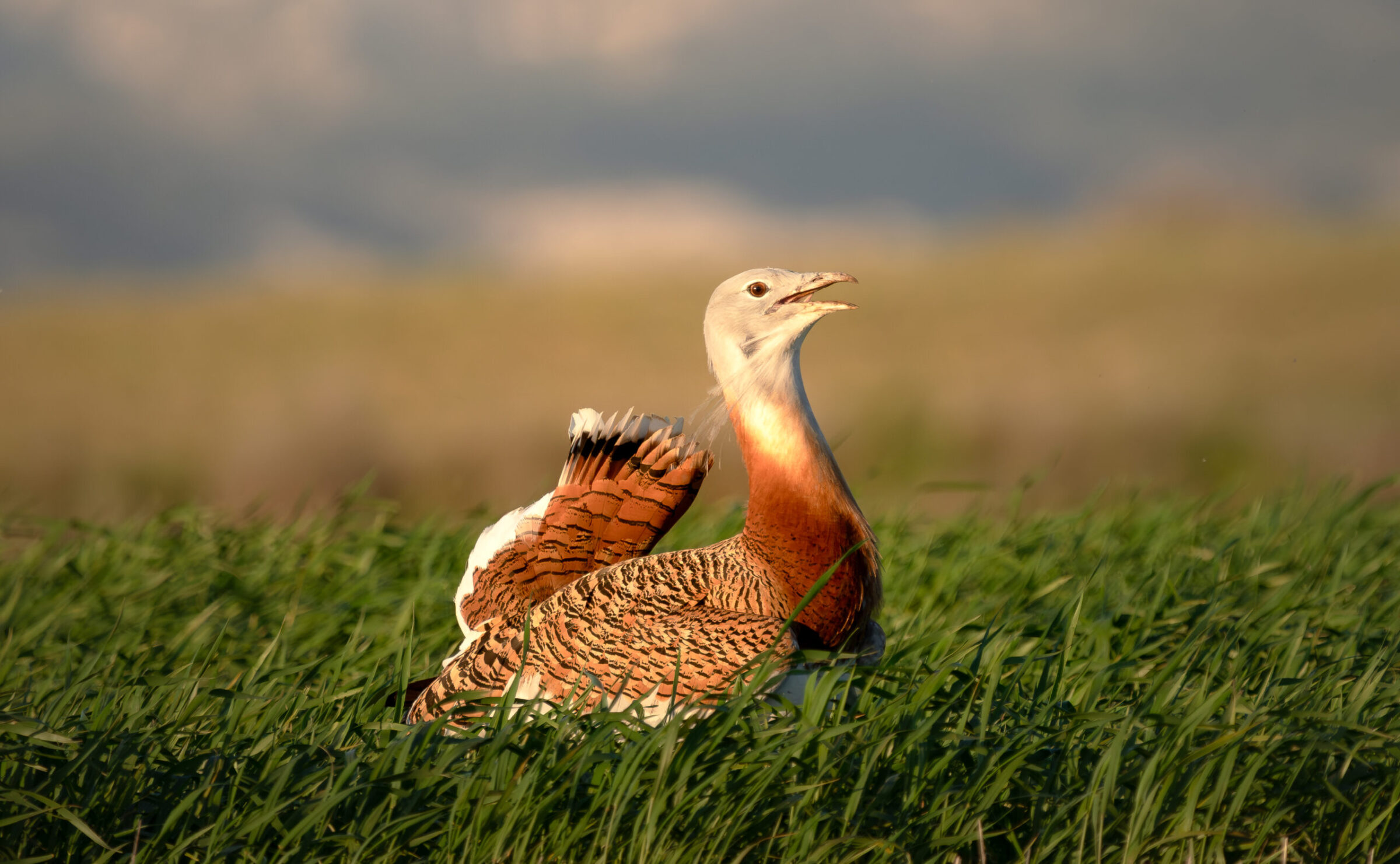
Great Bustard
Photo © wildatlasguide
Photo © wildatlasguide — Used with permissionIdentification
The great bustard is among the heaviest living flying birds, and is essentially unmistakable in appearance. Adult males are typically 90–105 cm tall with a wingspan of 2.1–2.7 m, weighing 5.8–18 kg on average, though the heaviest verified specimen reached about 21 kg. Males are brown above with blackish barring, white below, and feature a distinctive long grey neck and head. The breast and lower neck sides are chestnut, with a golden wash across the back that intensifies with age. During breeding season, males display striking long white neck bristles measuring up to 12–15 cm. In flight, the long wings are predominantly white with brown edges. Females are considerably smaller—about a third smaller in linear dimensions—with buff breast and neck, brown and pale plumage that provides excellent camouflage in open habitats. The great bustard is the most sexually dimorphic extant bird species by size, with males weighing on average 2.48 times more than females. Immature birds resemble females.
Range & Habitat
The great bustard breeds in open grasslands and farmland spanning from northern Morocco and South and Central Europe to temperate Central and East Asia. European populations are mainly resident year-round, while Asian populations migrate farther south in winter. Portugal and Spain now host approximately 60% of the world's great bustard population. The species was extirpated from Great Britain in the 19th century, with the last bird shot in 1832. Since 1998, reintroduction efforts by The Great Bustard Group have successfully re-established the species in England on Salisbury Plain, a British Army training area where lack of public access and disturbance provides the seclusion these ground-nesting birds require.
Behaviour & Diet
The great bustard is a ground-nesting species that requires open, undisturbed habitats. The species name "tarda" derives from Latin meaning "slow" and "deliberate," aptly describing the bird's typical walking style. The skewed sex ratio of approximately 1.5 females to 1 male reflects the significant size dimorphism between the sexes.
Best Time & Places to See It
The Iberian Peninsula, particularly Portugal and Spain, offers the best opportunities to see great bustards, as these countries host about 60% of the world's population. England's Salisbury Plain represents an emerging location for viewing reintroduced populations, though access may be restricted given its designation as a British Army training area. European residents are present year-round, while timing visits to eastern Asian ranges should account for winter migration patterns of those populations.
Photography Tips
The great bustard's large size and distinctive plumage make it a rewarding photographic subject, though patience is essential given the species' preference for undisturbed open grasslands and farmland. Males are particularly striking during breeding season when displaying their impressive white neck bristles. The bird's predominantly white wings in flight create strong visual contrast against the landscape, offering excellent opportunities for action shots. Early morning and late afternoon light will enhance the golden wash on males' backs and highlight the chestnut coloration of the neck and breast. Given the species' endangered status and sensitivity to disturbance, photographers should maintain appropriate distances and observe local regulations, particularly at reintroduction sites.
Monfragüe National Park
Torrejón el Rubio, Spain
+219 birds+10 mammals
Where the Tagus River cuts through limestone plateaus in central Extremadura, Monfragüe National Park rises as a fortress of Mediterranean and Atlantic woodland, its dramatic rocky…
VIEW NATIONAL PARKL’Albufera Natural Park
València, Spain
+321 birds+18 mammals
Where shallow lagoons meet Mediterranean coastal marshland, L'Albufera Nature Park unfolds as one of Spain's most vital wetland complexes. This protected landscape, designated under IUCN Category…
VIEW NATURAL PARKTablas de Daimiel National Park
Daimiel, Spain
+246 birds+6 mammals
Where the Guadiana River spreads into a labyrinth of shallow lagoons and reed beds across the sun-baked plains of central Spain, Tablas de Daimiel National Park…
VIEW NATIONAL PARKSouth Downs National Park
Chichester, United Kingdom
+298 birds+45 mammals
Chalk downland ridges rise and fall across the South Downs, their open grasslands and beech hangers creating a mosaic of habitats that has shaped human settlement…
VIEW NATIONAL PARKCabo de Gata-Níjar Natural Park
San José, Spain
+274 birds+11 mammals
Where volcanic ridges plunge toward the Mediterranean, Cabo de Gata-Níjar Nature Park unfolds across one of Europe's most arid coastlines, a landscape sculpted by tectonic violence…
VIEW NATURAL PARKParque-Reserva Natural de las Quinientas
Berlanga, Spain
+75 birds
Where Mediterranean scrubland rises and falls across the limestone plateaus of central Extremadura, the Parque-Reserva Natural de las Quinientas protects a landscape of profound ecological richness.…
VIEW NATURE RESERVECabañeros National Park
Retuerta del Bullaque, Spain
+183 birds+8 mammals
Cabañeros National Park is one of Spain’s finest wildlife destinations and one of the best-preserved examples of Mediterranean forest and scrubland in Europe. Located in the…
VIEW NATIONAL PARKFertő–hanság National Park
Fertőszéplak, Hungary
+246 birds+11 mammals
Where the Austro-Hungarian plains meet the foothills of Western Transdanubia, nearly 900 square kilometres of wetland, reed bed, and mixed woodland form one of Central Europe's…
VIEW NATIONAL PARKBükk National Park
Répáshuta, Hungary
+161 birds+15 mammals
Where forested limestone ridges rise across northern Hungary, Bükk National Park unfolds across nearly 900 square kilometres of temperate woodland, rocky gorges, and karst formations that…
VIEW NATIONAL PARKPeneda-Gerês National Park
A Baixa Limia, Portugal
+156 birds+15 mammals
Where granite gorges cut through ancient montane forests, the Peneda-Gerês National Park rises across the rugged borderlands between northern Portugal and Galicia, a landscape shaped by…
VIEW NATIONAL PARKSierra de Gredos Regional Park
Candeleda, Spain
+180 birds+18 mammals
Where granite peaks claw at 2,592 metres and alpine meadows give way to cork oak scrubland, Spain's central highlands reveal a landscape of remarkable vertical drama.…
VIEW NATURE RESERVEDirigida Laguna de Gallocanta Nature Reserve
Las Cuerlas, Spain
+250 birds+7 mammals
Where continental steppe meets the vast mirror of inland water, Spain's largest natural lagoon reveals a landscape of haunting beauty. The shallow alkaline lake, cradled in…
VIEW NATURE RESERVENo community observations of this species yet.