Identification
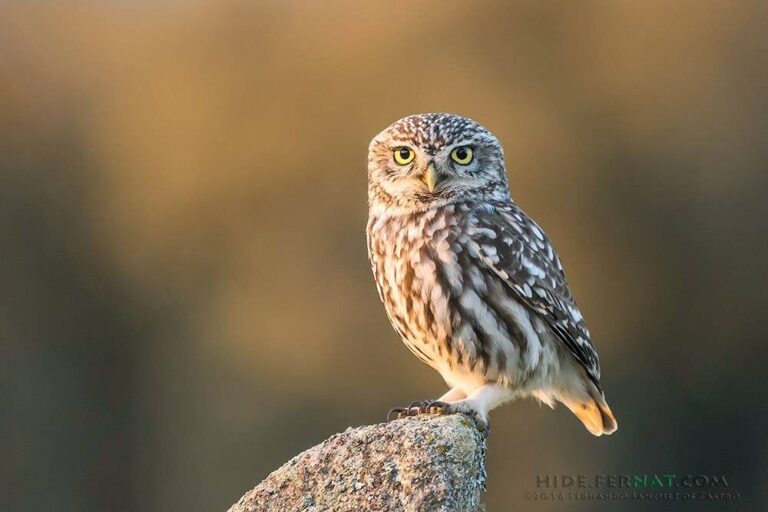
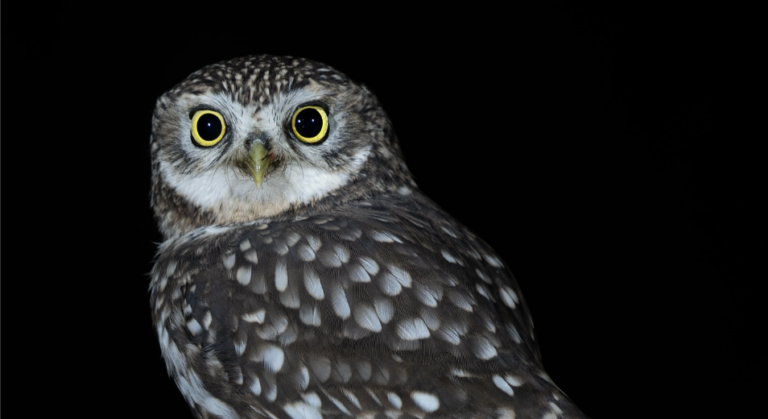
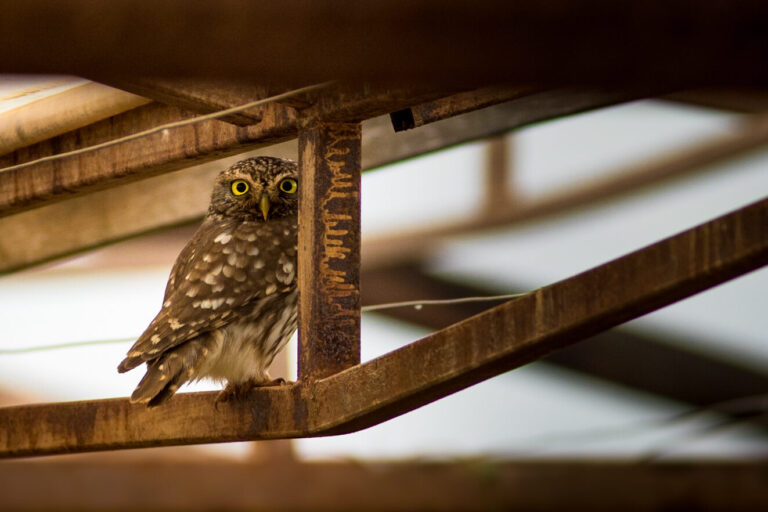
The little owl is one of Europe's smallest owls, measuring approximately 22 cm in length with a wingspan of around 56 cm. It has a distinctive flat-topped head, plump compact body, and short tail, giving it a stocky appearance. The most striking feature is its large head with a characteristic frowning expression, created by a flattened facial disc above the eyes and prominent white "eyebrows" that lend the bird a stern, perpetually serious look.
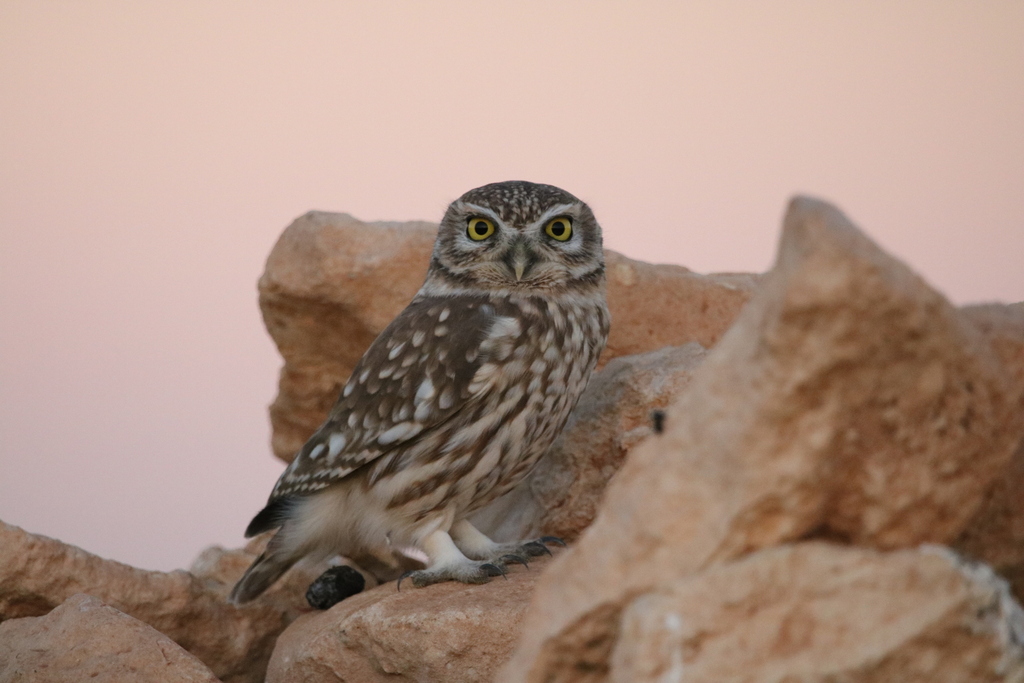
The nominate form found across much of Europe is greyish-brown with white spotting and streaking above, and pale underparts with darker streaking below. Its most conspicuous feature is its bright yellow eyes. The plumage provides excellent camouflage in its woodland and farmland habitats. Juveniles are duller than adults and lack the white crown spots characteristic of mature birds. The little owl has a distinctive bounding flight reminiscent of a woodpecker rather than typical owl flight.
Range & Habitat
The little owl inhabits much of the temperate and warmer regions of Europe, the Palearctic east to Korea, and North Africa, with its range extending from the Iberian Peninsula and Denmark eastwards to China and southwards to the Himalayas. In Africa, it occurs from Mauritania through Egypt to the Red Sea and Arabian regions. The species was introduced into Britain at the end of the 19th century and has since spread across much of England and Wales. It was also introduced to New Zealand's South Island in the early 20th century, where it is now widespread in eastern and northern regions.
This adaptable species occupies diverse habitats including farmland, woodland fringes, steppes, and semi-deserts. Its flexibility in habitat selection has aided its successful establishment in introduced ranges. The existence of numerous subspecies across its wide distribution reflects local variations, with the most distinct being the pale grey-brown Syrian little owl of the Middle East.
Behaviour & Diet
The little owl is primarily nocturnal, though it may be active during twilight hours. Males are highly territorial and actively defend their territories against intruders. The species is a cavity nester, laying a clutch of approximately four eggs in spring. The female alone incubates the eggs while the male provides food for her and, after hatching, for the chicks. As the young grow, both parents hunt to provision the nestlings, which fledge at around seven weeks of age.
The diet consists of insects, earthworms, other invertebrates, and small vertebrates. The species' calls include a characteristic querulous "kiew, kiew," with various whistling and trilling sounds also produced. During breeding season, birds make more modulated calls and may call in duet with their partner. Near the nest, they produce yelping, chattering, and barking sounds.
Best Time & Places to See It
As a common species with a wide range and large total population, the little owl should not be difficult to locate within its range, particularly in suitable farmland and woodland-fringe habitats. The breeding season in spring offers opportunities to hear territorial birds calling, particularly at dusk and dawn. In introduced ranges such as Britain, the species has become well-established across much of England and Wales.
Look for little owls in open countryside with scattered trees, woodland edges, and farmland with suitable nesting cavities. They may be spotted perched in daylight hours, often adopting their characteristic upright posture on prominent perches. Listening for their distinctive calls at dusk is often more effective than visual searching, particularly during the breeding season.
Photography Tips
The little owl's small size and cryptic coloration present both challenges and opportunities for photographers. Its greyish-brown plumage blends well with tree bark and stone, so patience and careful scanning of suitable perches are essential. The bird's characteristic stern expression, created by its white eyebrows and yellow eyes, makes for compelling portraits when successfully photographed.
Early morning and evening light during the breeding season offers the best opportunities, as birds are more active during twilight hours and may be more vocal and visible. The species' bounding, woodpecker-like flight is distinctive and worth attempting to capture. Look for individuals perched on posts, branches, or near cavities that might serve as nest sites, and remember that the bird's compact form and relatively short tail distinguish it from other European owls.