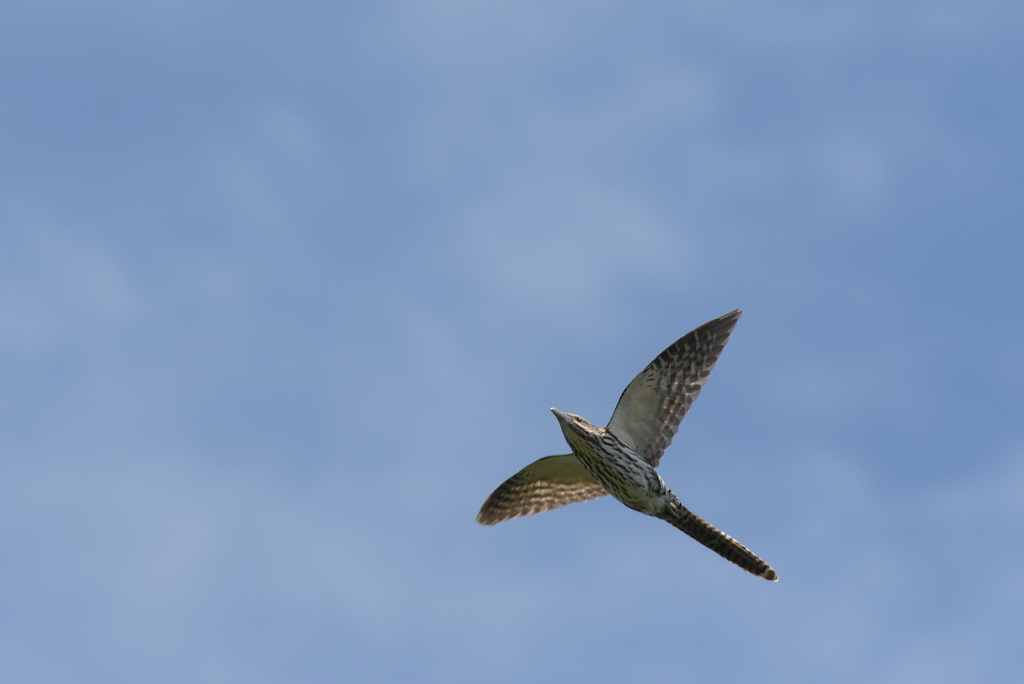
Long-tailed Koel
Photo © Christopher Stephens
Photo © Christopher Stephens — CC BY-SA 4.0 — Source: iNaturalist photo #60290834Identification
The long-tailed koel is a medium-sized cuckoo, approximately 40–42 cm in length with a wingspan of 47–52 cm and weighing about 120 grams. It is distinguished by its broad pointed wings, long softly-rounded tail, and short stout beak with a slightly hooked tip. Adults display brown barring on the upperparts and dark streaking on white underparts, with a dark brown crown and hindneck boldly streaked in buff. A white supercilium is bordered below by a bold dark-brown eye stripe that continues down the sides of the neck. The tail is tipped white, and the legs and feet are grey to green. Males and females share similar features. Juveniles are markedly different, appearing spotted with buff colouring underneath and on the sides of the head and neck.
Range & Habitat
Endemic to New Zealand, the long-tailed koel is found on Little Barrier Island, the West Coast of the South Island, Nelson, and throughout the central North Island. It prefers native forest habitats from sea level to mountainous areas, particularly favouring dense closed-canopy forests dominated by beech, broadleaf species, or podocarps, and is often found near exotic pine plantations. It may also inhabit mānuka scrub, cultivated land, recreational parks, residential areas and gardens.
This species is highly migratory, breeding only in New Zealand during the warmer months from early October until February or March, sometimes extending to April or later. For winter, it undertakes extraordinary migrations across the southern Pacific, with the average one-way journey from New Zealand to Polynesia covering approximately 2500–3500 kilometres. Its winter range stretches almost 11,000 km from Palau in the west to Pitcairn Island, including year-round residence on the Kermadec Islands, Norfolk Island group, and Lord Howe Island group.
Behaviour & Diet
The long-tailed koel is a brood parasite, laying its eggs in the nests of other bird species and leaving them to raise its chicks. It primarily targets Mohoua species—whiteheads in the North Island and yellowheads and brown creepers in the South Island—though it also parasitises robins, tomtits, and occasionally fantails. The koel's eggs hatch before those of the host, and the chicks eject the host's eggs; remarkably, young koels can mimic the calls of their host chicks. Males are highly territorial and vocal, producing a distinctive loud, shrill whistle; females are similarly vocal. Both sexes use courtship displays involving wing-spanning and fluttering. Individuals are usually solitary and mate easily before breaking up, taking multiple partners during their lifetime.
The long-tailed koel mostly eats insects but also preys on bird eggs, nestling birds, and adult birds as large as sparrows, bellbirds and thrushes, as well as lizards. It occasionally consumes fruit and seeds. Notably, it hardly ever forages on the ground, instead foraging at the top of trees or in shrubs, with most feeding occurring at night. Young birds are fed insects by their host parents.
Best Time & Places to See It
The long-tailed koel is present in New Zealand from early October through February or March, making this the prime season for observation. However, the species is at risk and very uncommon throughout its range. Look for it in native forests, particularly in the canopy, on Little Barrier Island, the West Coast of the South Island, Nelson, and throughout the central North Island. Early morning and evening are good times to listen for its distinctive loud, shrill whistle, as calling indicates territorial behaviour or mate-seeking. Its nocturnal foraging habits mean visual encounters are challenging, but vocal detection remains the most reliable method for locating this elusive species.
Photography Tips
Photographing the long-tailed koel presents considerable challenges due to its preference for foraging high in the canopy and its rarity. Focus on capturing it during its vocal periods when territorial males are most active and conspicuous. The bird's characteristic white-tipped tail, streaked underparts, and distinctive head markings make good identification features to aim for. Dawn and dusk light during the October to March breeding season may offer the best opportunities, though patience and persistence are essential given the species' uncommon status. Listening carefully for its loud, shrill calls will help locate individuals and allow you to position yourself for potential sightings in native forest canopy environments.
No community photos yet. Log in to add the first one.
No community observations of this species yet.