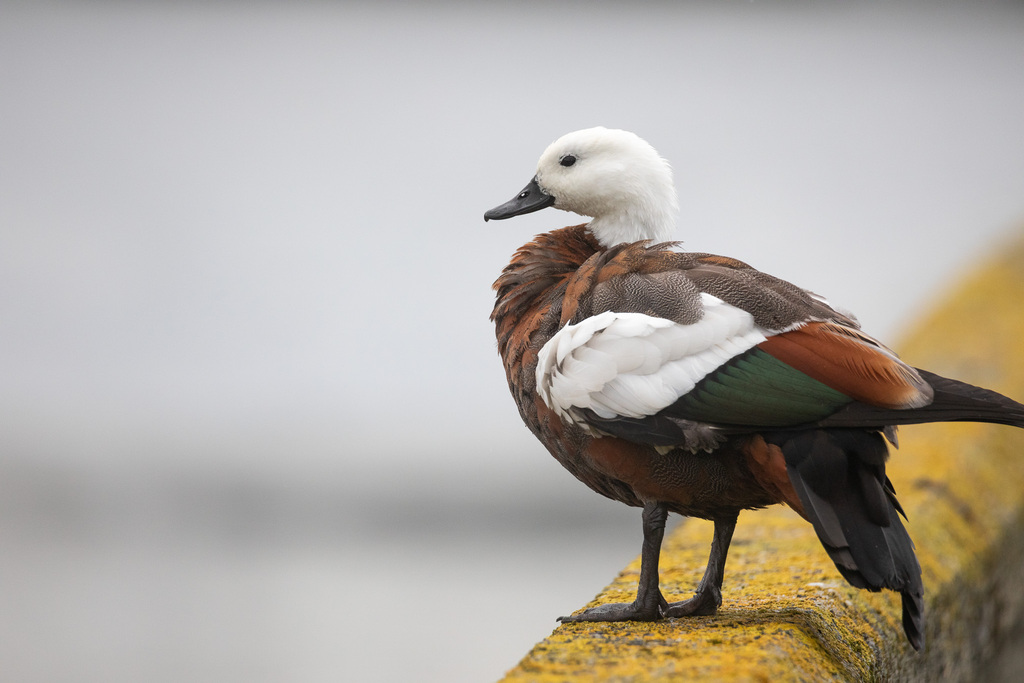
Paradise Shelduck
Photo © Jordyn Ashcroft
Photo © Jordyn Ashcroft — CC BY 4.0 — Source: iNaturalist photo #340872802Identification
The paradise shelduck is a striking and colourful waterfowl, easily recognised by its strong sexual dimorphism. Males display a distinctive blue-black head and neck, with a black rump and tail, while their back and flanks are lightly flecked with pale yellow. The wings feature contrasting white upper-coverts, black flight feathers, and metallic green speculum feathers. Females are equally distinctive, sporting an entirely white head and neck contrasting sharply with a dark or light chestnut body, depending on age and moulting stage. Both sexes share chestnut undertails, black legs, and webbed feet. Paradise shelducks are the largest members of the Tadorna genus, measuring 63 to 71 centimetres in length with a wingspan around 90 centimetres, and weighing between 1.09 and 2 kilograms. Downy young are white with a brown crown and stripes, while juveniles resemble adults but are smaller, with females developing their characteristic white head during their first moult.
Paradise shelducks can occasionally be confused with the vagrant Australian shelduck, which shares similar size and shape. However, paradise shelducks lack the white collar, white markings around the eye and bill base, and chestnut breast band characteristic of their Australian cousins, making careful observation essential for accurate identification.
Range & Habitat
Endemic to New Zealand, the paradise shelduck is the country's most widely distributed waterfowl. They inhabit both the North and South Islands as well as offshore islands including Little Barrier Island, Kapiti Island, Great Barrier Island, and Stewart Island. Populations are most numerous in the North Island, particularly in Hawkes Bay, Poverty Bay, Taranaki, and Tongariro National Park, with scattered populations in Waikato and Wellington. They are uncommon on the Canterbury Plains and generally absent from high mountain areas.
These ducks favour pasture, tussock grassland, and wetlands. In the North Island, they thrive in hilly farmland characterised by fertile riversides, farm dams, and natural pools. South Island birds favour tussock river valleys and high-country lakes, with smaller numbers in mountain streams, coastal flats, and brackish inlets. For breeding, they prefer water bodies with nearby grassland for feeding and dense vegetation cover such as reedbeds and forest for refuge, selecting sites with good vantage points overlooking or viewing the water.
Behaviour & Diet
Paradise shelducks are monogamous birds that mate for life and typically live as pairs. They undergo their annual moult between December and February. These are primarily herbivorous ducks, spending much of their time grazing on pasture grasses and clover. However, they are opportunistic feeders and have been observed consuming a wide range of invertebrates when available.
Best Time & Places to See It
Paradise shelducks can be observed year-round throughout their New Zealand range, though they are most numerous in the North Island. Tongariro National Park, Hawkes Bay, and Poverty Bay offer excellent opportunities. In the South Island, tussock river valleys and high-country lakes are productive locations. For photographers and wildlife watchers, visiting farmland with water bodies and wetlands edges during early morning or late afternoon often yields the best sightings, as birds feed close to water during these times.
Photography Tips
The striking plumage of paradise shelducks makes them rewarding photography subjects. The contrast between males' dark heads and pale-flecked bodies, and females' white heads and chestnut bodies, provides excellent compositional opportunities. Position yourself near water bodies with good vantage points, as the birds prefer habitats where they can maintain visual contact with water while feeding on adjacent grassland. Early morning light often enhances the metallic green speculum feathers visible on the wings. Photographing pairs is particularly rewarding, as their lifelong bond frequently results in close, behaviourally interesting compositions. A telephoto lens of at least 300mm is recommended to capture detailed shots while maintaining a respectful distance from these wary birds.
Abel Tasman National Park
Aoraki / Mount Cook National Park
Arthur’s Pass National Park
Egmont National Park
Fiordland National Park
Kahurangi National Park
Mount Aspiring National Park
Nelson Lakes National Park
Paparoa National Park
Nothing matches these filters.
No community photos yet. Log in to add the first one.
No community observations of this species yet.