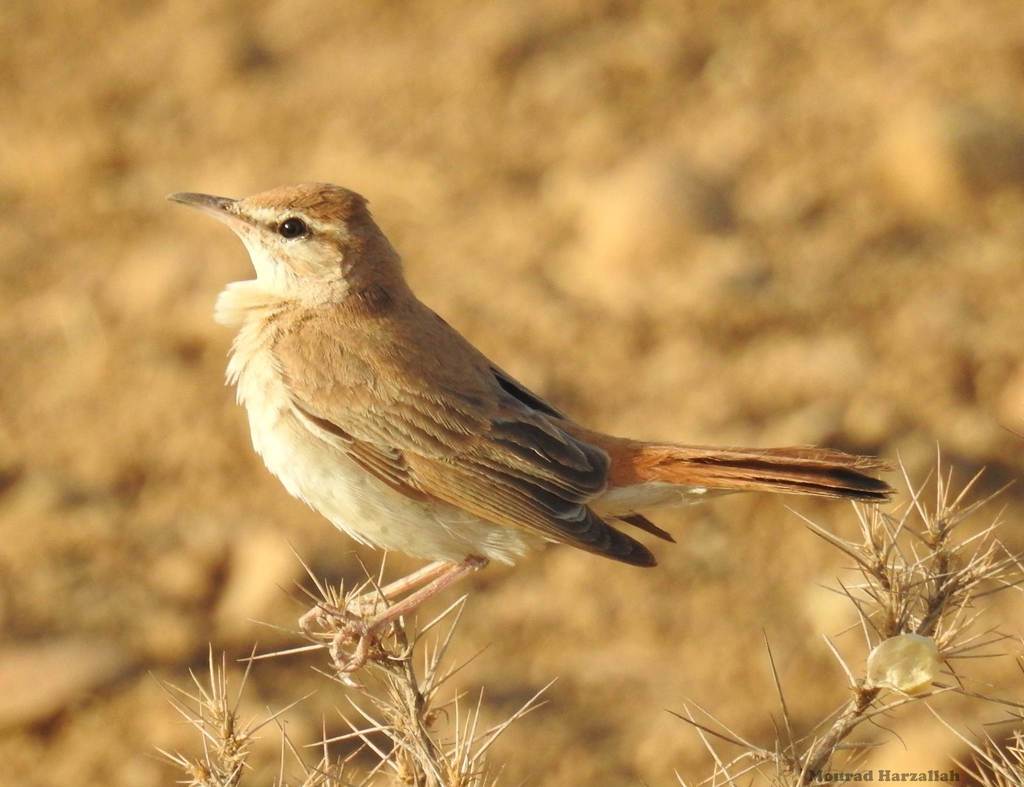
Rufous-tailed Scrub Robin
Photo © Mourad Harzallah
Photo © Mourad Harzallah — CC BY 4.0 — Source: iNaturalist #116411358The rufous-tailed scrub robin (Cercotrichas galactotes) is a medium-sized member of the family Muscicapidae. Other common names include the rufous scrub robin, rufous bush chat, rufous bush robin and the rufous warbler. It breeds around the Mediterranean and east to Pakistan. It also breeds south of the Sahara from the Sahel region east to Somalia; these African birds are sometimes considered to be a separate species, the African scrub robin (C. minor). It is partially migratory, wintering in Africa (Kenya, South Sudan, Ethiopia, Somalia) and India. This is a very rare visitor to northern Europe. The scientific name is from Ancient Greek. Cercotrichas is from kerkos, "tail" and trikhas, "thrush", and galactotes means resembling milk, from gala, "milk". The rufous-tailed scrub robin is a bird of dry open country with bushes and shrubs. It builds its nest a few feet off the ground; there are three to five eggs in a typical clutch. The rufous-tailed scrub robin is larger than the European robin. It has brown upper parts, whitish under parts, and a prominent whitish supercilium and a dark eye-stripe. The western race has a paler, warmer brown back than birds in southeastern Europe and Asia. The long rufous tail…
12 Days Birds & Culture Programme in Southern Portugal
12 Days Birds & Wine Programme in Portugal
12 Days in Spain Birdwatching Programme
12 Days Portugal & Spain Birdwatching Programme
Private Full-Day Birdwatching Tour from Algarve to the Alentejo (Castro Verde and the Guadiana Valley)
Private Full-Day Birdwatching Tour from Lisbon to the Alentejo (Castro Verde and the Guadiana Valley)
Nothing matches these filters.
Murchison Falls National Park
Doñana National Park
Estrecho Natural Park
Kidepo Valley National Park
Serra de Mariola Natural Park
Sierra de Andújar Natural Park
Tsavo East National Park
Tsavo West National Park
Nothing matches these filters.
No community photos yet. Log in to add the first one.
No community observations of this species yet.